Workers Compensation Cost California: Budgeting for Your Team

Workers compensation cost California is one of the biggest line items in most small business budgets. Yet many owners have no idea how their premiums are actually calculated or what they’re really paying for.

At Beach Break Insurance Agency, we’ve seen firsthand how much money gets wasted when business owners don’t understand the system. The good news is that your costs aren’t fixed-there are real, concrete steps you can take to lower them.

How California Workers Compensation Costs Are Calculated

The Three Factors That Set Your Premium

Your California workers compensation premium isn’t some random number your insurer pulls out of thin air. It’s built on three concrete factors that you can track, understand, and in some cases control. The first is your payroll size and the specific jobs your employees perform. California uses detailed job classification codes through the WCIRB to assign risk levels to different roles. A roofer costs significantly more to insure than an office administrator because the injury risk is fundamentally different.

When you misclassify a job-saying a roofer is an office worker to save money-you’re not just breaking the rules, you’re setting yourself up for massive fines and coverage gaps when someone actually gets hurt. The state can fine you up to $100,000 for intentional misclassification, and that doesn’t include reimbursements to the Uninsured Employers’ Benefit Trust Fund. Get your job classifications right from day one.

Experience Modification Rate and Your Company History

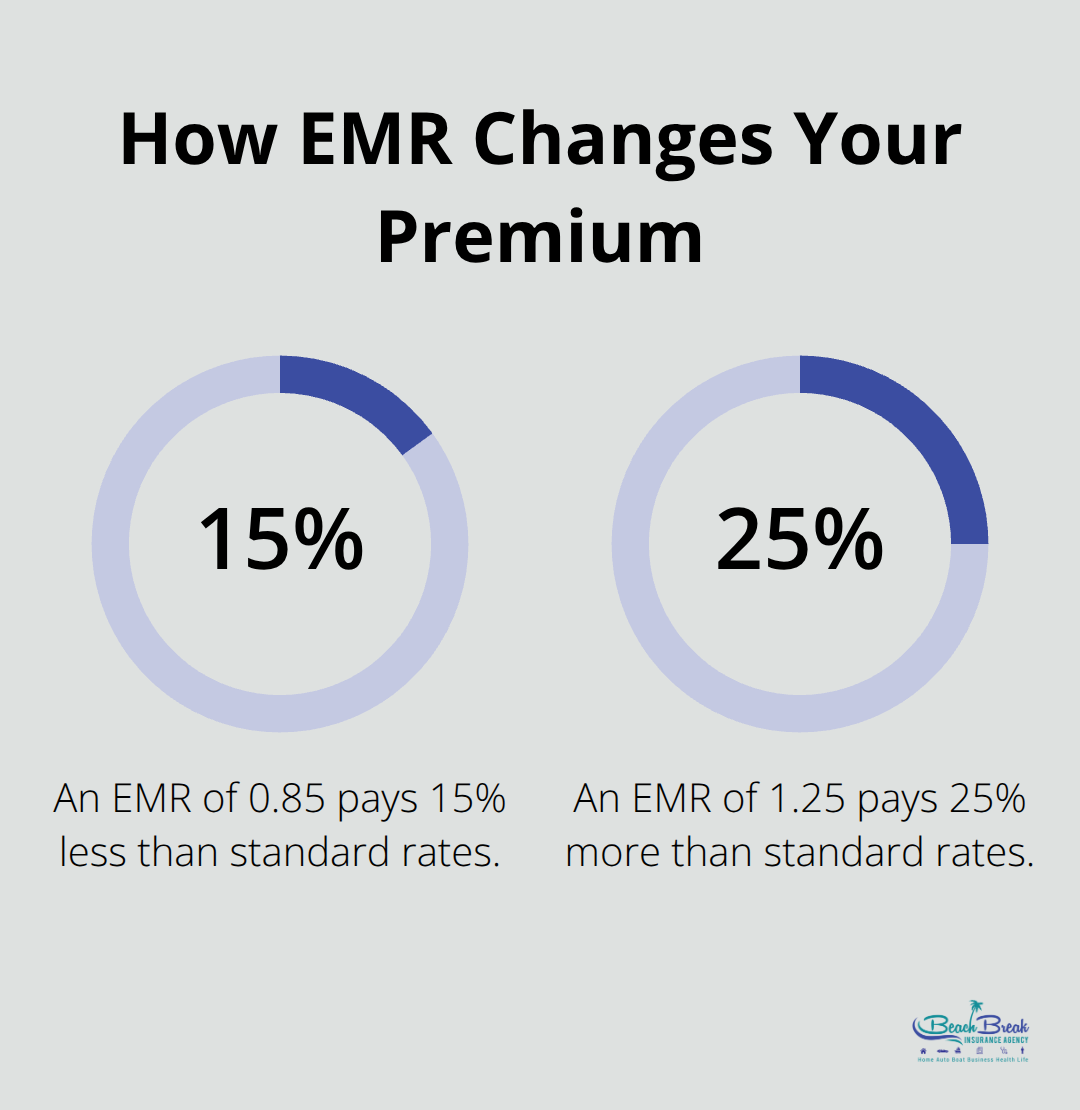
Your second driver is your company’s claims history, measured through something called your experience modification rate. This number compares your actual claims to what the state expects for your industry. If your team has fewer injuries than average, your rate drops below 1.0 and you pay less. If you have more claims, it climbs above 1.0 and you pay more.

This is why a single serious injury doesn’t just cost in medical bills-it affects your premiums for years. A business owner we’ve seen invest heavily in safety training and ergonomic equipment watched their modification rate drop from 1.15 to 0.89 over three years, cutting their annual premium by roughly 25 percent. Your claims history shapes your costs for years to come, which makes injury prevention a financial strategy, not just a safety one.

Industry Classification and Baseline Risk

The third factor is your industry’s baseline risk level. A construction firm and a consulting firm with identical payroll will pay completely different premiums because construction carries inherently higher injury risk. You can’t change your industry, but you absolutely can control how you manage safety within it and how accurately you report your payroll.

How These Factors Multiply Together

The real opportunity most small business owners miss is understanding that these three factors aren’t independent. Your payroll size directly affects your total premium dollars, but your experience modification rate and job classifications multiply that base number up or down. If you have a $500,000 annual payroll with a 1.2 modification rate across high-risk classifications, you’re paying significantly more than a business with identical payroll but a 0.9 modification rate in lower-risk classifications.

This is why accurate record-keeping matters so much-every employee classification and every reported injury shapes your future costs. Many owners skip the annual premium review because they assume it’s locked in, but rates actually get re-evaluated yearly. Your payroll changes, your claims history shifts, your job mix might evolve. Not reviewing your policy means you could be overpaying or, worse, carrying inadequate coverage.

The cost of coverage is typically lower than the financial and legal consequences of operating without it, but only if you’re actually paying the right amount for what you need. Understanding these three drivers puts you in position to spot where your money actually goes-and where you can cut costs without cutting corners. The next section shows you exactly how to take action on each of these factors.

How to Cut Your Workers Compensation Costs Without Sacrificing Coverage

Safety Investments That Lower Your Premiums

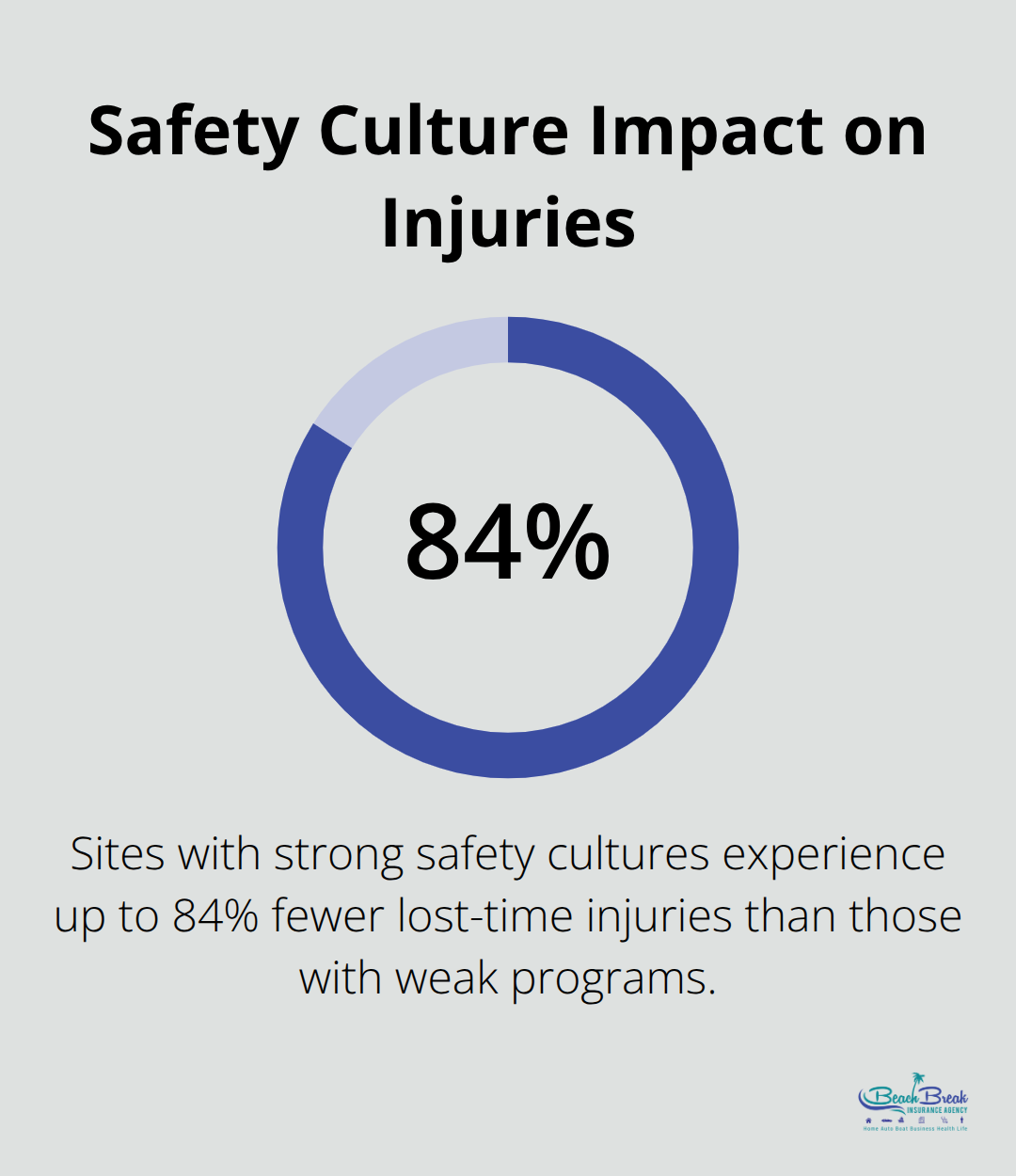
Safety investments pay for themselves faster than most small business owners realize. Safety investments that lower your premiums can deliver measurable results: a study showed a 9.4% drop in injury claims and a 26% average savings on workers’ compensation costs in the four years after a Cal/OSHA inspection. The specific actions that work are concrete: hazard assessments identify injury risks in your operations, documented safety procedures that employees actually follow reduce accidents, and regular equipment maintenance prevents breakdowns that cause injuries. Post required safety notices, enforce proper personal protective equipment use, and train new hires on your specific workplace hazards before they start working. These actions create the injury-free record that insurers reward with lower rates. Your claims history shapes your costs for years, so every prevented injury translates to money in your pocket through lower future premiums.

Getting Your Classifications and Payroll Right

Accurate payroll reporting and job classification matter more than most owners think because misclassification penalties can reach $100,000 from the state, and underreporting payroll triggers audits that often uncover additional violations. Review your employee classifications annually against WCIRB codes to confirm you’re using the right category for each role-a single misclassified employee can trigger fines that dwarf any premium savings you thought you were gaining. Keep detailed records of hours worked, duties performed, and payroll by classification so you can defend your premium calculation if the state audits you. When you work with your insurance provider to optimize coverage, ask specifically about pay-as-you-go premium plans that align payments with actual payroll rather than requiring large upfront deposits (this improves cash flow and prevents overpaying when payroll fluctuates). Request an annual policy review to catch classification changes or payroll shifts that might lower your rate, and don’t assume your current premium is correct just because you’ve been paying it for years. Rates get re-evaluated annually, which means your modification rate, payroll, or industry baseline may have shifted enough to warrant a quote comparison.

What Happens When You Compare Your Options

Getting multiple quotes from different carriers reveals how much your premium can vary based on how each insurer evaluates your risk profile. One carrier might weight your safety programs more heavily than another, or they might assess your job classifications differently. An independent agent who works with multiple top-rated carriers can help you compare these differences and find the coverage that fits your actual needs at the best price. This comparison process takes time upfront but often uncovers savings that compound year after year as your safety record improves.

Where Your Workers Comp Mistakes Cost the Most

Job Misclassification Destroys Your Coverage

The costliest error we see small business owners make happens quietly, often without them realizing the damage until an audit or claim denial hits. Job misclassification amounts to putting the wrong label on your employee’s role to dodge higher premiums. A receptionist who answers phones and schedules appointments should be classified as clerical work, but we’ve seen owners classify them as administrative professionals or warehouse staff to access lower rates. When an injury occurs and the claims administrator reviews the classification, the coverage denial follows fast.

California’s state labor department can impose significant penalties for willful worker misclassification, and that’s separate from any reimbursements owed to the Uninsured Employers’ Benefit Trust Fund. The fix is straightforward: pull your current employee classifications, compare them against the WCIRB job codes for your industry, and correct any that don’t match the actual work performed. This takes an afternoon, not weeks, and it eliminates your biggest compliance risk.

Underreporting Payroll Creates Massive Liability

Underreporting payroll to lower your premium feels like a small adjustment but creates enormous liability. You might think reporting $400,000 in payroll instead of $500,000 saves you a few hundred dollars on premiums, but when the state audits you (and they conduct these audits regularly), they demand back premiums plus penalties and interest. An underreported payroll audit can result in fines that exceed the premium savings you thought you gained over several years.
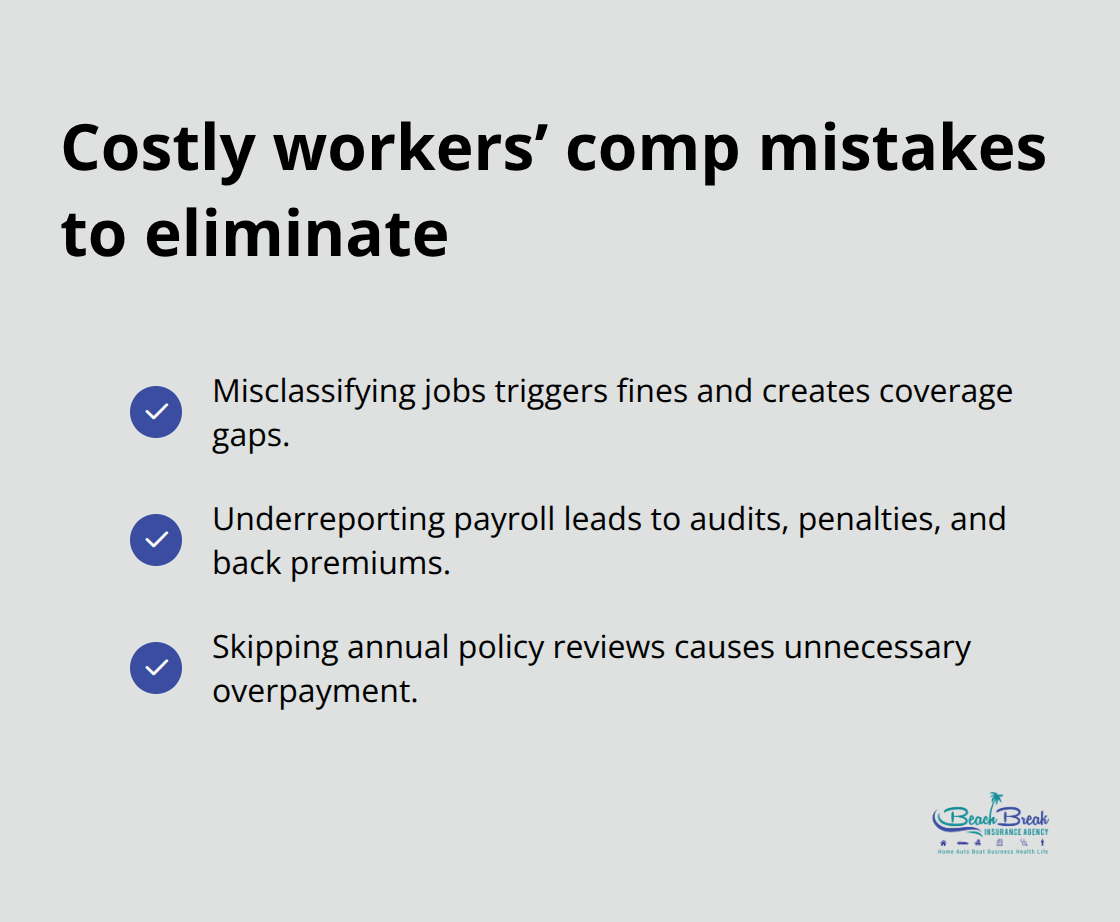
Three common California workers’ compensation mistakes that drive up premiums. - Workers compensation cost California

Worse, if an employee gets injured during a period of underreported payroll, your coverage might be inadequate or contested because the premium calculation was based on false information. Keep detailed payroll records separated by job classification so you can defend your reported numbers. Use these same records during your annual policy review to confirm your premium calculation is correct.

Ignoring Your Annual Policy Review Costs You Money

Treating your policy like a set-it-and-forget-it expense means you never review it until renewal time. Rates get re-evaluated annually according to the state, which means your experience modification rate can improve if you’ve had fewer claims, your payroll might have shifted, or your industry baseline could have changed. An owner who ignores their annual policy review could easily overpay by 15 to 20 percent without realizing it.

Schedule a formal review each year with your insurance provider and ask them to recalculate your rate based on current payroll and claims history. Request quotes from at least one other carrier to confirm you’re getting competitive pricing. These three mistakes compound over time, but each one has a concrete fix that takes minimal effort compared to the savings and risk reduction you gain.

Final Thoughts

Your workers’ compensation cost in California doesn’t have to feel like a mystery or a burden you simply accept. The three factors that drive your premium-payroll size, job classifications, and claims history-are all things you can track and influence. Start this week by pulling your current employee classifications and comparing them against WCIRB codes for your industry, then spend an hour reviewing your payroll records to confirm they match what you reported to your insurer.

The mistakes that cost the most-misclassification, underreporting payroll, and skipping annual reviews-are also the easiest to fix. You don’t need to overhaul your entire operation (just focus on the details that actually move your premium). When you combine accurate reporting with genuine safety investments, your modification rate improves and your future costs drop.

We at Beach Break Insurance Agency work with small business owners across California who want to stop guessing about their workers’ compensation costs and start making informed decisions. As an independent agency, we quickly compare quotes from multiple top-rated carriers so you see exactly how different insurers evaluate your risk and price your coverage. Let us help you find the right coverage at the right price.

The information provided in this blog is for general informational purposes only and does not constitute legal, financial, or insurance advice. Coverage options, terms, and availability may vary. Please consult with a licensed professional for advice specific to your situation.
Artificial intelligence may have been used to generate text and images in some blog articles.
Commercial Liability Insurance California: Essentials for SMBs

One lawsuit can wipe out years of profit for a California small business. Commercial liability insurance California protects you from the financial devastation of bodily injury claims, property damage lawsuits, and legal defense costs that can drain your business account.

At Beach Break Insurance Agency, we’ve seen too many SMBs operate without adequate coverage, only to face catastrophic losses when accidents happen. The right policy isn’t optional-it’s the foundation of responsible business ownership in California.

What Your Commercial Liability Policy Actually Covers

The Three Core Protections

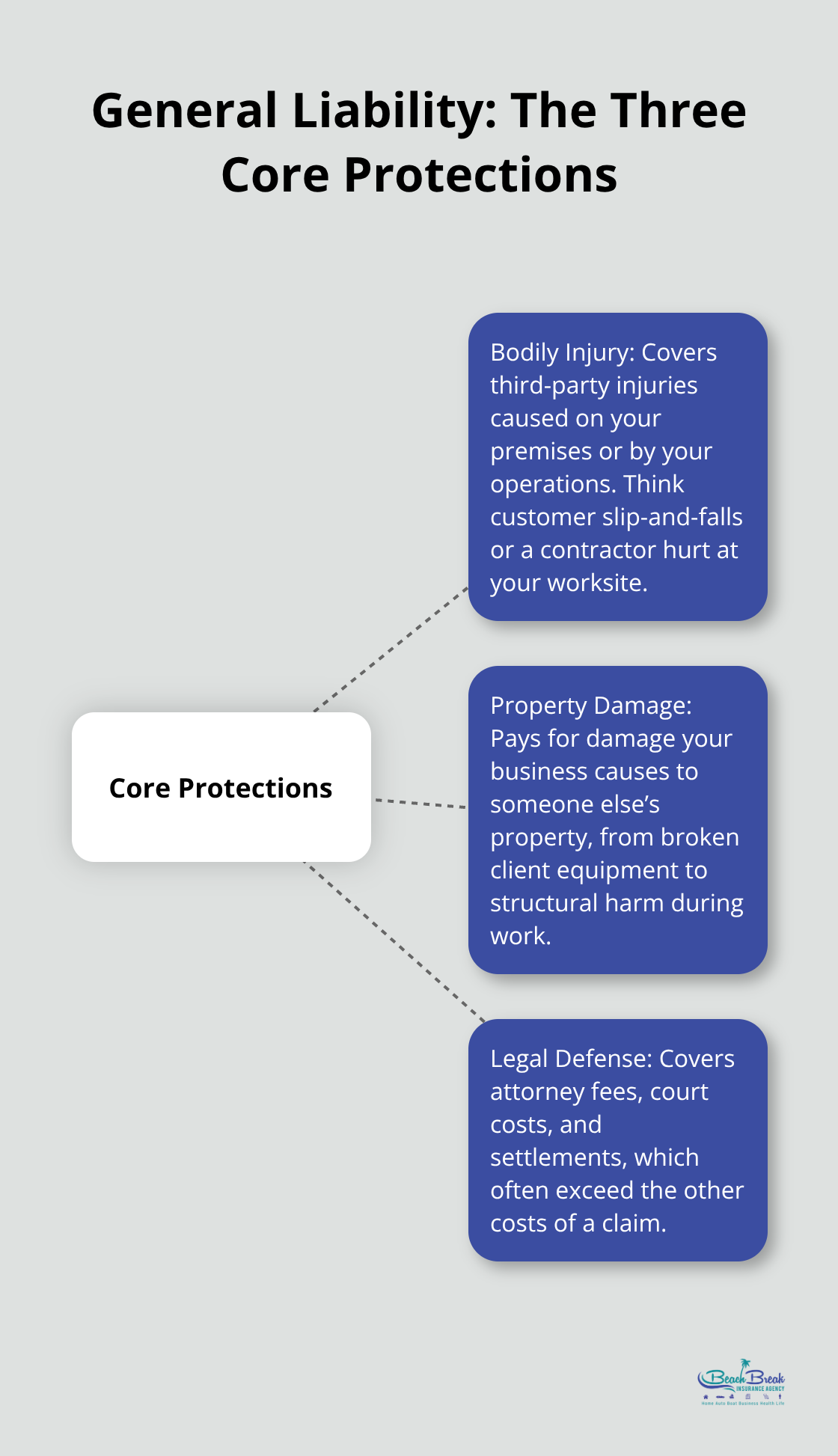
Commercial liability insurance protects your California business from third-party claims of bodily injuries or property damage. First, it covers bodily injury claims when someone is injured on your property or because of your business operations-think a customer slipping in your store or a contractor hurt at your worksite. Second, it handles property damage claims if your business damages someone else’s property, whether that’s a client’s equipment you accidentally broke or structural damage from your work. Third, and this matters more than most SMBs realize, the policy pays for your legal defense costs and court settlements.

Diagram showing the three core protections provided by general liability insurance for California SMBs. - Commercial liability insurance California

General liability remains the most common coverage for California SMBs precisely because these exposures affect nearly every business type. The policy typically covers medical payments for injured third parties without them having to sue you first, which often prevents claims from escalating into costly lawsuits.

What This Coverage Excludes

Understanding what commercial liability does not cover matters just as much as knowing what it does. General liability does not protect your own property-your building, equipment, or inventory-which is why a Business Owners Policy that bundles property coverage with liability makes more sense for most SMBs. Professional liability, sometimes called errors and omissions insurance, covers claims of negligence in your services but does not handle bodily injury or property damage claims.

If you operate vehicles for work, your personal auto policy excludes business use entirely, meaning you need commercial auto insurance as a separate line. These gaps leave many California business owners exposed without realizing it.

Coverage Limits and Premium Factors

The coverage limits you select significantly impact both your protection and your cost. A $1 million per occurrence and $2 million aggregate limit is the baseline most California contracts require, but higher-risk industries like construction or manufacturing often need $2 million per occurrence limits.

Your actual premium depends on your industry, location, number of employees, and claims history. A landscaper in San Francisco will pay substantially more than a consultant in a rural area due to higher physical risk and cost of living differences. Getting multiple quotes online takes roughly seven minutes and reveals how much your specific risk profile affects pricing.

Finding the Right Fit for Your Business

The policy you select must match your actual operations and the contracts your clients demand. An independent agency can quickly compare quotes from multiple carriers to help you identify the right limits and deductibles for your situation. This comparison process shows you exactly how different coverage levels affect your monthly costs, so you can make an informed decision rather than guessing at what you need.

Why Your California Business Needs This Coverage

Legal Requirements and Client Demands

California law mandates workers’ compensation insurance if you have employees, but commercial liability sits in a different category entirely. While the state doesn’t legally require general liability for most businesses, your clients absolutely will. According to the U.S. Small Business Administration, California has 4.3 million small businesses, and the vast majority of contracts-whether from larger companies, property owners, or event organizers-demand a certificate of insurance showing general liability coverage before they’ll work with you. This means liability insurance isn’t optional in practice, even if it’s not mandatory by statute. A contractor without proof of coverage loses bids. A service provider without general liability gets dropped from vendor lists. A consultant without errors and omissions insurance can’t sign client agreements.

The Real Cost of a Single Lawsuit

The financial exposure isn’t theoretical either. A single bodily injury lawsuit or property damage claim can exceed $100,000 in legal defense costs alone, even if you ultimately win. Medical bills for a serious injury spike fast, and California’s cost of living means settlements and jury awards run higher than national averages. Businesses that carried coverage survived these incidents; those without it faced devastating out-of-pocket costs that forced closures or bankruptcies.

Dangerous Gaps in Your Current Policies

Your existing business policies create dangerous gaps most owners don’t recognize until claims arise. Standard commercial property policies don’t cover liability claims. Personal auto insurance explicitly excludes business use, leaving you uninsured if you use your vehicle for work. Your landlord’s property coverage doesn’t protect you from third-party injury claims on the premises. Professional liability doesn’t cover bodily injury or property damage-it only covers negligence in your services. This fragmentation means you could carry three separate policies and still face a $500,000 lawsuit with zero protection.

Closing Coverage Gaps Affordably

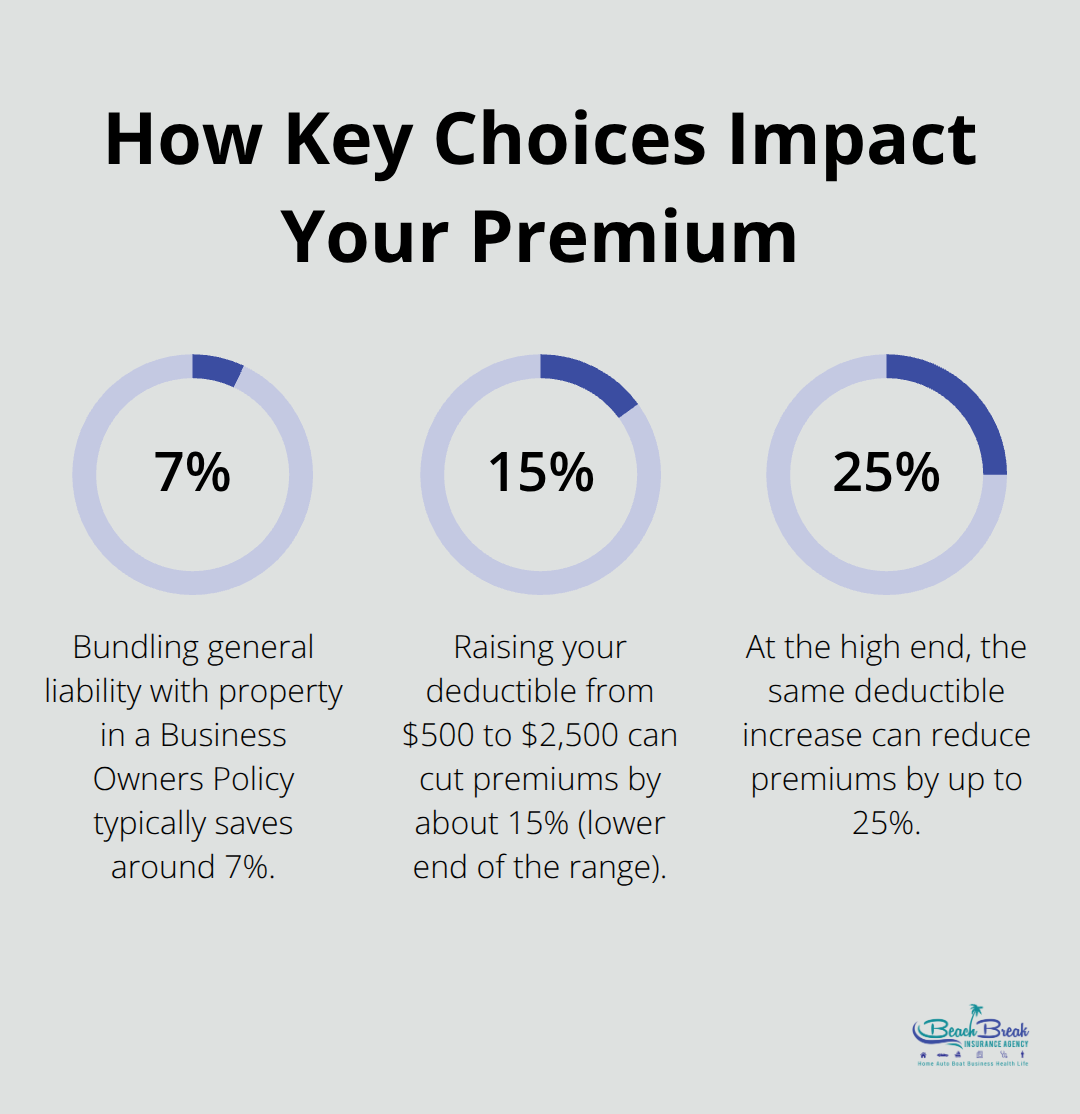
The solution isn’t buying more policies haphazardly; it’s understanding your actual risk profile and closing gaps with the right coverage. A Business Owners Policy combines general liability with property coverage, making it far more cost-effective than buying them separately. For 2025, general liability averages around $55 to $79 per month for new customers, depending on your industry and location, but bundling typically saves around 7% compared to standalone policies. The real cost of underinsurance isn’t the premium you avoid-it’s the uninsured loss that destroys your business when an accident happens.

Chart showing bundling savings and deductible impact on general liability premiums. - Commercial liability insurance California

What Comes Next

Now that you understand why coverage matters, the next step involves selecting the right policy limits and comparing carriers that fit your specific business type and risk profile.

How to Choose the Right Commercial Liability Policy

Assess Your Industry-Specific Risks

Start by listing exactly what your business does, where it operates, and who it could injure or whose property it could damage. A contractor’s risk profile looks nothing like a consultant’s, and a San Francisco restaurant faces different exposures than a landscaping crew in a rural county. Your industry classification code helps ensure consistency in premium calculation and supports underwriting guidelines. If you tell an insurer you’re a general contractor but also do electrical work, they may underprice your policy and later deny claims for work outside your stated classification.

Spend 30 minutes documenting your actual operations: the types of jobs you take, the locations where you work, the equipment you use, and the people who interact with your business. This inventory becomes your foundation for comparing quotes accurately. A general liability policy for a landscaper in Los Angeles might run $100 to $150 monthly, while the same coverage for a consultant in the same city could cost $40 to $60-your specific industry and location shift pricing dramatically.

Compare Coverage Limits and Deductibles

Once you know your real risk, you can evaluate coverage limits intelligently instead of guessing. Most California contracts demand $1 million per occurrence and $2 million aggregate as a baseline, but higher-risk work like roofing, excavation, or manufacturing often requires $2 million per occurrence limits. Your deductible choice directly affects your monthly cost: increasing your deductible from $500 to $2,500 typically cuts premiums by 15 to 25 percent, but only if you can afford to pay that amount out of pocket after a loss.

Contractors and service businesses often choose $1,000 deductibles as the practical middle ground-low enough to manage if a claim hits, high enough to reduce premiums meaningfully. Getting quotes online takes roughly seven minutes, and comparing three to five carriers reveals how your specific situation affects pricing. Bundling general liability with commercial property through a Business Owners Policy saves approximately 7 percent on your total premium compared to buying coverages separately, meaning a business that bundles often recoups the cost difference within months.

Review Carrier Ratings and Customer Service

Carrier ratings and claims handling speed matter far more than most business owners realize, yet they’re often overlooked in favor of chasing the lowest price. Check financial stability ratings through AM Best or S&P Global to confirm the carrier can actually pay claims when disasters strike.

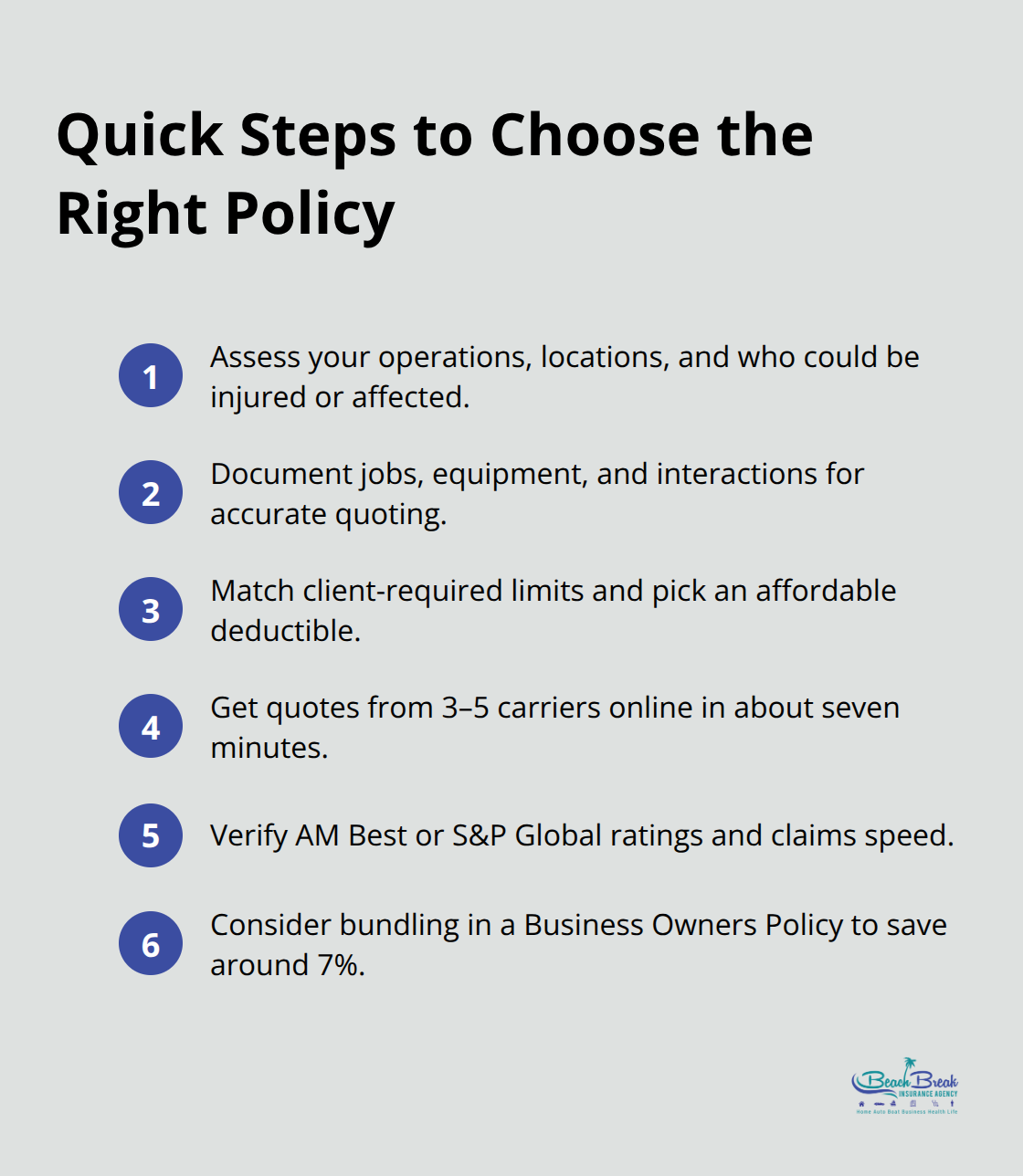
Compact checklist of key actions to select the right commercial liability coverage.

More importantly, verify claims handling speed by reading recent customer reviews on independent sites-not the carrier’s own website. A policy that costs $20 less monthly but takes three months to settle a $50,000 claim destroys that savings instantly. Contact the carrier’s customer service line with a test question about your specific business type and notice whether they answer clearly or deflect with jargon. An independent agency can represent your interests across multiple carriers, explain exactly what each policy covers and costs, and handle the comparison work for you. This approach typically saves you 10 to 15 hours of research while uncovering discounts you’d miss shopping alone.

Final Thoughts

Commercial liability insurance California protects your business from the financial devastation that follows a single lawsuit or accident claim. Without this coverage, bodily injury claims, property damage lawsuits, and legal defense costs can drain your business account in weeks and force closure. The right policy stands between survival and catastrophe when incidents happen.

Start by documenting your actual business operations and identifying the risks they create. Check whether your clients demand specific coverage limits through their contracts, and determine whether a Business Owners Policy bundling liability with property coverage makes financial sense for your situation, since bundling typically saves around 7 percent compared to buying coverages separately. Getting quotes from multiple carriers takes roughly seven minutes online and shows you exactly how your industry, location, and claims history affect pricing.

Contact Beach Break Insurance Agency to discuss your specific business type, the coverage your clients require, and your budget. We compare options from top-rated carriers that fit your risk profile and explain exactly what each policy covers, costs, and excludes. The right coverage protects your business today and gives you peace of mind tomorrow.

The information provided in this blog is for general informational purposes only and does not constitute legal, financial, or insurance advice. Coverage options, terms, and availability may vary. Please consult with a licensed professional for advice specific to your situation.
Artificial intelligence may have been used to generate text and images in some blog articles.
California Wildfire Insurance Costs: Budget and Plan

California wildfire insurance costs have skyrocketed in recent years, leaving many homeowners scrambling to understand their options. If you’re facing premium increases or struggling to find affordable coverage, you’re not alone.

At Beach Break Insurance Agency, we help California homeowners navigate these rising costs and find protection that fits their budget. This guide breaks down what drives your premiums, how to reduce them, and when the FAIR Plan makes sense for your situation.

What Determines Your Wildfire Insurance Premium in California

Fire Risk Zones Shape Your Rate

CAL FIRE’s Fire Hazard Severity Zone maps divide California into three risk categories: Moderate, High, and Very High. Your property’s location on these maps is the single biggest factor insurers use to set your rate. A home in a Very High zone will pay dramatically more than an identical home in a Moderate zone. Insurers also examine your specific address against historical fire perimeters, proximity to vegetation, slope exposure, and local infrastructure capacity. According to Federal Insurance Office data, homeowners in fire-prone ZIP codes saw premiums rise 8.7% above general inflation from 2018 to 2022. In Pacific Palisades, premiums climbed 33% above inflation during that period, jumping from $5,025 to $6,689 annually. Altadena saw a 26% increase above inflation, moving from $1,485 to $1,873. These aren’t small adjustments; they reflect insurers pricing in the real cost of wildfire exposure.

Chart showing premium increases above inflation in California fire-prone areas, including statewide fire-prone ZIP codes, Pacific Palisades, and Altadena. - California wildfire insurance costs

The California Department of Insurance approved a 17% rate increase for State Farm homeowners policies statewide, signaling how systematically insurers are raising rates across the market.

Rebuilding Costs Drive Rate Hikes

Since 2017, nine of the ten most expensive wildfires in U.S. history occurred, and over the last 30 years, insured wildfire losses have doubled as a share of total catastrophe claims. After the Palisades and Eaton wildfires, approximately 11,300 homes were destroyed with total economic losses reaching around $52.5 billion. Insurers absorb these massive payouts and pass the cost forward through higher premiums for everyone in fire-prone areas. Your rate increase reflects the mathematical reality of claims history. Homeowners in elevated-risk areas should expect premium jumps of 20 to 33% above inflation in places like California’s fire zones, not temporary spikes.

Regional Differences Create Budget Gaps

A home 10 miles away might cost half as much to insure simply because it sits outside a Very High hazard zone. If traditional insurers decline your property, the California FAIR Plan charges roughly $3,200 annually compared to an average traditional market rate around $1,460 (more than double). Private wildfire insurance through surplus lines carriers typically runs $1,800 to $3,200 or higher depending on the property’s risk profile and coverage limits. Before buying in California, check CAL FIRE’s hazard maps to see exactly where your property falls. That single check determines whether your insurance budget will be manageable or crushing. The gap between regions isn’t theoretical; it’s the difference between affording coverage and scrambling for FAIR Plan access. Understanding these regional cost variations helps you make informed decisions about where to buy and what coverage options actually work for your situation.

Ways to Reduce Your Wildfire Insurance Costs

Home Hardening Cuts Premiums Through Documented Upgrades

Wildfire insurance premiums in California won’t drop on their own, but you control several levers that meaningfully lower what you pay. Home hardening and defensible space improvements deliver the most powerful results, and insurers reward them with tangible discounts. Install a Class A fire-resistant roof, upgrade to non-combustible or fire-resistant siding, replace single-pane windows with tempered glass, and create defensible space by clearing vegetation within 30 feet of your structure. These retrofits require upfront investment, but regulators commonly offer premium discounts for specific mitigation actions. A home in Pacific Palisades facing a $6,689 annual premium can potentially reduce that bill by hundreds of dollars annually with documented upgrades. Verify which upgrades qualify for discounts in your specific area before investing; different insurers and regions recognize different improvements. Document every upgrade with photos and receipts because insurers will ask for proof.

Checklist of wildfire mitigation upgrades that can reduce California homeowners insurance premiums.

Private wildfire insurance carriers and certification programs like California Safer from Wildfire and IBHS Wildfire Prepared Home explicitly incentivize mitigation and require ongoing maintenance for continued coverage, meaning your investment protects both your home and your budget long-term.

Shopping Around Reveals Significant Premium Differences

Comparing multiple carriers often reveals 30 to 50 percent premium differences for identical coverage. Most homeowners pay hundreds more than necessary simply because they never checked alternatives. Get quotes from at least three carriers and request the same coverage limits and deductibles across each quote so you compare apples to apples. Bundling your auto and home policies with a single insurer frequently yields 10 to 15 percent discounts, though this only works if that insurer’s home rate is competitive to begin with. Some carriers offer additional discounts for paid-in-full premiums, security systems, or loyalty, so ask explicitly what discounts apply to your situation.

Private Surplus Lines Carriers Serve High-Risk Properties

If you’re in a Very High fire hazard zone and traditional insurers decline you, the California FAIR Plan becomes your fallback. However, don’t assume it’s your only option; private surplus lines carriers sometimes insure high-risk properties that traditional carriers won’t touch. While their premiums run $1,800 to $3,200 or higher, they often provide better coverage limits than the FAIR Plan’s standard offerings. An independent agency that quickly compares quotes from multiple top-rated carriers can deliver tailored options without forcing you to contact insurers individually, saving you hours while ensuring you see all realistic options for your property’s risk profile. This approach proves especially valuable when you face coverage rejections from standard market carriers and need to evaluate both FAIR Plan and private market solutions side by side.

When the FAIR Plan Becomes Your Coverage Option

Why the FAIR Plan Exists in California’s Insurance Market

The California FAIR Plan exists because traditional insurers have stepped back from high-risk fire zones. Established in 1968 under California Insurance Code, it functions as a state-mandated pool where all property and casualty insurers participate, not as a government-funded program. When a standard carrier declines your property due to wildfire exposure, the FAIR Plan provides mandatory access to fire insurance. This matters because without it, homeowners in Very High hazard zones would have no legal way to obtain basic fire protection.

Coverage Details and Policy Limits

The plan covers dwelling damage, structural loss, and related perils, though coverage limits typically run lower than private market policies. As of March 2025, California’s FAIR Plan held over 500,000 residential policies, a historic high reflecting how constrained the private market has become.

Hub-and-spoke diagram summarizing key elements of the California FAIR Plan for homeowners. - California wildfire insurance costs

In fire-prone areas like Pacific Palisades and Altadena, FAIR Plan policies more than doubled between 2021 and 2024, growing from 1,184 to 2,388 policies. This signals a fundamental shift in insurance availability for California homeowners in elevated-risk zones. Coverage limits in the FAIR Plan remain lower than many private policies, and the plan generally excludes personal property coverage for renters and condo owners.

How to Qualify and Apply for FAIR Plan Coverage

Your path to FAIR Plan coverage starts with rejection letters from traditional carriers. You cannot apply directly; insurers must first decline you for fire risk before you become eligible. Once declined, you submit your application and documents to the FAIR Plan administrator. The process takes weeks, not days, so timing matters if you’re under a mortgage requirement to carry coverage.

Premium Costs and Emergency Assessments

Standard FAIR Plan premiums average around $3,200 annually, more than double the $1,460 market average for traditional homeowners policies. However, recent rate increases and emergency assessments have pushed costs higher. After the Palisades and Eaton wildfires, the FAIR Plan received approximately 5,000 claims and levied roughly $1 billion in emergency assessments on member insurers in 2025, with up to 50% potentially passed to policyholders as surcharges. This means your annual FAIR Plan premium could jump significantly beyond the base rate.

Comparing FAIR Plan to Private Wildfire Insurance Options

Private wildfire insurance through surplus lines carriers typically costs $1,800 to $3,200 or more but often delivers higher limits and broader protection. The real decision isn’t whether the FAIR Plan is expensive; it’s whether you have other options. An independent agency comparing quotes from multiple carriers can reveal whether a private insurer will accept your property despite its fire hazard zone designation, potentially saving you hundreds annually compared to FAIR Plan rates while providing better coverage limits.

Final Thoughts

California wildfire insurance costs demand action now, not after your next premium notice arrives. Your location determines your baseline rate, home hardening cuts that rate through documented upgrades, and shopping multiple carriers reveals savings you won’t find by staying with one insurer. Start by checking your property’s fire hazard zone on CAL FIRE maps, then request quotes from at least three carriers with identical coverage limits so you see real price differences.

Document any home improvements you’ve made, because insurers reward fire-resistant roofs, defensible space, and upgraded windows with measurable discounts. If traditional carriers decline you, the FAIR Plan provides access but expect to pay roughly double the standard market rate plus potential emergency assessments. Private surplus lines carriers sometimes insure high-risk properties at competitive rates, making comparison shopping essential before accepting FAIR Plan coverage as your only option.

Budget for premium increases of 20 to 33 percent above inflation in fire-prone areas, anticipate potential surcharges from FAIR Plan emergency assessments, and start mitigation upgrades now to maximize future discounts. We at Beach Break Insurance Agency help California homeowners cut through this complexity by comparing quotes from multiple top-rated carriers to deliver tailored coverage that fits your specific risk profile and budget. Contact us today to protect your home and your budget.

The information provided in this blog is for general informational purposes only and does not constitute legal, financial, or insurance advice. Coverage options, terms, and availability may vary. Please consult with a licensed professional for advice specific to your situation.
Artificial intelligence may have been used to generate text and images in some blog articles.

Business Owners Policy Quotes: Quick Comparisons

A Business Owners Policy bundles property and liability coverage into one package, making it the smart choice for most small businesses. Comparing business owners policy quotes from different carriers helps you find the right protection at the right price.

At Beach Break Insurance Agency, we’ve helped countless business owners cut through the confusion and land policies that actually fit their needs. The right quote comparison takes just a few steps, and we’ll walk you through them.

What a Business Owners Policy Actually Covers

A Business Owners Policy combines commercial property insurance and general liability into one package, protecting both your physical assets and your financial exposure. Property coverage pays for damage to your building, equipment, inventory, and tools from fire, theft, vandalism, and weather events. Liability coverage handles claims when someone gets hurt on your property or your business causes property damage to someone else. You also receive business interruption coverage, which replaces lost income and covers operating expenses if a covered event forces you to shut down temporarily. Hartford customers report paying around $141 per month on average for a BOP, though your actual cost depends on your industry, location, and the specific risks you face. The real advantage here is simplicity: you get comprehensive protection without managing multiple policies from different insurers. Most small businesses need both property and liability coverage anyway, so bundling them into one policy makes financial sense and reduces administrative headaches.

Why a Single Policy Beats Buying Separately

Purchasing property and liability insurance as separate policies costs significantly more than combining them into a BOP. When you bundle, carriers typically offer discounts up to 10 percent when you add workers compensation to your BOP. That’s real money back in your pocket.

Infographic showing potential savings when adding workers compensation to a Business Owners Policy - Business owners policy quotes

A single policy means one renewal date, one agent relationship, and one portal to manage certificates of insurance. You avoid coverage gaps that occur when separate policies don’t align properly. A BOP also simplifies claims handling because everything flows through one insurer rather than coordinating between multiple carriers when something goes wrong.

The Specific Risks Your Business Actually Faces

Your industry determines which BOP components matter most. A retail store faces different risks than a consulting firm, yet both benefit from property coverage for their equipment and liability for customer injuries. If you operate from rented space, your BOP covers your belongings and liability but not the building itself (which your landlord’s insurance handles). Construction businesses need higher liability limits because bodily injury claims run expensive. Food service operations face property damage from equipment breakdown and liability from foodborne illness claims. The Hartford BOP allows liability limits up to four million dollars in aggregate coverage, giving you flexibility to match your actual exposure. The right coverage level matters more than finding the cheapest quote, because underinsurance leaves you exposed to catastrophic losses that a policy discount won’t cover.

How Coverage Limits Shape Your Protection

Liability limits determine how much your insurer pays when someone sues your business. A four million dollar aggregate limit (the maximum The Hartford offers) protects you far better than a one million dollar limit if a serious accident occurs. Property coverage limits should reflect the actual replacement cost of your building, equipment, and inventory. If you own ten thousand dollars in tools but insure them for five thousand dollars, you absorb the loss yourself. Deductibles work the opposite way: higher deductibles lower your premium but increase what you pay out of pocket when you file a claim. Most small businesses choose deductibles between five hundred and two thousand five hundred dollars, balancing affordability with reasonable out-of-pocket costs.

What Comes Next in Your Quote Comparison

Now that you understand what a BOP covers and why it matters, the next step involves comparing actual quotes from multiple carriers to see how coverage and price differ across insurers.

How to Compare BOP Quotes Without Wasting Time

Getting multiple quotes is the only way to spot real price differences and coverage gaps that matter. Most small business owners accept the first quote they receive, which costs them hundreds or thousands annually. You need quotes from at least three different carriers to see meaningful variation in pricing and coverage options. The Hartford, ERGO NEXT, CNA, Nationwide, and BiBERK all serve small businesses with different pricing structures and liability limits.

Request Quotes with Consistent Information

Request quotes online or call carriers directly with the same business information for each one-your industry, annual revenue, number of employees, property value, and location. This consistency lets you compare apples to apples rather than receiving wildly different quotes because you described your business differently to each insurer. Many carriers offer online quote tools that take fifteen to twenty minutes to complete. Write down the exact coverage limits, deductibles, and premium for each quote before moving forward. Spreadsheets work perfectly for this, with columns for carrier name, general liability limit, property coverage limit, business interruption limit, annual premium, and any available discounts. You’ll immediately see which carriers price aggressively in your industry and which ones offer superior coverage for a reasonable cost.

Evaluate Liability Limits and Deductibles

The Hartford offers liability limits up to four million dollars in aggregate coverage, which exceeds what many competitors provide. ERGO NEXT matches that four million dollar limit with a faster online claims process. CNA includes inflation protection automatically, meaning your coverage limits increase each year without you requesting changes-a feature most competitors charge extra for or don’t offer at all.

Compact list comparing BOP features from The Hartford, ERGO NEXT, CNA, and BiBERK

BiBERK pushes liability limits to six million dollars, the highest available, though they carry more customer complaints than expected relative to their size.

Deductibles typically range from five hundred to twenty-five hundred dollars, and jumping from five hundred to one thousand dollars usually saves ten to fifteen percent on your annual premium. Don’t chase the lowest deductible unless you file claims frequently; most small businesses go years without property claims, making high deductibles sensible. The difference between a four million and six million dollar liability limit might cost only fifty to one hundred dollars annually, making it worth the upgrade if your business faces serious injury exposure.

Compare Additional Coverages and Features

Review what additional coverages each quote includes at no extra cost versus what costs extra. Workers compensation, professional liability, cyber insurance, and commercial auto insurance rarely come standard in a Business Owners Policy but can be added through most carriers. Request certificates of insurance from each carrier to confirm they generate them digitally and instantly through their portal-this matters when clients need proof of coverage quickly.

An independent agency compares quotes from multiple top-rated carriers simultaneously, eliminating the need for you to contact each one separately and track down different requirements for each application. This approach saves you time while ensuring you evaluate all viable options side by side.

Once you’ve narrowed your choices based on price and coverage, the next step involves assessing your specific business needs to confirm the quote you select actually protects what matters most to your operation.

Tailoring Your BOP to Match What Your Business Actually Needs

Your industry, revenue, location, and operational risks determine which BOP features matter most and what you should actually pay. A photography studio in San Diego faces completely different exposures than a plumbing contractor, yet both need property and liability coverage. Start by identifying your highest-risk scenarios: What would cost you the most if it happened tomorrow? For a retail store, that might be a fire destroying inventory and forcing a temporary closure. For a consulting firm, it’s a client injury or a lawsuit over professional mistakes. Once you pinpoint these scenarios, you can evaluate whether standard BOP coverage handles them or if you need add-ons like professional liability or cyber insurance.

How Your Business Profile Shapes Your Premium

Your annual revenue matters because higher-revenue businesses typically need higher liability limits and more property coverage. A business generating fifty thousand dollars annually needs different protection than one generating five hundred thousand dollars. Location also shifts your costs significantly: businesses in high-fire zones pay more for property coverage, while urban areas with higher foot traffic increase liability exposure. Request quotes that reflect your actual situation rather than generic estimates, because carriers price based on your specific risk profile, not industry averages.

Factors You Can Control to Lower Your Costs

Several factors directly control your premium that you can influence. The Hartford’s data shows that small business customers pay an average of $1,687 a year for a Business Owner’s Policy, but this varies substantially based on your deductible choice, coverage limits, safety features in your building, and claims history.

Checklist of actions to reduce Business Owners Policy premiums - Business owners policy quotes

A five-hundred-dollar deductible costs more than a two-thousand-five-hundred-dollar deductible because the insurer assumes more risk. Installing alarm systems, sprinkler systems, or security cameras often qualifies you for discounts ranging from five to fifteen percent because these reduce your likelihood of loss. If you’ve gone three to five years without claims, mention this when requesting quotes because most carriers reward clean claims history with better pricing. Your number of employees significantly impacts workers’ compensation costs if you add it to your BOP, so bundling workers’ comp with your BOP often yields that ten percent discount.

Working with an Agent to Get the Right Coverage

An independent agency compares these variables across multiple carriers simultaneously, which saves you from requesting quotes individually and allows you to see exactly how each carrier weights different risk factors. This approach reveals which insurers price aggressively for your specific profile rather than generic small businesses. When you work with an agent rather than using online quote tools alone, you gain someone who understands your industry’s particular exposures and can recommend coverage limits and add-ons that actually protect your operation. The agent also handles endorsements as your business grows or changes, keeping your coverage aligned with reality instead of whatever you guessed was adequate when you first purchased the policy.

Final Thoughts

Comparing business owners policy quotes from multiple carriers reveals real price differences and coverage variations that matter for your specific operation. Most small business owners accept the first quote they receive, which costs them hundreds or thousands annually in unnecessary expenses or inadequate protection. You spot meaningful savings and superior coverage options only when you evaluate quotes from at least three different carriers side by side.

Request quotes with consistent information about your business, evaluate liability limits and deductibles across carriers, and review what additional coverages each option includes. Pay attention to features like digital certificates of insurance, inflation protection, and claims handling speed because these affect your experience when you actually need the policy. Your industry, location, revenue, and claims history all shape your premium, and understanding these factors helps you make informed decisions rather than guessing at adequate coverage levels.

At Beach Break Insurance Agency, we compare quotes from multiple top-rated carriers to deliver tailored coverage that fits your business needs and budget. Contact us to get started with your business owners policy quotes comparison and discover how much you could save while gaining better coverage.

The information provided in this blog is for general informational purposes only and does not constitute legal, financial, or insurance advice. Coverage options, terms, and availability may vary. Please consult with a licensed professional for advice specific to your situation.
Artificial intelligence may have been used to generate text and images in some blog articles.

Restaurant Insurance Requirements: What Business Owners Should Know

Running a restaurant means juggling dozens of moving parts. Insurance shouldn’t be one of them-but getting restaurant insurance requirements right is non-negotiable.

Most owners we work with at Beach Break Insurance Agency discover they’re either over-insured or dangerously under-protected. The gap between what’s legally required and what actually protects your business is wider than you’d think.

State-Mandated Insurance Requirements for Restaurants

Workers’ Compensation: Your Legal Shield

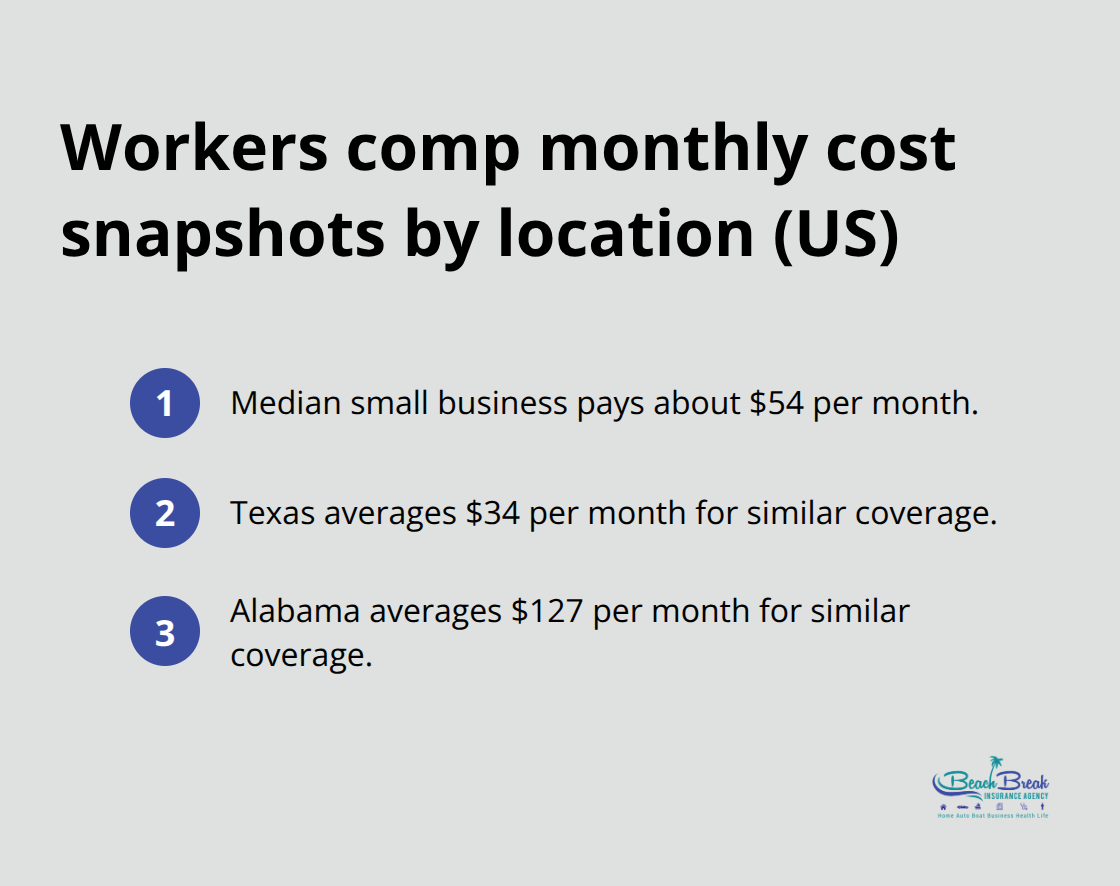
Workers’ compensation is mandatory in nearly every state if you have employees. California requires it regardless of headcount, while Texas makes it optional. The cost averages about $54 per month according to Insureon, but this varies dramatically based on your payroll and job classifications. A kitchen worker costs more to insure than front-of-house staff because burns and cuts happen regularly in food service.

Stop thinking of workers’ comp as a grudge expense and start viewing it as your legal shield. When an employee gets hurt, this coverage pays their medical bills and lost wages, which means they’re less likely to sue you personally. The NFPA reports that kitchen injuries from knives and hot surfaces occur frequently enough that you should enforce strict standard operating procedures, require proper PPE like cut-resistant gloves and heat-resistant sleeves, and train staff quarterly on safety protocols.

General Liability: The Landlord’s Requirement

General liability insurance protects you when a customer slips on a wet floor or claims your food made them sick. It’s not technically mandatory everywhere, but your landlord will demand it before you sign a lease. Most restaurants operate with $1 million per occurrence and $2 million aggregate limits, which costs around $141 monthly on average.

Quick view of typical monthly costs for workers’ comp, general liability, and liquor liability for U.S. restaurants. - Restaurant insurance requirements

This coverage specifically excludes alcohol-related claims. That exclusion is why a separate liquor liability policy becomes essential the moment you serve beer, wine, or spirits. Without it, you face a significant protection gap that can expose your business to serious financial risk.

Liquor Liability: The Dram Shop Law Reality

If you serve alcohol, liquor liability insurance is non-negotiable because dram shop laws in most states hold you liable when an intoxicated patron injures themselves or someone else. This coverage averages $41 per month and protects you from lawsuits filed by third parties harmed by your patrons, not just claims from the intoxicated person themselves.

Your state’s specific dram shop law determines your actual exposure, so verify whether your state requires this coverage for licensing or simply makes it smart business. A customer who leaves your bar and causes a car accident can sue you directly, and without liquor liability, your general liability policy won’t cover the defense costs.

Server training on responsible alcohol service reduces your claims frequency, which helps when you renew your policy next year. The NCSL notes that frequent ID checks with scanners, documented refusal logs, and incident documentation create the paper trail that insurers reward with better rates. Bars and taverns face higher liquor liability premiums than casual dining restaurants, so your operation type shapes what you’ll pay.

What These Three Coverages Leave Unprotected

These three coverages meet baseline legal requirements, but most restaurant owners discover too late that legal minimums leave dangerous gaps in their protection. Your equipment, inventory, and employees face risks that state-mandated insurance simply doesn’t address. The next section reveals which coverage gaps cost restaurant owners the most money.

Coverage Gaps Most Restaurant Owners Miss

Property Insurance Protects Your Equipment and Inventory

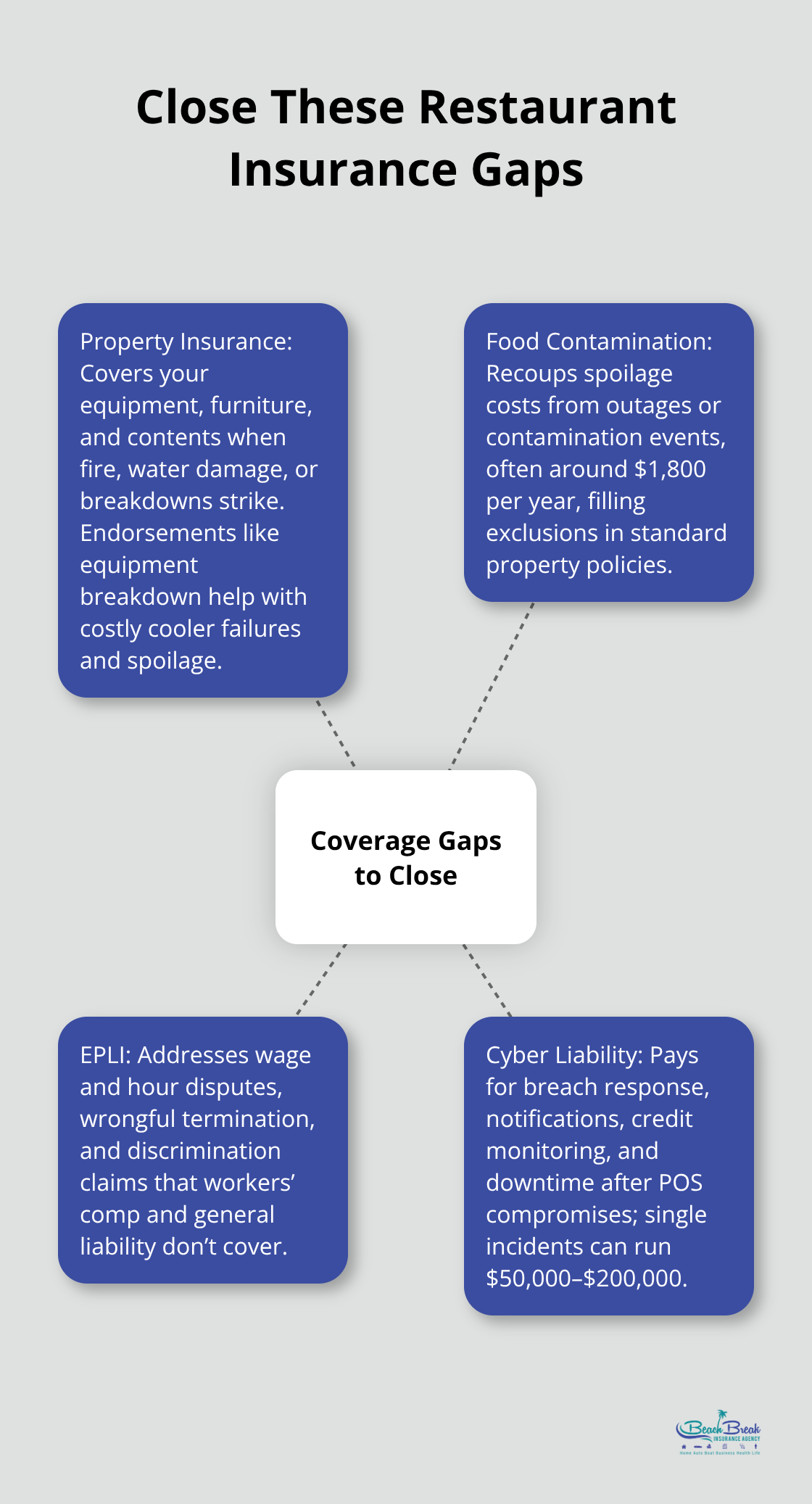
Property insurance is where most restaurant owners realize their existing coverage falls dangerously short. A kitchen fire, refrigerator failure, or water damage from a burst pipe destroys thousands of dollars in equipment and inventory overnight. Your general liability policy covers someone else’s injury on your premises, not your own losses. According to recent industry research, restaurant owners can expect to pay anywhere from about $3,000 to $10,000 per year for comprehensive property insurance that protects your cooking equipment, furniture, and building contents with a typical $1,000 deductible.

Central coverage gaps restaurants should close: property, food contamination, EPLI, and cyber, with brief U.S.-focused guidance.

Kitchen fires stem from grease buildup in hoods and ducts that haven’t been serviced, according to the NFPA. Without property coverage tied to regular maintenance schedules, you absorb the full replacement cost yourself. Equipment breakdown endorsements matter more than most owners realize because a single failed walk-in cooler costs $5,000 to $15,000 to replace, and spoilage losses stack up quickly during downtime.

Food Contamination Coverage Recoupes Spoilage Losses

A power outage spoils your inventory in hours. Food contamination coverage recoupes those costs at around $1,800 per year with no deductible. This endorsement protects you when equipment fails or contamination events occur, covering losses that property insurance alone might exclude. Most restaurant owners overlook this protection until they face actual spoilage, which makes it an easy gap to miss during initial policy setup.

Employment Practices Liability Addresses Wage and Hour Disputes

Employment practices liability insurance addresses wage and hour disputes, wrongful termination claims, and discrimination allegations that workers’ compensation doesn’t touch. The U.S. Department of Labor Wage & Hour Division tracks persistent violations around tip pooling disputes, overtime miscalculations, and retaliation claims that cost restaurants real money in settlements and legal defense.

This coverage protects you when an employee sues over scheduling practices, failure to promote, or alleged harassment, which general liability explicitly excludes. Precise timekeeping systems and wage and hour policy enforcement reduce your exposure, but this insurance provides the financial protection when disputes arise anyway.

Cyber Liability Protects Payment Card Data

Cyber liability insurance has become non-negotiable because your point-of-sale system stores customer payment card data that hackers actively target. The Verizon Data Breach Investigations Report 2025 shows payment card intrusions remain common in hospitality, and a single breach notification costs $50,000 to $200,000 depending on customer count and notification requirements.

Cyber insurance covers breach response costs, customer notification, credit monitoring services, and business interruption if your POS system gets compromised. Restaurants handling 50 or more customer records should treat cyber coverage as mandatory, not optional. Multi-factor authentication, segmenting your POS network from guest Wi-Fi, and phishing simulations reduce your cyber risk profile and help you negotiate better premiums when you shop for coverage.

These gaps in protection expose your restaurant to financial losses that state-mandated insurance simply won’t cover. The next section shows how bundling strategies and risk management practices lower your overall costs while closing these dangerous protection gaps.

Cost-Saving Strategies Without Sacrificing Protection

Bundle Policies Strategically for Real Savings

Bundling your restaurant policies with a single carrier cuts premiums significantly, but only if you understand which coverages belong together and which ones don’t. A Business Owner’s Policy bundles general liability and property coverage into one package. However, bundling workers’ compensation with your BOP rarely makes financial sense because workers’ comp rates depend entirely on your payroll and job classifications, while property and liability rates depend on your building and operations.

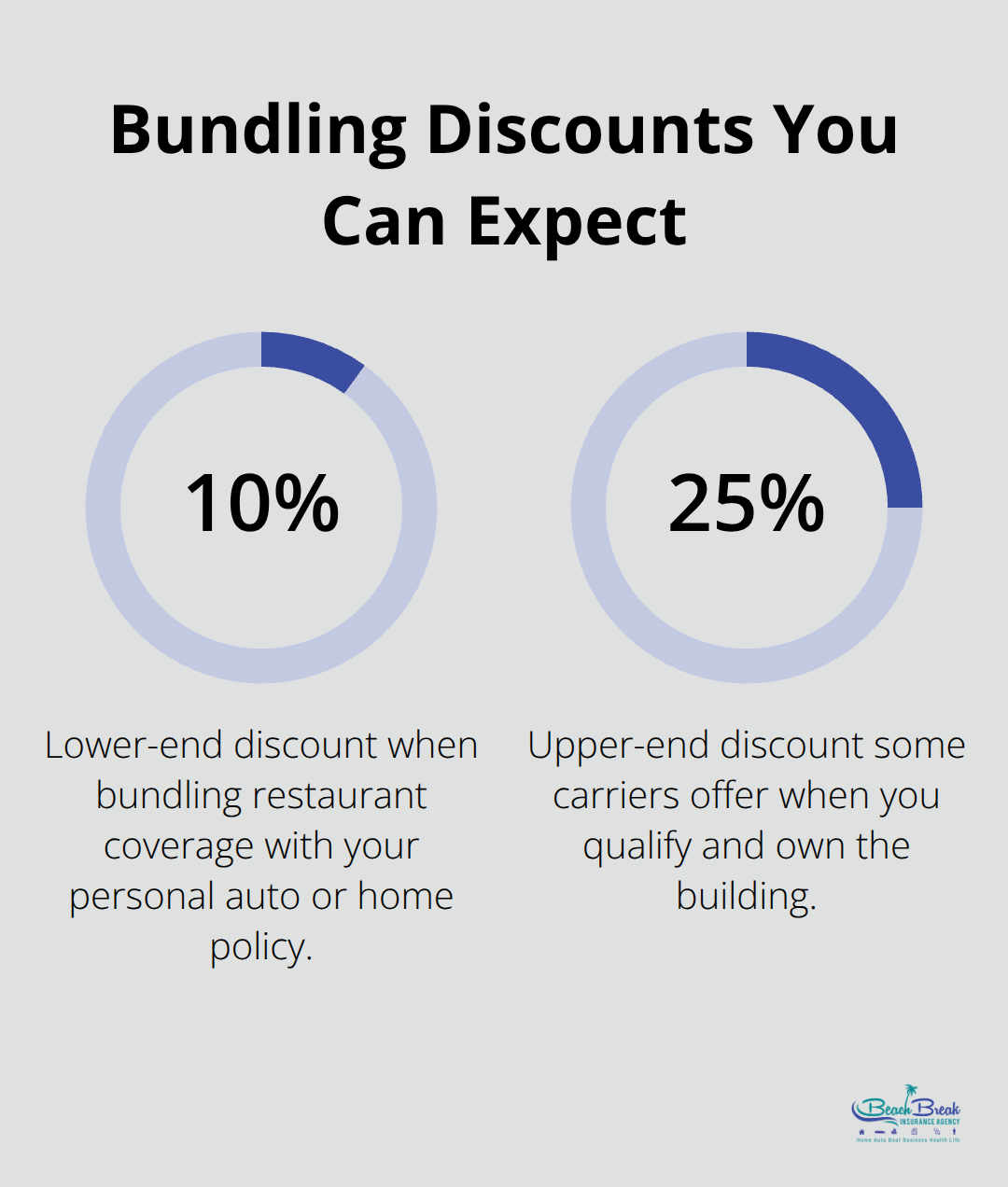
The real savings come from bundling your restaurant coverage with your personal auto or home policy if you own the building, which can yield 10 to 25 percent discounts depending on your carrier. Shop quotes from at least three carriers before accepting a bundled package because some insurers price bundled policies aggressively while others don’t, and you want to verify that bundling actually saves you money versus standalone policies with better limits or lower deductibles.

Visualizing potential premium savings from bundling restaurant coverage with personal policies in the U.S. - Restaurant insurance requirements

Document Safety Practices to Lower Premiums

Your actual risk profile determines what you’ll pay far more than any discount strategy does. Restaurants with documented safety practices pay significantly lower premiums than identical restaurants without them. The NFPA confirms that kitchen fires stem from grease buildup in hoods and ducts, so schedule hood cleaning and duct inspections every quarter and maintain verification records. This documentation tells your insurer you take fire prevention seriously and directly lowers your property insurance renewal rates.

Slip and fall claims drive liability costs higher than almost any other restaurant risk. Implement daily front-of-house floor inspections, use wet-floor cones aggressively, keep aisles clear of clutter, and photograph any incident within 24 hours. This risk management demonstrates commitment that insurers reward with better rates. Food safety documentation matters equally because the FDA Food Code 2022 emphasizes handwashing timing, time and temperature logs, food labeling, and excluding ill workers. Restaurants that maintain these records with timestamps face lower food contamination premiums than those relying on verbal policies.

Update Coverage When Your Operations Change

Review your coverage annually as your restaurant changes because adding a delivery operation increases your auto liability exposure and requires hired and non-owned auto coverage. Expanding your customer data handling expands your cyber liability needs. A restaurant that added online ordering during the pandemic probably needs more cyber coverage than the original policy provided, and your premiums reflect outdated risk profiles until you update them.

Contact your agent before making operational changes so coverage adjustments happen simultaneously with your business growth rather than leaving gaps that only appear when a claim occurs. This proactive approach prevents expensive surprises and keeps your protection aligned with your actual operations.

Final Thoughts

Restaurant insurance requirements protect your business, your employees, and your customers from financial devastation, but legal minimums alone leave you exposed. Workers’ compensation, general liability, and liquor liability form your legal foundation, while property insurance, food contamination coverage, employment practices liability, and cyber insurance fill the gaps that separate surviving a disaster from closing your doors permanently. The restaurants that recover quickly from fires, equipment failures, or employee disputes align their policies with actual operations and risk profiles rather than settling for bare-minimum coverage.

Start by gathering your current policies and identifying which gaps exist in your protection. Then contact Beach Break Insurance Agency to review your coverage against your current operations. A quick conversation now prevents expensive surprises later.

The information provided in this blog is for general informational purposes only and does not constitute legal, financial, or insurance advice. Coverage options, terms, and availability may vary. Please consult with a licensed professional for advice specific to your situation.
Artificial intelligence may have been used to generate text and images in some blog articles.

California Restaurant Insurance Quotes: Compare Today

Running a restaurant in California means facing risks that standard business policies simply don’t cover. From customer injuries to equipment fires, the gaps in generic coverage can cost you thousands.

We at Beach Break Insurance Agency help restaurant owners find the right restaurant insurance quotes in California without wasting hours comparing carriers. This guide walks you through exactly what coverage you need and how to get accurate quotes fast.

Why Standard Business Policies Fall Short for Restaurants

The Coverage Gaps That Cost You Thousands

A standard commercial general liability policy designed for office buildings or retail shops leaves restaurant owners exposed to massive gaps. Your typical business policy excludes foodborne illness claims, alcohol-related incidents, and spoilage from equipment failure-three of the costliest risks you face. According to data from restaurant insurance providers, slip-and-fall claims represent the leading claim type in food service, yet many basic policies cap coverage or impose strict exclusions when the injury occurs on a wet kitchen floor or near a dining area.

California’s Workers’ Compensation Requirement

California restaurants with employees face a legal mandate: you must carry workers’ compensation insurance for every employer with at least one employee. Noncompliance triggers criminal charges and substantial fines. A generic business policy will not satisfy this requirement. This is not optional.

Real Claim Scenarios That Expose Your Risk

The actual cost of being underinsured becomes clear when you examine real claim scenarios. A kitchen fire caused by grease buildup in an unserviced hood destroys your equipment, forces a weeks-long closure, and leaves you liable for spoilage of inventory worth thousands. Equipment breakdown alone-a refrigeration failure that spoils ingredients-often goes uncovered under standard property policies without a specific endorsement.

Alcohol Service and Delivery Operations

If you serve alcohol, you face dram shop liability in California. Your business can be held responsible for damages caused by an intoxicated patron served by your staff. General liability policies exclude alcohol-related claims unless you add liquor liability coverage as a separate policy. For restaurants running delivery operations, personal auto insurance does not cover business driving, leaving you and your employees unprotected if an accident occurs while delivering food.

Why Restaurant-Specific Policies Protect You Better

The gap between what you think is covered and what actually is covered can cost you $50,000 or more in a single incident. Restaurant-specific policies address these gaps with coverage for product liability, business interruption, equipment breakdown, and liquor liability built into packages designed for your actual operations. Understanding exactly which types of coverage you need is the first step toward protecting your business-and that starts with knowing what each policy actually covers.

Hub-and-spoke chart illustrating key components of restaurant-specific insurance coverage.

What Coverage Your California Restaurant Actually Needs

General Liability: Your Foundation Coverage

General liability insurance protects you when a customer slips on a wet floor or claims your food made them sick. According to Insureon, general liability averages $141 per month for California restaurants and covers third-party bodily injury and property damage with typical limits of $1 million per occurrence and $2 million aggregate. Landlords and local licensing boards require proof of general liability before they issue permits or approve leases, making this coverage non-negotiable. However, general liability excludes alcohol-related claims entirely, which creates a significant gap if you serve drinks.

Liquor Liability: Essential for Alcohol Service

Restaurants serving alcohol need a separate liquor liability policy averaging $41 per month. Dram shop laws in California hold your business responsible for damages caused by intoxicated patrons your staff served. This coverage protects you against claims that general liability explicitly excludes, making it non-negotiable if you pour drinks.

Property Insurance and Equipment Protection

Property insurance covers your building, leasehold improvements, and equipment like walk-in coolers, ovens, and POS systems. If you rent, your policy must protect both the landlord’s property and your personal property inside the space. Equipment breakdown coverage, often added as an endorsement, protects against repair costs when refrigeration fails or a fryer stops working. Wildfire damage represents a critical concern in California, so verify your policy does not exclude wildfire or impose sublimits in high-risk zones.

Workers’ Compensation: A Legal Requirement

Workers’ compensation is mandatory in California for any restaurant with employees and costs around $113 per month according to Insureon, covering medical bills and lost wages for employees injured on the job. For a restaurant with $500,000 in annual payroll, workers’ comp premiums typically run $15,000 to $30,000 annually depending on job classifications and claims history. This requirement has no exceptions.

Commercial Auto and Delivery Coverage

Commercial auto insurance averages $181 per month and covers accidents involving company vehicles. If your staff uses personal vehicles for deliveries, you need hired and non-owned auto insurance instead. This coverage protects your business when employees use their own cars for work since personal auto policies explicitly exclude business driving.

Compact list of average monthly insurance costs for California restaurants, including general liability, liquor liability, workers’ comp, commercial auto, and BOP. - Restaurant insurance quotes California

A Business Owner’s Policy bundles general liability and property coverage for roughly $251 per month, making it the most cost-effective option because you save money buying combined rather than separate policies. Most restaurant owners start with a BOP, then layer on liquor liability, workers’ comp, and commercial auto based on their specific operations. Understanding your exact coverage needs sets the stage for getting accurate quotes that reflect your actual risk profile.

How to Get Accurate Restaurant Insurance Quotes

Collect the Details That Shape Your Quote

Accurate quotes start with complete information about your operation. Document your annual revenue, total payroll, number of employees, and seating capacity. Specify whether you own or lease the building, the replacement value of your kitchen equipment and furniture, and your hours of operation-including late nights or weekend service. If you serve alcohol, state what percentage of your revenue comes from drink sales, as this directly affects premium calculations. For delivery operations, clarify whether you own vehicles, lease them, or rely on employee personal vehicles. Insureon reports that restaurants providing this level of detail receive quotes that are 20 to 30 percent more accurate than those based on minimal information.

Percentage chart showing 20% to 30% improvements in quote accuracy when restaurants provide full operational details. - Restaurant insurance quotes California

One critical detail many owners overlook is current claims history. Insurers want to know about any losses in the past three to five years, even if they were minor. If you’ve had a kitchen fire, a slip-and-fall settlement, or a workers’ comp claim, disclose it. Hiding claims history creates problems later when the carrier discovers the gap and potentially denies coverage.

Compare Multiple Carriers for Real Price Differences

Comparing quotes across multiple carriers reveals dramatic price differences for identical coverage. According to Insureon’s benchmarks, a Business Owner’s Policy in California ranges from roughly $200 to $350 monthly depending on the carrier and your specific risk profile, yet many owners accept the first quote they receive. Request quotes from at least three carriers and ensure each quote covers the same policy limits, deductibles, and endorsements so you’re comparing apples to apples.

Pay close attention to deductibles since a $1,000 deductible versus a $2,500 deductible significantly impacts your out-of-pocket costs during a claim. Review whether equipment breakdown, business interruption, and liquor liability are included or added as endorsements because these details shift the final premium. Verify that wildfire exclusions or sublimits don’t apply in your location, especially if you operate in high-risk California zones.

Identify Coverage Gaps That Cost Extra

Many restaurant owners discover during the comparison process that they need higher liability limits than they initially thought. Locations with high foot traffic, full bars, or busy delivery operations typically benefit from $2 million per occurrence limits rather than the standard $1 million, even if the premium increase is modest. As an independent San Diego-based agency, Beach Break Insurance Agency compares quotes from top-rated carriers and delivers tailored options, helping you avoid contacting insurers individually while ensuring coverage matches your operation.

Final Thoughts

Finding the right restaurant insurance quotes in California requires you to gather accurate details about your operation, compare quotes across multiple carriers, and identify coverage gaps specific to your business model. Most restaurant owners waste weeks contacting insurers individually or accept the first quote without realizing they’re overpaying by hundreds of dollars annually. The difference between a $200 monthly premium and a $350 premium for identical coverage compounds over years of operation.

Your restaurant faces distinct risks that generic business policies ignore-slip-and-fall claims, equipment breakdowns, liquor liability, and delivery vehicle accidents represent the actual threats to your business. You need to be specific about your revenue, payroll, seating capacity, alcohol sales percentage, and claims history when you request quotes. This transparency produces quotes that reflect your actual risk profile rather than industry averages that may not apply to your situation.

We at Beach Break Insurance Agency compare quotes from multiple top-rated carriers and deliver tailored coverage options that match your restaurant’s actual operations. Contact Beach Break Insurance Agency to get accurate restaurant insurance quotes California and protect your restaurant without the hassle.

The information provided in this blog is for general informational purposes only and does not constitute legal, financial, or insurance advice. Coverage options, terms, and availability may vary. Please consult with a licensed professional for advice specific to your situation.
Artificial intelligence may have been used to generate text and images in some blog articles.

California Business Owners Insurance: A Local Perspective

California business owners face insurance challenges that most other states don’t. Property values keep climbing, wildfire seasons grow more intense, and liability risks shift constantly.

We at Beach Break Insurance Agency know that generic policies fall short for California operations. This guide walks you through what coverage actually matters for your business and how to build protection that fits your specific situation.

Why California Demands Different Insurance

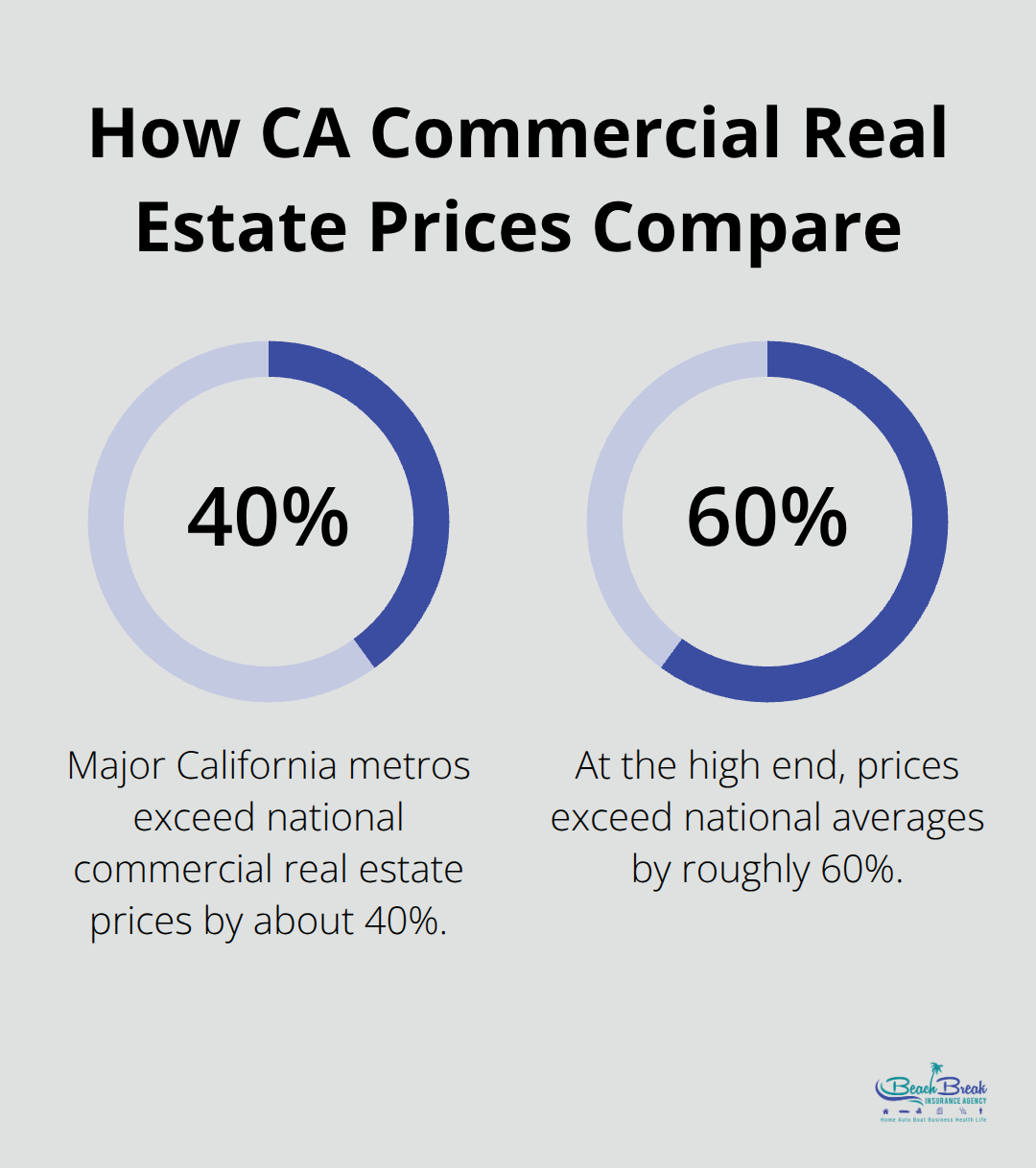
California’s insurance landscape stands apart from the rest of the country, and business owners who ignore this reality pay the price. Property values in California have climbed faster than nearly everywhere else-median commercial real estate prices in major metros like San Francisco and Los Angeles exceed national averages by 40 to 60 percent. This means your building, equipment, and inventory carry replacement costs that standard policies from other states simply don’t account for. If you underinsure your property to its full replacement value, California law penalizes you through coinsurance clauses that reduce your claim payout dollar-for-dollar.

Percentage range by which major California metros exceed national averages

A $2 million building insured for only $1.5 million isn’t just underprotected; it triggers penalties that can slash your recovery by half or more after a loss. Replacement Cost coverage, not Actual Cash Value, is the only rational choice in this market, and Agreed Value policies with upfront appraisals eliminate coinsurance risk entirely.

Wildfire Risk Changes Everything

Wildfire exposure has become the dominant factor in California commercial insurance. The 2023 wildfire season burned over 730,000 acres across the state, and the California FAIR Plan-the insurer of last resort for properties that can’t obtain standard coverage-now holds roughly 1.3 million policies, many of them in high-fire zones. Standard property policies exclude wildfire damage unless you pay for specific endorsements, yet many business owners learn this gap only after a loss strikes. If your operation sits within a fire-hazard severity zone, your carrier may demand defensible space inspections, roof material upgrades, or vegetation management before issuing a quote. Commercial General Liability policies also exclude pollution and damage from smoke, ash, and water runoff, leaving you exposed to liability claims from neighboring properties affected by your building’s fire-related impacts.

Key insurance impacts and requirements driven by California wildfire exposure - California business owners insurance

Inland Marine coverage becomes critical if you store equipment off-site or operate mobile assets; it protects inventory in transit and in your care during evacuation or relocation.

Liability That Extends Beyond Your Walls

California courts award some of the highest liability judgments in the nation, with jury verdicts in urban areas regularly exceeding $5 million for serious bodily injury or property damage claims. Your standard General Liability policy typically carries per-occurrence limits of $1 million, which sounds adequate until a single incident exhausts that ceiling and leaves you personally liable for the remainder. Commercial Umbrella coverage sits above your primary policies and starts at $1 million in excess protection, with many carriers recommending $2 to $5 million for businesses with significant customer or employee exposure. Completed operations liability-the risk that your product or service causes harm weeks or months after delivery-requires explicit coverage under your CGL policy, and many California contractors and manufacturers face claims years into a project’s completion. If you employ staff, California’s strict employment practices liability environment means wrongful termination, discrimination, and harassment claims occur regularly; Employment Practices Liability Insurance protects you from six-figure legal defense costs and settlements.

How Your Industry and Location Shape Your Needs

Your specific business type and geographic location within California determine which coverage gaps matter most. A retail operation in downtown Los Angeles faces different wildfire exposure than a warehouse in the Central Valley, yet both confront California’s elevated liability environment. Your industry classification affects workers’ compensation rates, property underwriting standards, and the types of liability endorsements carriers will offer. A contractor operating in a fire zone needs different protections than a professional services firm in a coastal city. The next section walks you through how to assess these industry-specific risks and build a coverage strategy that actually protects your operation.

What California Business Owners Actually Need to Protect

Property Coverage That Matches Your Real Replacement Costs

California property coverage operates under rules that trip up business owners from other states. You must insure your building to its full replacement cost, not what you think it’s worth or what you paid for it years ago. Property values climb 3 to 5 percent annually in most California markets, which means a building you insured for $2 million five years ago now costs $2.3 to $2.6 million to rebuild. Standard policies force you to absorb the gap through coinsurance penalties that can cut your claim recovery by 50 percent or more. Agreed Value coverage eliminates this trap entirely-you and your carrier agree upfront on the property’s replacement cost through a professional appraisal, then the policy waives coinsurance if a loss occurs.

Equipment and machinery require separate attention because standard property policies exclude breakdowns from mechanical failure, electrical surge, and boiler malfunction. Boiler and Machinery coverage costs $500 to $2,000 annually depending on your equipment age and maintenance records, but it protects against losses that property policies won’t touch. This gap catches many California business owners off guard when a critical system fails and they discover their standard policy leaves them exposed.

Commercial Auto and Vehicle Protection

If you operate vehicles for business purposes, Commercial Auto insurance is mandatory and separate from your property policy. Most California carriers require per-vehicle limits of $500,000 to $1,000,000 Combined Single Limit, with higher limits recommended if you transport clients or carry high-value cargo. Your personal auto policy explicitly excludes business use, so operating a vehicle for work without Commercial Auto coverage violates your personal policy and leaves you personally liable for any accident.

Liability Coverage in California’s Aggressive Legal Environment

General Liability protection in California must account for the state’s aggressive litigation environment and high jury awards. A single premises liability claim-a customer slipping in your office, a delivery driver injured on your property-can exceed $1 million in medical costs and legal fees before a jury verdict even factors in. Your standard Commercial General Liability policy covers bodily injury and property damage at per-occurrence limits you select, typically $1 million, but California courts regularly award significant damages in serious cases.

Commercial Umbrella insurance sits above your primary policy and provides $1 to $5 million in additional coverage for $300 to $800 annually, depending on your underlying limits and claims history. This protection is not optional for businesses with significant customer or employee contact. Completed operations liability-the risk that your product or service causes harm weeks or months after delivery-requires explicit coverage under your CGL policy, and many California contractors and manufacturers face claims years into a project’s completion.

Income Protection When Operations Stop

Business Interruption coverage restores your lost income when a covered event-fire, theft, equipment breakdown-forces you to close temporarily. If your business generates $50,000 monthly revenue and a fire shuts you down for three months, Business Interruption reimburses that $150,000 loss plus ongoing expenses like payroll and utilities. Extra Expense coverage complements Business Interruption by funding temporary relocation costs, emergency repairs, and accelerated rebuilding so you resume operations faster.

The Hartford reports that small business customers pay roughly $141 monthly for bundled coverage combining property, liability, and business income protection, making this protection affordable for nearly any operation. If you lease space, your landlord requires proof of liability coverage through a Certificate of Insurance you can generate 24/7 online, and many California leases demand $2 million in limits before you even sign the agreement.

Matching Coverage to Your Specific Operation

Your industry classification affects workers’ compensation rates, property underwriting standards, and the types of liability endorsements carriers will offer. A contractor operating in a fire zone needs different protections than a professional services firm in a coastal city. The next section walks you through how to assess these industry-specific risks and build a coverage strategy that actually protects your operation.

Building Coverage That Fits Your California Operation

Map Your Risk Exposure Against Carrier Standards

Assembling the right insurance package for a California business demands more than checking boxes on a standard form. You need to start by mapping your actual risk exposure against what carriers will underwrite at a price you can sustain. Most California business owners accept whatever quote arrives first or select limits based on what competitors claim to carry, rather than analyzing their own operation’s specific vulnerabilities. Your industry classification, location within California, number of employees, revenue level, and claims history determine which carriers will offer you coverage and at what premium. A contractor in a fire zone with a prior water damage claim faces completely different underwriting than a professional services firm in San Diego with a clean loss history.

Document Property Values and Liability Requirements

Start by documenting your property values precisely-not estimated or historical values, but current replacement costs obtained from a commercial appraiser or your accountant. This single step eliminates the coinsurance penalty trap that catches so many California owners off guard. Next, audit your liability exposure by reviewing your lease agreement, customer contracts, and employee agreements to identify coverage requirements your counterparties impose.

Five-step checklist to align insurance with California risks - California business owners insurance

Many California commercial leases demand $2 million in General Liability limits before you occupy the space, and some landlords require higher limits if you operate a restaurant, manufacturing facility, or contractor business. Workers’ compensation classification codes vary dramatically by industry, so verify your carrier assigns the correct classification code before accepting a quote.

Compare Quotes Across Multiple Carriers

Comparing quotes from multiple carriers matters far more in California than in other states because underwriting standards vary significantly based on each insurer’s appetite for local risks like wildfire exposure and earthquake damage. However, these averages mask the reality that California carriers often charge 20 to 40 percent premiums above national averages due to elevated property values, aggressive litigation trends, and natural disaster frequency. When you request quotes, specify your exact property replacement cost, employee count broken down by job classification, annual revenue, and whether you occupy a fire-hazard severity zone-vague information produces unreliable quotes that shift dramatically during underwriting.

Select Deductibles That Match Your Cash Position

Deductibles deserve careful attention because selecting a $5,000 deductible instead of $2,500 might reduce your annual premium by $300 to $500, but it forces you to absorb larger out-of-pocket losses when claims occur. Try matching your deductible to your available cash reserves rather than chasing the lowest premium; if a $5,000 deductible would strain your business cash flow during a loss, the lower premium savings evaporate the moment you need to file a claim.

Adjust Coverage Annually as Your Business Evolves

Review your policy limits annually as your business grows, property values climb, and liability exposures shift. California’s 3 to 5 percent annual property appreciation means a building you insured for $2 million three years ago likely requires $2.2 to $2.3 million in coverage today, and failing to adjust creates immediate coinsurance penalties on any loss. An independent agency can help you compare quotes from multiple carriers and adjust your coverage as your operation changes, saving you time while keeping your policies aligned with your actual risk exposure.

Final Thoughts

California business owners insurance demands a fundamentally different approach than coverage in other states because elevated property values, aggressive litigation trends, wildfire exposure, and strict regulatory requirements create gaps that generic policies cannot fill. Underinsuring your property triggers coinsurance penalties that slash your claim recovery by half, liability judgments regularly exceed $5 million, and wildfire exclusions in standard policies expose you to catastrophic losses. The path forward starts with a clear-eyed assessment of your actual replacement costs, liability exposure, and industry-specific risks through professional appraisal rather than guessing.

Document your property values precisely, review your lease agreements and customer contracts to identify coverage requirements, and verify your workers’ compensation classification code matches your actual operations. Request detailed quotes from multiple carriers, specifying your exact exposures rather than accepting vague estimates that shift during underwriting. Match your deductible to your available cash reserves so you can actually afford to file a claim without straining your business, since a $5,000 deductible might save $300 annually but forces you to absorb larger out-of-pocket losses when claims occur.

We at Beach Break Insurance Agency understand that California business owners need coverage tailored to local risks and changing circumstances. As an independent San Diego-based agency, we compare quotes from multiple top-rated carriers to deliver protection that fits your specific operation. Contact us today to review your current coverage gaps and align your policies with your actual needs while controlling costs.

The information provided in this blog is for general informational purposes only and does not constitute legal, financial, or insurance advice. Coverage options, terms, and availability may vary. Please consult with a licensed professional for advice specific to your situation.
Artificial intelligence may have been used to generate text and images in some blog articles.
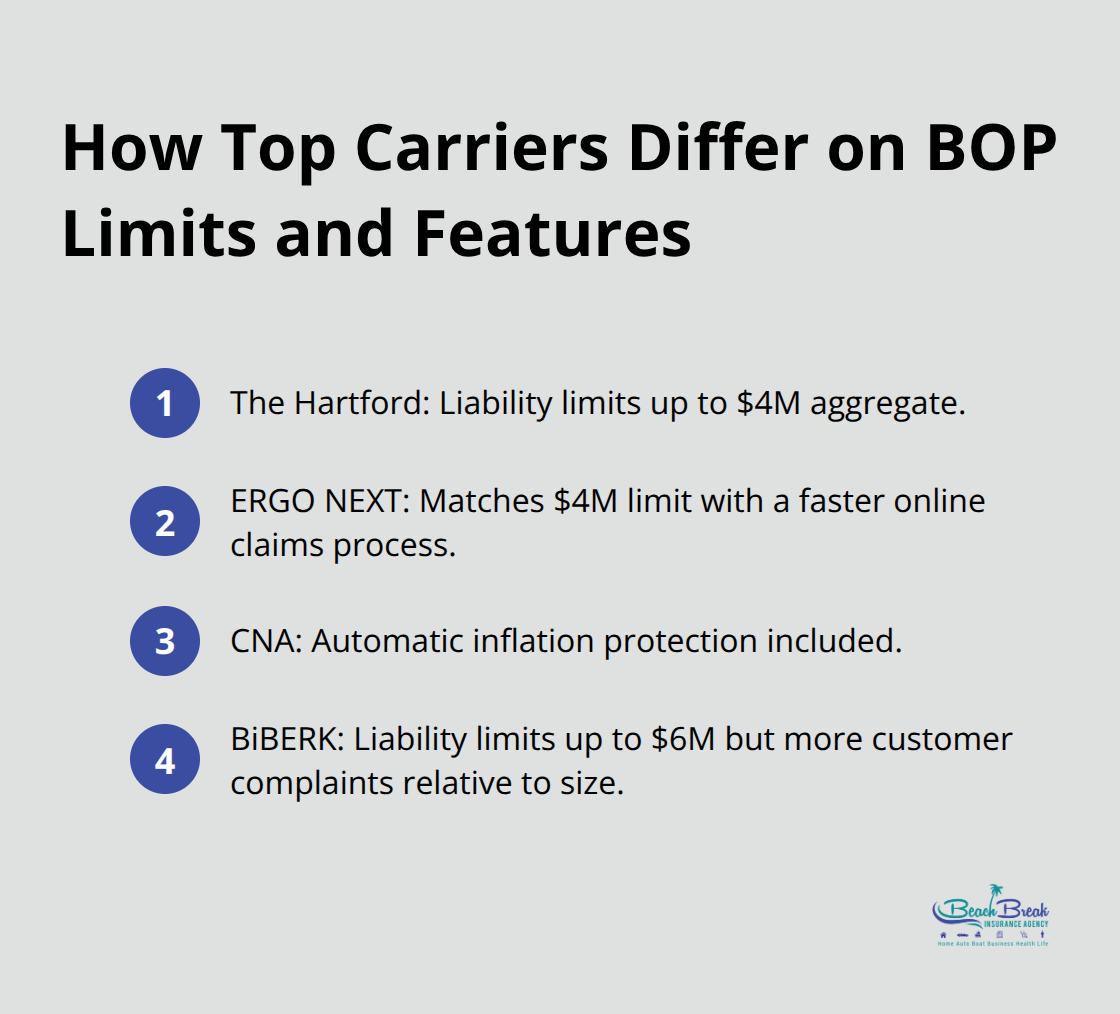
Workers Compensation Insurance Quotes: Fast Comparisons

Workers compensation insurance quotes vary wildly between providers. Small business owners often overpay simply because they haven’t compared their options side by side.

At Beach Break Insurance Agency, we’ve seen businesses cut their premiums by 20–30% just by reviewing multiple quotes. The right comparison takes less time than you’d think and can reveal coverage gaps that cost far more than the premium savings.

Why Workers Comp Quotes Matter

Workers compensation costs have climbed steadily across nearly every industry over the past decade. According to data from Insureon, the median small business now pays around $54 per month for workers comp, though this masks significant regional variation. Texas businesses average $34 monthly while Alabama pays $127 monthly for comparable coverage. These differences stem from state benefit structures, medical cost inflation, and the risk profile of local industries.

Monthly workers compensation cost examples for the U.S., including median and selected states - Workers compensation insurance quotes

The National Council on Compensation Insurance reports that rates are forecast to decline for the seventh consecutive year, yet this doesn’t help businesses paying inflated premiums today based on outdated quotes or incomplete information. A single outdated quote can lock you into overpaying for months or even years.

The Real Cost of Skipping Comparisons

Most small business owners treat workers comp as a static expense rather than a negotiable one. This assumption costs money. Rating plans, experience modification rates, and classification codes shift annually, meaning your premium from last year may no longer reflect your actual risk profile or market rates. The Hartford notes that premiums for small businesses with payroll under $300k can start as low as $13 per month, yet many businesses pay three or four times that amount without exploring alternatives. The gap between your current premium and what you should actually pay often exceeds $200 per year. Comparing quotes across multiple carriers takes roughly 10 minutes online and frequently reveals savings of 20–30 percent. That efficiency matters when your time is already stretched thin running operations.

Coverage Gaps Hide in Quote Details

Price comparisons alone create dangerous blind spots. Many small business owners chase the lowest number without verifying what that quote actually covers. A quote missing employer’s liability coverage leaves you exposed to employee lawsuits that workers comp doesn’t address. Others accept quotes with classification codes that don’t match their actual job duties, resulting in either inadequate coverage or overpayment for protection you don’t need. State-specific requirements add another layer of complexity. Colorado and Idaho require workers comp after your first employee, while Kansas imposes payroll thresholds before coverage becomes mandatory. Selecting a quote without confirming it meets your state’s legal requirements creates compliance risk that far outweighs any premium savings.

Carriers Worth Your Attention

The Hartford, Liberty Mutual, Travelers, AIG, and QBE represent the major carriers most worth comparing (though availability and pricing vary significantly by location and industry). Each carrier applies different rating plans and credits to their base rates, which means the same business profile produces different quotes from different insurers. Shopping across multiple carriers reveals these variations and puts you in position to negotiate better terms. Your next step involves gathering the right information before requesting quotes.

How to Get the Right Quote Comparison

Comparing workers comp quotes demands more precision than simply requesting numbers from five carriers. You need to walk into each quote request with identical information so the quotes you receive are actually comparable.

Locate Your Classification Code First

Start by finding your four-digit classification code on your current policy declarations page. This code determines your risk level and directly drives your premium. If you’re a new business without a policy, identify the code that matches your primary job duties using the WCIRB classification search tool. The National Council on Compensation Insurance maintains these codes, and getting yours right prevents both overpricing and underpricing. Many small business owners skip this step and end up with quotes based on incorrect classifications, making comparisons meaningless.

Gather Accurate Payroll Information

Next, collect your actual payroll figures separated by state if you operate in multiple locations. Insureon data shows that 47 percent of small businesses pay less than $50 monthly while 24 percent pay between $50 and $100 monthly, but these figures only apply when payroll is accurately reported. Underestimating payroll leads to artificially low quotes that balloon at audit time.

Share of U.S. small businesses by monthly workers compensation premium

Overestimating inflates your premium unnecessarily. If you’re unsure of your exact payroll, estimate conservatively and note it as an estimate when requesting quotes.

Account for Your Experience Modification Rate

Your experience modification rate and claims history dramatically shape final pricing but rarely appear in initial quotes. This EMR score reflects your actual safety record compared to similar businesses in your industry and state. Request quotes that specifically account for your loss history rather than accepting generic base rate quotes.

Evaluate Coverage Beyond Price

When you receive quotes, ignore the temptation to select based on price alone. Instead, verify that each quote includes employer’s liability coverage, confirm the classification codes match your actual job duties, and check whether the carrier applies any available discounts for safety training, association memberships, or schedule rating programs. These differences matter far more than a $10 monthly premium variation.

Checklist of coverage items to verify on workers comp quotes - Workers compensation insurance quotes

Request Quotes from Multiple Carriers

Request quotes from at least three carriers including Liberty Mutual, Travelers, and AIG alongside regional specialists. Once you have quotes in hand, resist the urge to switch carriers mid-term if your current short-rate cancellation penalty erodes the savings you’d gain. Instead, wait until renewal unless savings exceed 25 percent of your annual premium. With your quotes in hand and coverage details verified, the next step involves identifying and avoiding the mistakes that trap most small business owners during this process.

Common Mistakes That Inflate Your Workers Comp Quote

The gap between what you pay and what you should pay rarely stems from market conditions alone. Most small business owners sabotage their own quote comparisons through preventable errors that carriers exploit without hesitation.

Underestimating Payroll Destroys Quote Accuracy

Underestimating payroll ranks first among these mistakes. When you request quotes based on projected payroll rather than actual payroll, carriers price coverage conservatively, then audit your account at year-end and bill you for the difference. Insureon data shows that small businesses with payroll under $300k face significant variation in final premiums, yet many owners submit estimates that understate their true wage expenses. If your business grew 15 percent this year, your payroll estimate should reflect that growth. Carriers don’t reward guessing.

Similarly, misclassifying your employees or job duties creates quotes that bear no relationship to your actual risk profile. A construction supervisor classified as a general laborer receives an artificially low quote that transforms into a compliance violation and premium spike at audit. Your four-digit classification code determines everything-get it wrong and your quote becomes worthless.

Industry-Specific Coverage Requirements Matter More Than Price

Restaurants need different coverage limits than IT consulting firms, yet many owners accept generic quotes without verifying that limits match their operational reality. A restaurant with 12 employees working with hot equipment and slippery floors faces injury frequency that IT firms never encounter, yet both might receive identical quotes if classification codes aren’t examined carefully.

State-specific mandates compound this problem. Some states require employer’s liability coverage automatically included in workers comp policies while others treat it as optional. Selecting a quote without confirming it meets your state’s legal requirements leaves you exposed to employee lawsuits that workers comp specifically excludes.

Coverage Gaps Hide Behind Low Monthly Premiums

Most dangerous of all, small business owners choose quotes based solely on monthly premium without evaluating what that premium actually covers. A $40 monthly quote missing employer’s liability coverage exposes you to employee lawsuits that workers comp specifically excludes. The Hartford and Liberty Mutual both include employer’s liability in standard policies, yet regional carriers sometimes offer lower prices by excluding it entirely. A $15 monthly savings becomes a $50,000 liability if an employee sues.

Verify that each quote includes employer’s liability coverage, confirm the classification codes match your actual job duties, and check whether the carrier applies any available discounts for safety training or association memberships. Incomplete applications force underwriters to make assumptions that inflate premiums or create coverage gaps you did not expect. This verification takes five minutes and prevents the costliest mistakes small business owners make.

Final Thoughts

Fast comparisons between workers compensation insurance quotes eliminate the guesswork that costs small business owners thousands annually. When you request quotes from multiple carriers using identical payroll figures and accurate classification codes, you see exactly where market rates stand and which carriers offer the best value for your specific risk profile. This transparency prevents the premium creep that happens when businesses accept outdated quotes year after year without questioning whether better options exist.

Getting accurate workers compensation insurance quotes requires three concrete steps. First, locate your four-digit classification code and verify it matches your actual job duties. Second, gather your real payroll figures separated by state if you operate in multiple locations, and third, request quotes from at least three major carriers and compare them side by side, paying attention to coverage details rather than chasing the lowest monthly premium.

We at Beach Break Insurance Agency streamline this entire process by comparing quotes from multiple top-rated carriers simultaneously, eliminating the back-and-forth that wastes your time. Our team verifies that classification codes match your operations, confirms your state’s specific coverage requirements are met, and identifies available discounts you might otherwise miss. Contact Beach Break Insurance Agency to compare workers compensation insurance quotes from carriers that match your business profile and budget.

The information provided in this blog is for general informational purposes only and does not constitute legal, financial, or insurance advice. Coverage options, terms, and availability may vary. Please consult with a licensed professional for advice specific to your situation.
Artificial intelligence may have been used to generate text and images in some blog articles.
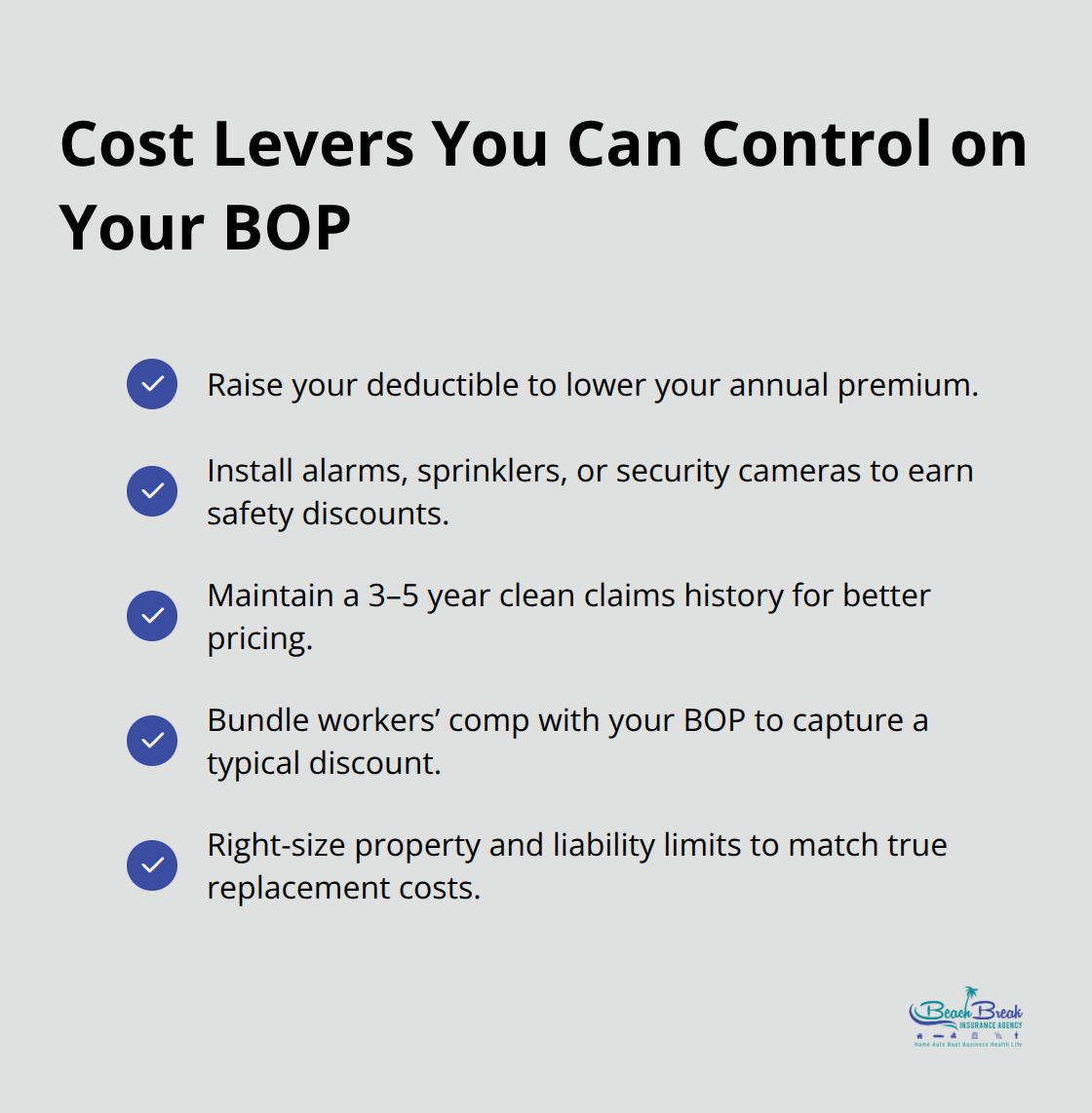
Construction Workers Compensation California: Building Safer Worksites

Construction workers compensation in California isn’t optional-it’s the law. If you employ construction workers, you need coverage, and you need it right.

At Beach Break Insurance Agency, we’ve helped countless construction business owners navigate California’s complex requirements while actually reducing their injury rates and insurance costs. This guide walks you through what you’re legally required to carry, how to build a safer worksite, and where to find real savings on your premiums.

What California Actually Requires From Construction Employers

California law doesn’t give you wiggle room on workers’ compensation insurance. If you have even one employee, you must carry coverage-no exceptions, no delays. Business and Professions Code section 7125 makes this crystal clear, and the penalties for ignoring it are severe. Operating without coverage is a criminal offense with fines up to $10,000 and potential jail time up to one year. The state takes this seriously because injured workers need immediate access to medical care and wage replacement.

When you hire your first employee, coverage must be active before they start work. If you’re a sole proprietor with no employees, you can opt out, but the moment you bring on even a part-time worker, the requirement kicks in. Some license classifications demand coverage regardless of whether you have employees-C-8 Concrete, C-20 HVAC, C-22 Asbestos Abatement, C-39 Roofing, and C-61/D-49 Tree Service all fall into this category. If your CSLB license holds one of these codes, you must maintain proof of coverage or self-insurance certification at all times.

Five California CSLB license classifications that require workers’ compensation coverage even with zero employees. - Construction workers compensation California

How Classification Codes Determine What You Pay

Your premium isn’t random-it’s tied directly to your work classification and payroll. You report up to three classification codes with the highest estimated payroll to the CSLB, and these codes determine your rate class. The catch is that rates vary significantly by carrier, and the state doesn’t set them. Instead, insurers file rates with the California Department of Insurance, meaning you can shop around and find real savings.

Your experience modification factor also matters-if your company has had fewer injuries than industry average, your rates drop. If you’ve had more claims, they rise. This is why safety investments directly impact your bottom line. When you file your Certificate of Workers’ Compensation Insurance with the CSLB, make sure the classification codes actually reflect your real payroll. Misreporting codes is a common mistake that can trigger audits later.

The CSLB doesn’t verify accuracy, so that responsibility falls on you. If you perform work outside your primary classification, you may need additional codes. Some contractors incorrectly report low-payroll codes to reduce premiums-this creates audit exposure and potential penalties.

Employee Versus Contractor Status Matters More Than You Think

Misclassifying workers as independent contractors when they should be employees is one of the fastest ways to face serious liability in California. The state uses a strict ABC test to determine employment status, and it’s stacked against contractors. A worker is presumed an employee unless your company proves all three conditions: the worker operates free from your control and direction, they perform work outside your usual business scope, and they’re independently established in that trade.

Most construction workers fail this test. A framing subcontractor working on your projects under your specifications and schedule is likely an employee in California’s eyes, not a contractor, even if they have their own business license. If you misclassify and that worker gets injured, you’re liable for their medical care and lost wages, plus the state can assess penalties and back payroll taxes.

The Uninsured Employers’ Benefit Trust Fund will pay their claim and then pursue you for reimbursement with interest. Your best move is to work with an insurance professional who understands California construction to confirm your worker classifications are defensible. Proper classification protects your workers, keeps you compliant, and actually simplifies your payroll and tax reporting.

Once you lock in the right coverage and classification structure, the next critical step is building a safety culture that actually prevents injuries and reduces your claims-which directly lowers your premiums and keeps your team healthy.

Building Safety Systems That Actually Prevent Injuries

Safety on construction sites isn’t about compliance theater or posting posters nobody reads. It’s about designing systems that stop injuries before they happen, and the data proves this works. According to CPWR and NIOSH research, construction sites with strong safety cultures experience up to 84% fewer lost-time injuries compared to those with weak programs. That’s not theoretical-it directly translates to fewer claims, lower premiums, and workers who show up ready to work instead of calling out injured.

Percentage reduction in lost-time injuries on construction sites with strong safety cultures. - Construction workers compensation California

The Four Hazards That Kill Construction Workers

The four leading causes of construction deaths are falls, struck-by incidents, caught-in/between hazards, and electrocutions, accounting for over 60% of all construction fatalities. Every one of these is preventable with proper planning and execution. Start with a Job Hazard Analysis before work begins. Review your project scope, site conditions, seasonal concerns, and emergency response procedures. This pre-job planning is among the strongest predictors of safety performance because it forces you to identify problems while you can still change your approach.

Create a hierarchy of controls: engineering solutions first (guardrails, electrical GFCI protection, trench shoring), administrative controls second (exclusion zones, flaggers, work schedules), and personal protective equipment last. PPE is your final line of defense, not your primary one.

Fall Protection and Elevated Work

Falls demand your most aggressive controls because they’re the leading killer. Install guardrails with a 42-inch top rail, midrails, and toe boards on elevated work. Use safety nets on larger projects and personal fall arrest systems where guardrails won’t work. Document your fall protection plan in writing and review it with your crew before they’re at height.

Underground Work and Electrical Hazards

For trenching and underground work, call 811 for utility locates 48-72 hours ahead-this single step prevents electrocutions and struck-by hazards that can be fatal. Use protective systems for trenches over five feet: shoring, shielding, or proper sloping. Have a competent person inspect trenches daily and require safe access within 25 feet of workers. On struck-by and caught-in hazards, establish exclusion zones around heavy equipment and suspended loads. Use flaggers and spotters trained to direct traffic safely. Require high-visibility vests and hard hats in all work areas. For electrical work, GFCI protection is mandatory on 120-volt circuits, and maintain at least 10 feet clearance from overhead power lines.

Training, Fatigue, and Heat Management

Training matters more than most contractors realize. Implement layered training: orientation for all new hires, task-specific training before workers perform specialized work, and refresher training annually. Conduct toolbox talks at the start of each shift-these 5-10 minute conversations about daily hazards keep safety top-of-mind.

Track fatigue and heat exposure closely. Fatigue accounts for a significant portion of construction accidents, so manage schedules to prevent exhaustion. Implement acclimatization for new workers (7-14 days), enforce hydration breaks, schedule work during cooler hours in extreme heat, and have an emergency response plan ready.

Documentation and Continuous Learning

Equip your sites with baseline personal protective equipment: hard hats, safety glasses, high-visibility vests, gloves, protective footwear, and hearing protection. Maintain these items, replace them when damaged, and keep on-site PPE stations stocked. Document everything. When injuries or near-misses occur, conduct root-cause analysis focused on systems and processes, not blame. Share lessons learned across your projects and protect workers from retaliation for reporting hazards. This continuous learning closes gaps and prevents repeat incidents, which directly reduces your workers’ compensation claims and creates the foundation for lower premiums and better insurance outcomes.

How Lower Injury Rates Actually Cut Your Insurance Costs

The connection between workplace safety and your workers’ compensation premiums is direct and measurable. Your experience modification factor calculates whether you pay more or less than the standard rate for your classification. If your actual losses fall below the industry average, your EMR drops below 1.0 and you receive a rate discount. If losses exceed the industry average, your EMR climbs above 1.0 and you pay a premium. A contractor with an EMR of 0.85 pays 15% less than standard rates, while one at 1.25 pays 25% more.

Two example percentages showing premium difference at EMR 0.85 and 1.25.

Over a year, that difference on a $500,000 payroll could mean $12,500 in savings or additional costs. The math is simple: fewer injuries mean lower premiums, period.

Safety Investments Pay Back Directly

Safety investments aren’t expenses-they’re direct reductions to your insurance costs. Focus on the hazards that actually cause claims in construction: falls, struck-by incidents, caught-in hazards, and electrocutions. These four categories generate the majority of claims payouts. Implement specific controls for each and you’ll see your loss history improve within 12 to 24 months.

Many contractors assume their claims history is locked in, but it’s not. The California Department of Insurance calculates EMR based on your prior three years of losses, meaning aggressive injury prevention now directly lowers what you pay next year. Safety programs work because they reduce the exact thing that raises your experience modification factor: workplace injuries. A single serious injury can spike your EMR for years, while consistent safety performance steadily reduces it.

How to Manage Claims When Injuries Occur

When an injury does occur, how you document and manage the claim determines whether it becomes a minor expense or a major cost driver. California law requires you to provide a claim form within one working day of injury report, return a copy to the worker within one working day of receipt, and forward it to your claims administrator within one working day. Speed matters because delays trigger penalties and worker frustration.

Authorize up to $10,000 in appropriate medical treatment within one working day of receiving the claim-don’t fight this decision. Early, quality medical care gets workers back to work faster and reduces long-term disability costs. If treatment is delivered through a Medical Provider Network, confirm your injured worker understands whether they can choose their own provider or must use network physicians. Some workers pre-designate a personal physician before injury, which is allowed if they have non-occupational health coverage and provide written notice.

Documentation That Protects You

Document the incident thoroughly: what happened, environmental conditions, equipment involved, witness statements, and photos if safe to take them. This documentation protects you if the claim is ever disputed and helps your claims administrator process it efficiently.

Conduct a root-cause investigation focused on what system failed, not who made a mistake. Did the guardrail have a gap? Was the worker fatigued from scheduling? Was communication unclear about the hazard? Fix the system, not just the individual, and you prevent the same injury from happening to another worker.

Share Lessons Across Your Projects

Share these lessons across your projects-if one site identifies a hazard pattern, all your sites benefit. This continuous improvement approach naturally reduces future claims because you systematically eliminate the conditions that cause injuries. Your loss history improves, your experience modification factor drops, and your premiums reflect the safer operation you’ve built.

Final Thoughts

Construction workers compensation California protects your workers, keeps your business compliant, and directly impacts your bottom line through lower premiums and fewer disruptions. Your experience modification factor responds to what you do today-every month without a serious injury, every near-miss you investigate and fix, every worker you train properly moves your EMR downward and reduces what you pay next year. The contractors winning work and building strong reputations understand that safety and compliance are competitive advantages, not obstacles.

Start this week with a concrete action: review your current workers’ compensation certificate to confirm your classification codes match your actual work and payroll, conduct a quick site assessment to identify which of the four major hazards pose the biggest risk on your projects, and assign one person responsibility for implementing a Job Hazard Analysis before your next project starts. These steps take hours, not weeks, and they establish the foundation for measurable improvements in safety and cost. Beach Break Insurance Agency can help you compare coverage options from multiple carriers to deliver tailored workers’ compensation coverage for your construction business.

California’s construction industry moves fast, and compliance requirements keep changing. Stay connected with Cal/OSHA resources, review your safety program quarterly, and adjust your approach as your business grows. The investment in proper coverage and safety systems pays back consistently through lower premiums, healthier workers, and projects that stay on schedule.

The information provided in this blog is for general informational purposes only and does not constitute legal, financial, or insurance advice. Coverage options, terms, and availability may vary. Please consult with a licensed professional for advice specific to your situation.
Artificial intelligence may have been used to generate text and images in some blog articles.
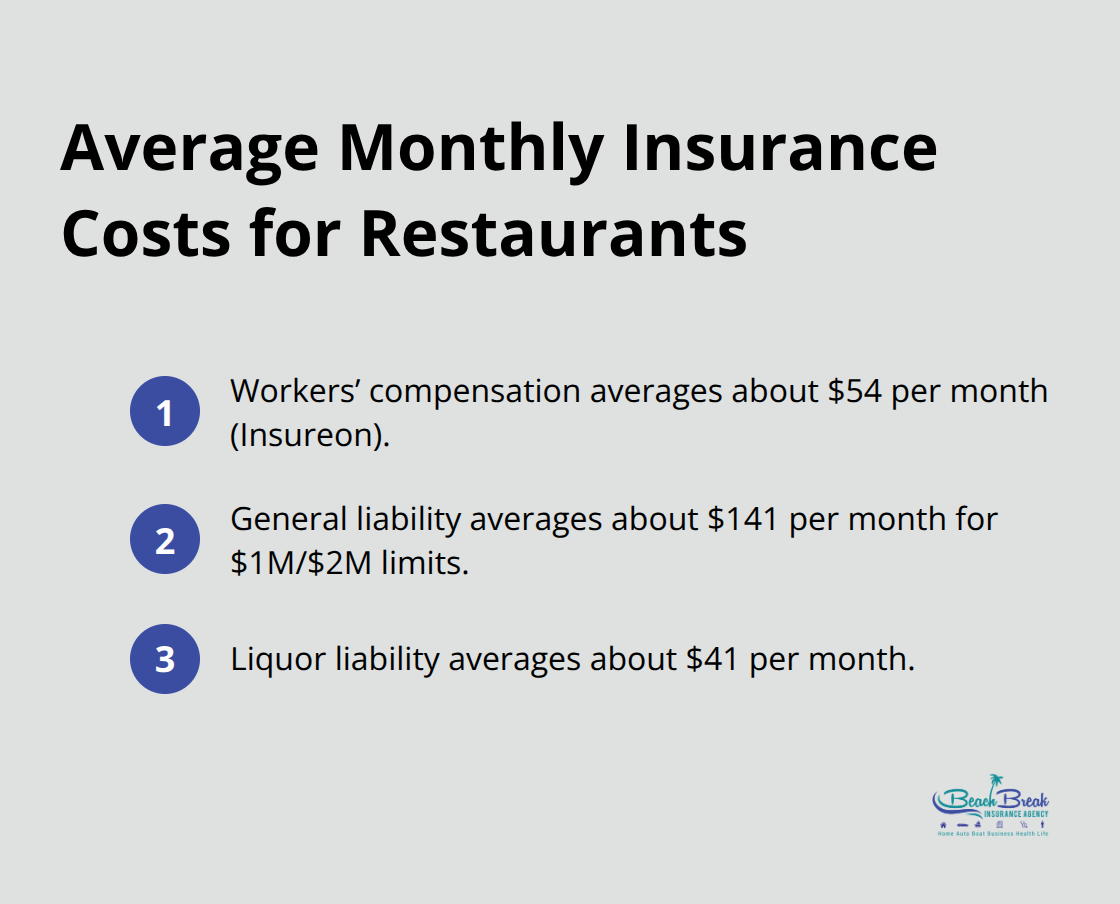
Small Business Insurance in California: What You Need to Know

Running a small business in California means navigating insurance requirements that differ from other states. Workers’ compensation is mandatory, property coverage is harder to find in fire zones, and costs keep climbing.

At Beach Break Insurance Agency, we help California business owners cut through the confusion and find coverage that actually fits their needs. This guide walks you through the insurance types you need, state-specific rules, and how to pick the right provider.

The Three Core Coverages Every California Small Business Needs

General liability, property insurance, and workers’ compensation form the foundation of business protection in California. General liability covers third-party bodily injury and property damage claims, protecting you if a customer gets hurt on your property or your work damages someone else’s assets. This coverage typically costs between $50 and $80 per month for new commercial customers, though California pricing varies significantly by industry and location. Contractors, restaurants, and manufacturers face substantially higher premiums due to elevated injury risk and claim frequency.

Diagram showing general liability, property insurance, and workers' compensation as the core coverages for California small businesses.

Property insurance protects your physical assets-buildings, equipment, inventory, and tools-against fire, theft, weather damage, and other covered perils. The cost depends entirely on your property value and regional risk; a San Francisco business might pay 30 percent more than an identical operation in Fresno due to population density and higher reconstruction costs. Workers’ compensation is mandatory in California for any business with employees, covering medical expenses and wage replacement if an employee is injured on the job. California’s workers’ compensation costs rank among the highest in the nation. Solo operators in certain high-risk trades like HVAC and tree service must carry coverage even without employees.

Why Industry Type Drives Your Actual Costs

Your insurance expenses depend heavily on what you do. Restaurants pay more because of liquor liability exposure and kitchen fire risk. Transportation and trucking operations face steep premiums from vehicle accidents and cargo exposure. Manufacturers need coverage for expensive equipment and inventory concentration, making business interruption protection especially valuable if production stops. Retail and ecommerce businesses increasingly need cyber liability coverage to address data breach and payment system risks. Construction and contracting businesses encounter higher workers’ compensation costs from jobsite injury frequency and subcontractor liability. The California Department of Insurance provides a Commercial Insurance Information Guide that helps you map your specific risk profile to necessary coverage levels and suggested limits.

Beyond the Basics: Additional Coverages That Matter

A Business Owners Policy bundles general liability and property coverage into one package, often costing 20 to 30 percent less than purchasing policies separately. This approach works well for small to mid-size businesses with owned or rented property. Professional liability (also called errors and omissions) protects service-based businesses against negligence claims and is frequently required by contracts. Cyber insurance covers data breaches and hacking costs, including investigation expenses and legal fees. Many California businesses skip cyber coverage entirely, even though customer data exposure creates real financial and legal risk. Umbrella insurance provides additional liability coverage above your standard policy limits, protecting personal assets if a major claim exceeds your underlying coverage. A single lawsuit can easily exceed standard limits of $1 or $2 million, making this protection valuable for business owners with significant personal wealth.

What Comes Next in Your Coverage Search

Once you understand what types of coverage your business needs, the next step involves comparing quotes from multiple carriers to find the right fit for your budget and risk profile.

What Makes California Insurance Different

Workers’ Compensation: A Mandatory and Expensive Requirement

California’s insurance landscape operates under rules that don’t exist elsewhere, and these rules directly affect your costs and coverage options. Workers’ compensation is mandatory for any business with employees, with no exceptions and no negotiation. The California Department of Insurance enforces this requirement strictly, and penalties for non-compliance include fines up to $10,000 per employee plus potential criminal liability. California’s workers’ compensation system costs $1.86 per $100 of payroll, ranking among the highest in the nation. A construction company with five employees earning $50,000 each will pay roughly $5,000 annually just for workers’ comp, compared to maybe $2,500 in Texas or Florida. Even solo operators in specific trades like HVAC, tree service, and roofing must carry coverage without employees, making this a non-negotiable business expense. The state imposes these requirements because California’s employment laws create elevated injury risk and litigation exposure compared to other states.

Fire Risk Reshapes Property Insurance Availability

Property insurance availability in California depends almost entirely on fire risk, and this reality reshapes your entire insurance strategy. Standard carriers have dramatically restricted coverage in high-fire zones across Northern California, the Sierra foothills, and Southern California wildland areas. If your business sits in a fire-prone region and a standard insurer denies you, the California FAIR Plan steps in as the backstop option.

Three key facts on fire risk and property insurance availability in California. - Small business insurance California

The FAIR Plan focuses exclusively on fire coverage and charges significantly higher premiums than standard policies, sometimes 40 to 60 percent above market rates for comparable coverage. However, it covers only fire, lightning, and smoke damage-not wind, theft, or water damage-making it a stripped-down safety net rather than comprehensive protection.

Finding Coverage When Standard Carriers Won’t Write

As of 2026, California has 4.3 million small businesses according to the U.S. Small Business Administration, and tens of thousands operate in areas where standard property coverage is unavailable or prohibitively expensive. We at Beach Break Insurance Agency help clients access the California FAIR Plan when standard carriers won’t write policies, and we also work with specialty carriers who still write fire coverage in high-risk zones, though at elevated rates that reflect the actual wildfire exposure. Your next step involves understanding how to compare your coverage options against your specific industry and location risks.

Picking the Right Insurer Without Wasting Time

Get Multiple Quotes Fast

Multiple quotes are non-negotiable, and the process takes far less time than most business owners expect. Online quotes for California small business insurance appear in as little as five to seven minutes, meaning you can compare three or four carriers in under 30 minutes and see real pricing differences. Industry matters tremendously here: a contractor quote from Progressive might run $200 per month while a restaurant quote from the same carrier could hit $350 for comparable coverage because risk profiles differ so sharply. Location amplifies these differences further-a San Francisco business often pays 25 to 30 percent more than an identical operation in Fresno simply due to higher reconstruction costs and population density increasing claim likelihood.

When you request quotes, provide specific information about your actual operations. Tell carriers if you have employees, what they do, your annual payroll, whether you own vehicles, and what assets you’re protecting. Vague information produces vague pricing that won’t reflect your real costs. Progressive markets itself as America’s No. 1 commercial auto insurer according to SNL Financial data from Q3 2025, and they’re worth including in your comparison if commercial vehicles are part of your operation. biBerk, part of the Berkshire Hathaway Insurance Group, offers online quotes directly without requiring a broker and claims up to 20 percent savings versus competitors, backed by 75 years of experience.

Percentage-based price differences relevant to California small business insurance. - Small business insurance California

Match Coverage to Your Actual Industry Risk

The coverage options you choose should match your actual industry risk, not some generic template. A restaurant needs liquor liability coverage because serving alcohol creates exposure that manufacturing operations never face; a manufacturer needs business interruption coverage because equipment breakdown stops production entirely, while a consulting firm loses no revenue if the office floods. The California Department of Insurance’s Commercial Insurance Information Guide provides a framework to align your specific risk profile with appropriate coverage levels rather than guessing at limits.

Evaluate Policy Flexibility for Changing Needs

After you’ve narrowed carriers down to two or three finalists, examine policy flexibility for changing needs because your business won’t stay static. If you’re planning to hire staff in the next year, confirm that your workers’ compensation coverage can expand without penalty or rate recalculation. If you’re considering adding a service vehicle, verify that commercial auto can be added mid-policy rather than forcing a renewal. Some carriers charge substantial fees for mid-term changes while others build flexibility into their standard policies.

Read the Fine Print on Exclusions and Deductibles

Read the actual policy terms, not just the marketing summary, because exclusions matter more than coverage names. A property policy that excludes equipment breakdown won’t protect your HVAC system when the compressor fails, even though you thought you had comprehensive coverage. Ask each carrier directly: what specific situations are excluded, what are your deductible options, and what happens to your premium if you file a claim (these conversations reveal whether an insurer genuinely understands your business or is simply moving quotes through a system).

Final Thoughts

Small business insurance in California requires three foundational coverages: general liability to protect against third-party claims, property insurance for your physical assets, and workers’ compensation for employee protection. Your specific industry determines which additional coverages matter most-a restaurant needs liquor liability, a manufacturer needs business interruption protection, and a consulting firm needs professional liability. Tailored coverage means matching your policy to your real operations, not to what an insurer’s standard package includes.

Location, claims history, payroll size, equipment value, and growth plans all shift what coverage makes financial sense for your business. A contractor with five employees and two service vehicles faces completely different risks than a solo consultant working from home, yet both operate under the same California insurance rules. Your insurance needs to adapt as your business changes-you’ll hire staff, add vehicles, relocate, or expand services.

We at Beach Break Insurance Agency help California small business owners compare quotes from multiple top-rated carriers and find coverage that actually fits their operations and budget. Contact us to get started with a free quote and let us handle the comparison work so you can focus on running your business.

The information provided in this blog is for general informational purposes only and does not constitute legal, financial, or insurance advice. Coverage options, terms, and availability may vary. Please consult with a licensed professional for advice specific to your situation.
Artificial intelligence may have been used to generate text and images in some blog articles.