

California Workers Comp Rates: What Small Businesses Pay
California workers comp rates can take a significant bite out of your small business budget. The good news is that your premiums aren’t set in stone-they’re based on specific factors you can actually control.
At Beach Break Insurance Agency, we’ve helped countless small business owners understand what drives their costs and find real ways to reduce them. This guide walks you through exactly how California calculates your rates and what you can do about it.
What Actually Drives Your California Workers Comp Premium
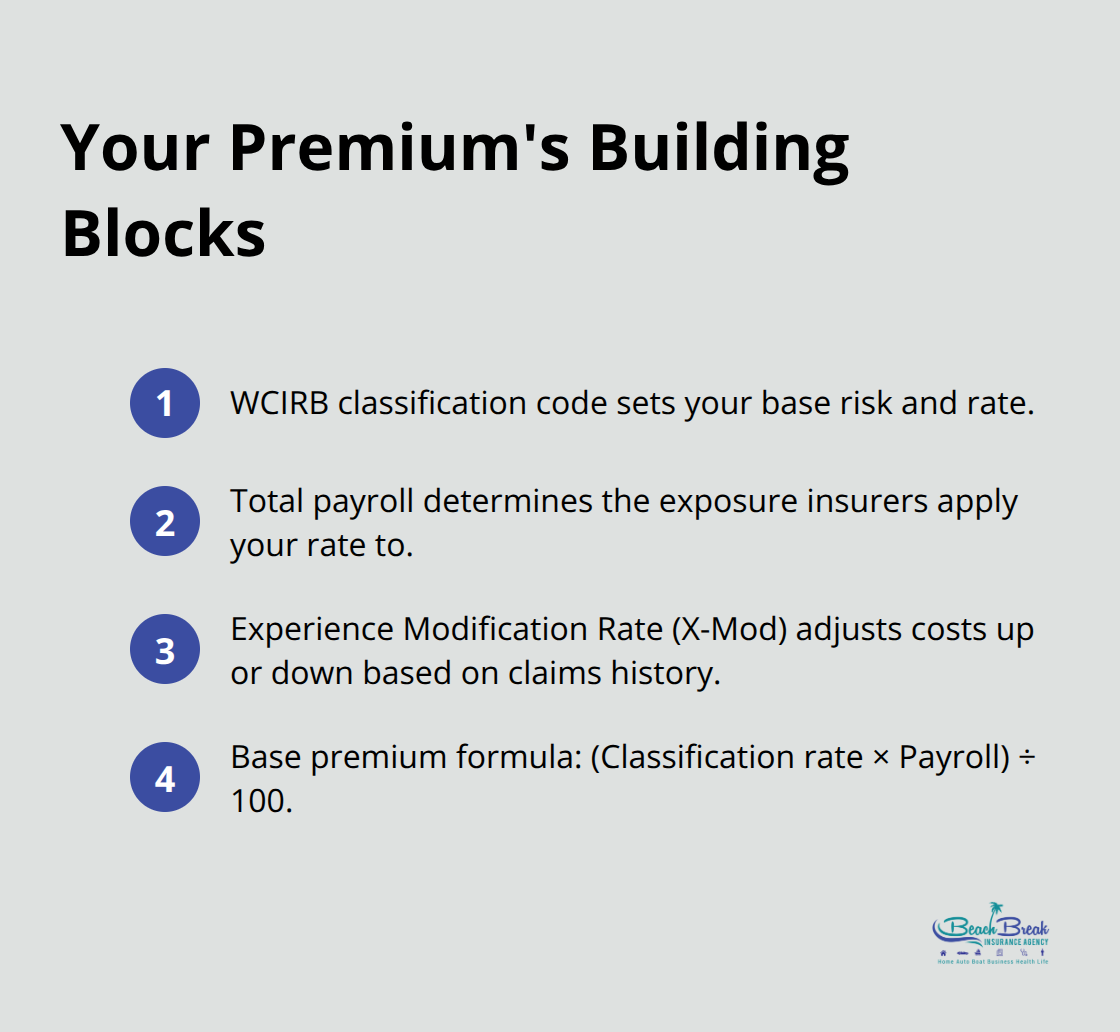
Your California workers comp premium starts with three concrete numbers: your industry classification code, your total payroll, and your experience modification rate. These aren’t theoretical-the California Department of Insurance files them and they directly determine what you pay. As of September 2025, the advisory base rate across California stands at $1.52 per $100 of payroll, but your actual rate depends entirely on your classification. A construction company pays $8 or more per $100 of payroll, while an office-based business pays $0.50. The formula is straightforward: multiply your classification rate by your total payroll divided by 100, and you get your base premium before adjustments.
Your Classification Code Sets the Foundation
The WCIRB assigns a four-digit classification code to your business based on job duties, not your industry name. Two landscaping companies with different equipment or service types fall into different codes with dramatically different rates. Misclassification ranks as one of the fastest ways to overpay-or underpay and face audit penalties. Pull your classification code from your current policy and verify it against the WCIRB’s Standard Classification System. If your employees perform multiple tasks, each task receives its own code and rate. A roofing company with office staff needs separate codes for roofers and administrative workers. Contact your insurer directly if you’re unsure about your classification; they won’t change it without cause, but they will explain how they arrived at it.
Experience Modification Rate Rewards or Penalizes Your Safety Record
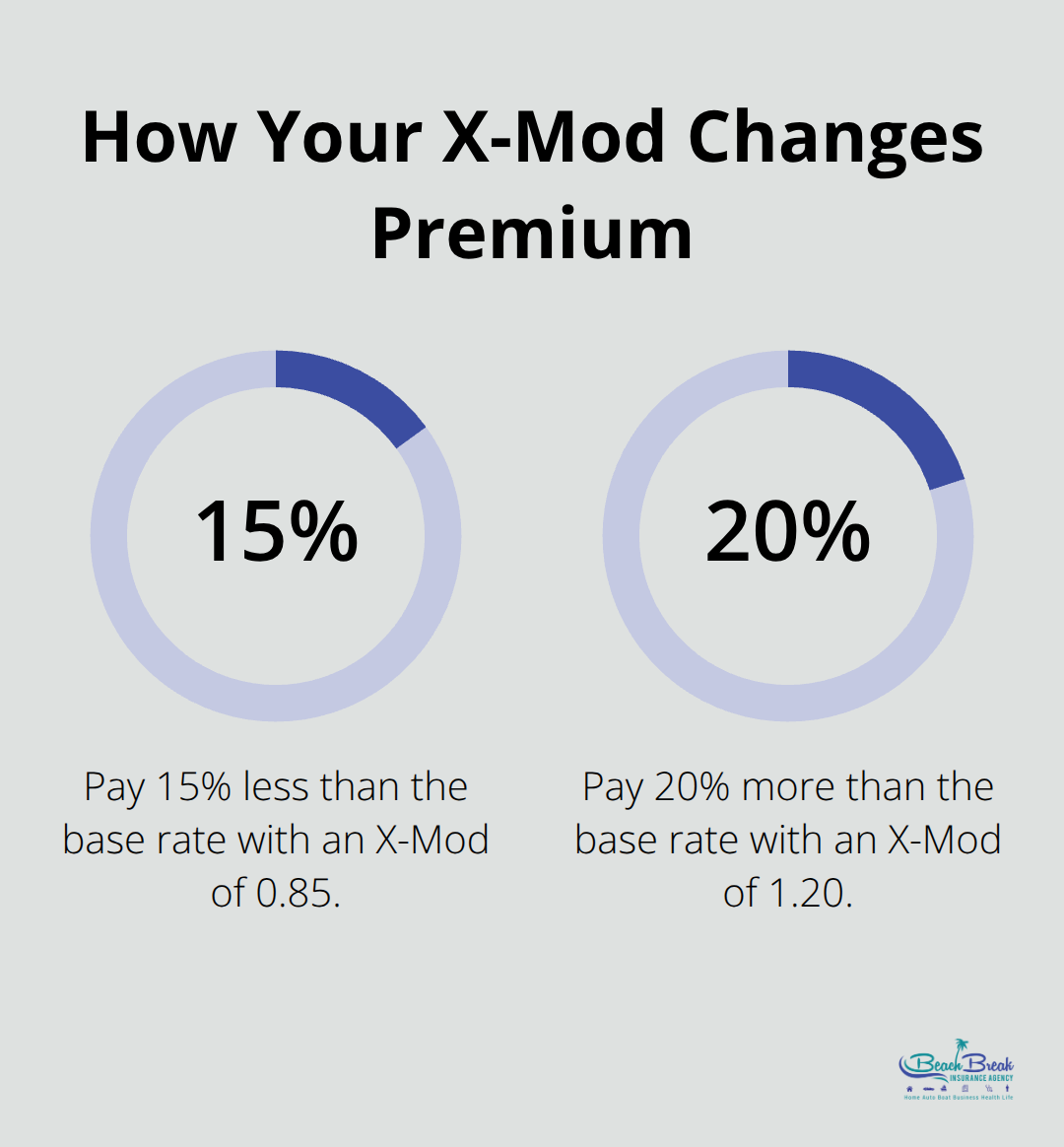
Your experience modification rate, or X-Mod, adjusts your base premium up or down based on your claims history compared to similar businesses. An X-Mod of 0.85 means you pay 15% less than the base rate because your claims outperform the average. An X-Mod of 1.20 means you pay 20% more because your claims exceed what’s typical for your classification.
The WCIRB calculates your X-Mod by comparing your actual losses to the expected losses for your classification and size. For small businesses with under $50,000 in payroll, you might not have an X-Mod yet-the WCIRB requires sufficient exposure to calculate it reliably. Once you have one, it updates annually and can shift 15% to 30% of your premium depending on your claims history. Lower losses directly reduce your X-Mod over time, making workplace safety programs a financial investment, not just a compliance requirement.
Payroll Reporting Accuracy Prevents Surprise Audits
Your payroll amount multiplied by your classification rate equals your premium-but insurers verify this with audits during and after your policy term. Underreporting payroll creates serious problems; if an insurer discovers misreporting, they adjust your premium upward, sometimes to triple your estimated amount. Keep detailed payroll records, separate employees by classification, and report accurately at renewal. Small businesses often make mistakes (classifying all employees under one code or forgetting seasonal workers in payroll projections). The insurer will audit your actual payroll records, tax filings, and job descriptions to confirm accuracy. If your business grows mid-year, your payroll estimate may fall short, triggering a significant adjustment at audit. A licensed broker or agent helps catch these issues before they become expensive problems.
What Happens Next With Your Premium
Once your classification, X-Mod, and payroll align, your insurer applies rating plans and adjustments that can further modify your final cost. These adjustments-whether credits for safety group memberships or debits for new business status-vary significantly between carriers, which is why shopping around matters. The next section walks you through the specific factors that increase or decrease your premiums and shows you where you actually have control.
What Pushes Your Premiums Up or Down
Your classification code and Experience modification rate (X-Mod) form your rate foundation, but several real-world factors either reward you with lower premiums or penalize you with higher ones. The most direct lever is your claims history. When you file a workers comp claim, that claim stays on your record for three years and directly influences your X-Mod calculation. A serious injury claim can raise your X-Mod, translating to hundreds of dollars in additional annual premium. Conversely, three years without claims moves your X-Mod downward, sometimes dramatically. A small plumbing business with zero claims over three years might see their X-Mod drop from 1.15 to 0.90, saving roughly $2,000 to $3,000 annually depending on payroll size. This is why workplace safety programs aren’t optional-they’re direct investments in your bottom line. Track near-misses, enforce equipment maintenance schedules, and document safety training. When you prevent injuries, you prevent premium increases that compound year after year.
Industry Classification Determines Your Baseline Risk
Industry classification determines your baseline risk, and certain sectors face dramatically higher rates than others. According to the WCIRB, construction and roofing classifications carry rates of $8 to $12 per $100 of payroll, while office-based classifications run $0.50 to $1.00. Food delivery and warehouse work fall in the $3 to $5 range. If your business straddles multiple classifications, your premium becomes a weighted average across all your employees’ job duties. A landscaping company with office staff, equipment operators, and ground workers pays three different rates. Review your payroll breakdown by classification annually-if you misclassify even a few employees, your premium swells unnecessarily.
Turnover and Training Shape Your Insurability
Employee turnover and training directly affect your insurability and cost. High turnover signals instability to insurers and often results in higher experience modification rates because new, less-trained workers file more claims. Businesses with stable, well-trained workforces show lower injury rates and qualify for better rates. Some insurers offer premium credits for formal safety training programs or membership in industry safety groups. A construction company that invests in OSHA 10-hour training for all field staff may receive a 5 to 10 percent premium credit, offsetting the training cost within months. Document your training investments and share them with your insurer at renewal-these programs create measurable value.
How to Identify Your Specific Cost Drivers
Your premium reflects the intersection of your classification, claims history, and operational practices. Pull your current policy and identify which classification codes apply to your workforce. Cross-reference those codes against the WCIRB’s Standard Classification System to confirm accuracy. Check your most recent X-Mod statement to see whether your modification sits above or below 1.00. If your X-Mod exceeds 1.10, your claims history costs you real money-safety improvements become urgent. If your X-Mod sits below 0.95, you’ve built a strong safety record worth protecting. Many small business owners discover they’re paying for classifications that no longer match their actual operations. A contractor who shifted from field work to project management might still carry a high-risk code. An office manager who added occasional warehouse duties might be underclassified. These mismatches create either overpayment or audit risk. Correcting them often yields immediate savings or prevents future penalties.
What Comes Next in Your Rate Strategy
Understanding what drives your premium is the first step. The next section shows you concrete strategies to lower your costs-from safety programs that reduce claims to shopping tactics that expose rate differences between carriers.
How to Actually Lower Your Workers Comp Costs
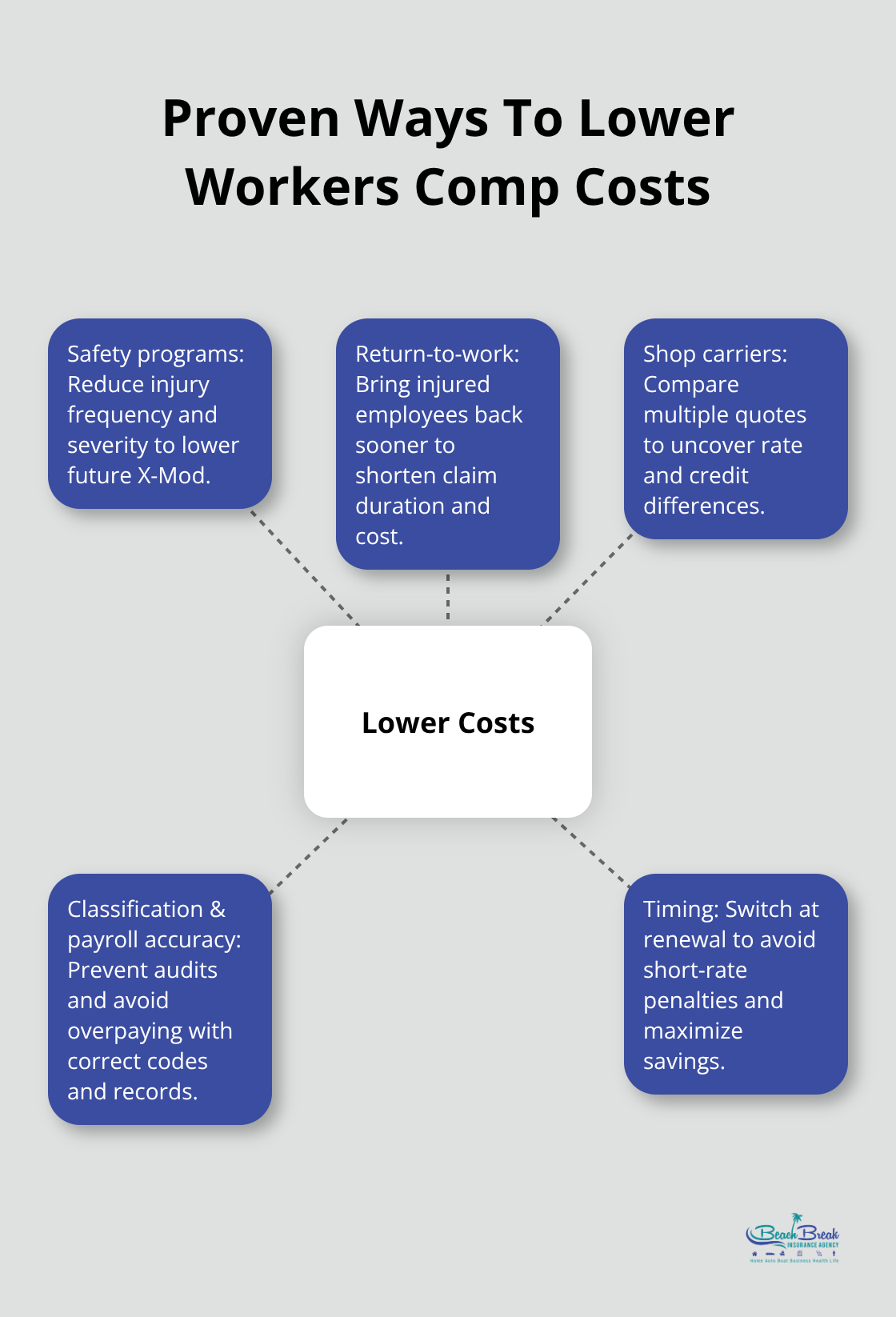
Safety programs work because they reduce the exact thing that raises your X-Mod: workplace injuries. A roofing contractor who implements daily toolbox talks, enforces fall protection protocols, and documents near-misses sees measurable results within 12 to 24 months. When claims drop, your X-Mod falls, and your premium follows. WCIRB’s data shows that businesses with formal safety programs experience measurable improvements in claims reduction compared to comparable businesses without them.
Identify Your Highest-Risk Tasks and Address Them
Start with your highest-risk tasks. If your workforce spends 60 percent of time on ladders, invest in ladder safety training and inspection schedules. If repetitive motion injuries plague your team, implement ergonomic assessments and job rotation. Some insurers offer premium credits directly for participation in industry safety groups or completion of recognized training programs like OSHA certification. Contact your insurer before launching a program and ask specifically which activities generate credits. A manufacturing business that joins a safety council and completes quarterly audits might receive a meaningful premium reduction.
Use Return-to-Work Programs to Reduce Claim Costs
Return-to-work programs create another direct savings path by getting injured employees back into productive roles faster, which reduces claim duration and severity. When an employee sustains a minor injury, offering modified duties keeps them earning wages, maintains morale, and shortens the time they draw temporary disability benefits. Document these efforts with your insurer because claim management directly influences your next X-Mod calculation. A small landscaping company that returns an injured worker to office tasks within two weeks rather than keeping them off work for six weeks demonstrates better claims management to underwriters, which can translate to rate stability or improvement at renewal.
Compare Quotes Across Multiple Carriers
Shopping for quotes exposes rate differences that often exceed 30 to 40 percent between carriers for identical businesses. California’s open rating system means each insurer sets their own rates within regulatory guidelines, creating genuine competition. Pull your four-digit classification code from your current policy and gather your most recent payroll figures and X-Mod statement. Contact at least three carriers directly or work with a broker who accesses multiple markets.
Compare the base rates they quote per $100 of payroll, but don’t stop there. Ask each carrier about available credits: safety group memberships, loss control services, preferred provider discounts, or schedule rating adjustments for businesses with strong records.
A contractor with a 0.90 X-Mod and documented safety practices might qualify for an additional 5 to 15 percent credit that another carrier won’t offer. Some insurers charge higher base rates but provide better service or more flexible claims handling. Others compete aggressively on price but have limited loss control support. For small businesses, the difference between a carrier offering proactive safety guidance and one that simply processes claims can prevent future losses.
Time Your Switch to Maximize Savings
Request quotes 60 to 90 days before your renewal date so you have time to make changes if switching saves money. Be aware that mid-term switches trigger short-rate cancellation penalties on your current policy, sometimes 10 to 15 percent of remaining premium. Compare your total out-of-pocket cost including penalties against the savings from the new carrier. A small business saving $3,000 annually but facing a $1,500 cancellation penalty still nets $1,500 in year-one savings, making the switch worthwhile. If your renewal is approaching, switching at renewal eliminates cancellation penalties entirely and gives you a clean start with a new carrier’s underwriting perspective.
Final Thoughts
Your California workers comp rates reflect three controllable factors: your classification accuracy, your claims history, and your operational practices. Classification codes determine your baseline rate, your experience modification rate rewards or penalizes your safety record, and your payroll reporting accuracy prevents expensive audits. The businesses that pay the least aren’t necessarily in low-risk industries-they’re the ones that maintain accurate classifications, invest in workplace safety, and shop aggressively across multiple carriers.
Start with your current policy and verify your classification codes match your actual job duties. Check your experience modification rate to understand whether your claims history costs you money. If your X-Mod exceeds 1.10, prioritize safety improvements because every claim reduction directly lowers your future premiums. Request quotes from at least three carriers 60 to 90 days before your renewal date, since California’s open rating system creates rate differences of 30 to 40 percent for identical businesses. Ask each carrier about available credits beyond their base rate-safety group discounts, loss control services, and schedule rating adjustments add up quickly.
Beach Break Insurance Agency helps you compare quotes from multiple top-rated carriers to find the best coverage for your workers comp needs. We identify rate differences and available credits that individual carriers won’t highlight, so you focus on running your business instead of shopping for insurance. Contact us to see how much you might save on your California workers comp rates.
The information provided in this blog is for general informational purposes only and does not constitute legal, financial, or insurance advice. Coverage options, terms, and availability may vary. Please consult with a licensed professional for advice specific to your situation.
Artificial intelligence may have been used to generate text and images in some blog articles.


