San Diego BOP Coverage: Streamlined Protection for Local Businesses

Running a small business in San Diego means protecting what you’ve built. A Business Owners Policy, or BOP, combines property, liability, and business interruption coverage into one streamlined package designed for companies like yours.

At Beach Break Insurance Agency, we’ve seen how the right San Diego BOP coverage can be the difference between a business that recovers quickly and one that struggles after an unexpected loss. This guide walks you through what you need to know to get protected.

What Your BOP Actually Covers

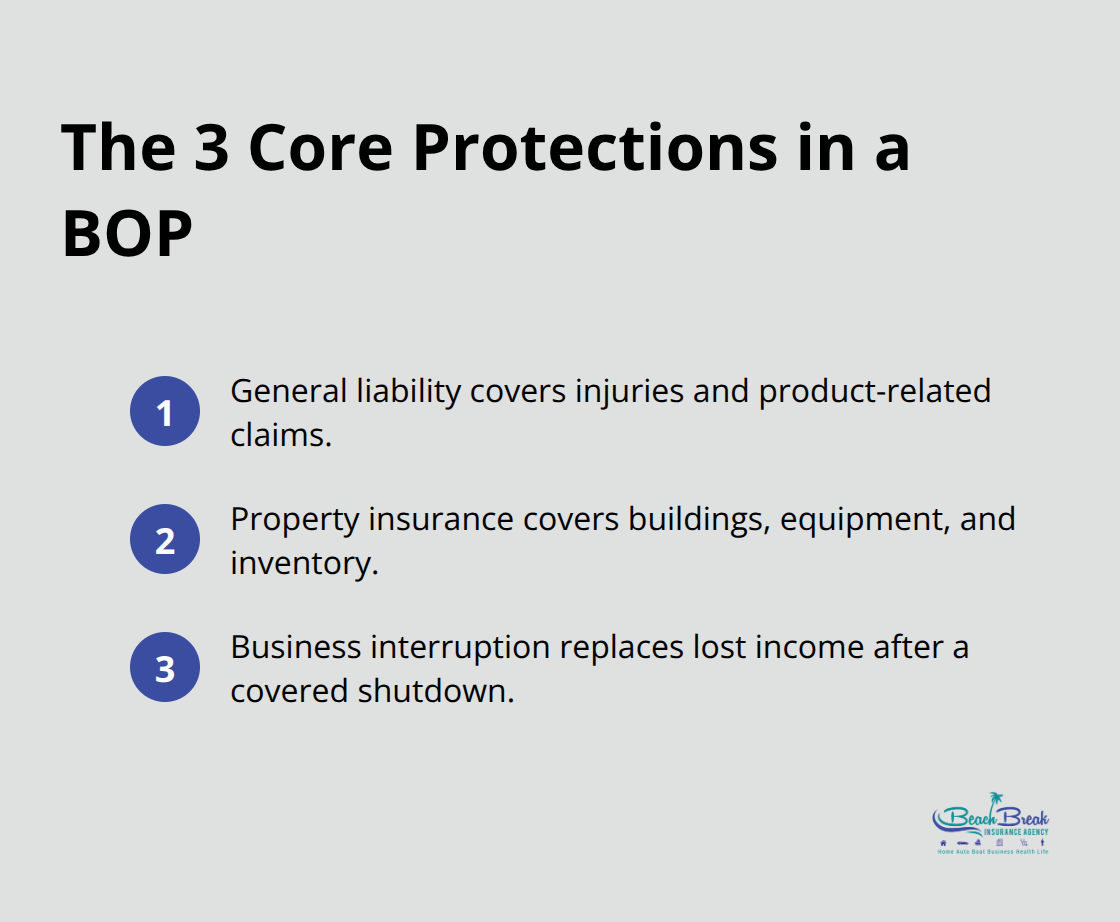
A Business Owners Policy combines three essential protections that work together to shield your San Diego operation. Property coverage protects your building, equipment, inventory, and furniture from damage caused by fire, theft, weather, and other covered perils. Liability coverage handles third-party claims when someone gets injured on your property or your business causes damage to their belongings-California commercial leases often require proof of liability protection before you can occupy the space. Business interruption coverage reimburses you for the income your business loses during a covered shutdown, including continuing fixed expenses like rent, payroll, and utilities, allowing your business to survive the financial hit while you rebuild.

Most San Diego businesses underestimate how quickly these losses add up. A single fire that closes a restaurant for two weeks costs $15,000 to $30,000 in lost revenue alone, not counting temporary repair expenses. The national median monthly cost for a new BOP runs around $80 according to Progressive Commercial data, though San Diego businesses typically pay between $50 and $150 monthly depending on property value, business type, and claims history.

Why San Diego Businesses Face Different Risks Than Other Markets

Your location creates specific exposures that inland businesses never encounter. Earthquake risk sits at the top of the list because standard BOPs explicitly exclude earthquake damage-a significant seismic event could leave you with no coverage unless you purchase an earthquake endorsement. Coastal properties face salt spray damage that corrodes metal fixtures and equipment faster than elsewhere in California. Businesses near wildfire zones must contend with smoke damage, evacuation orders, and ash accumulation that can halt operations for weeks.
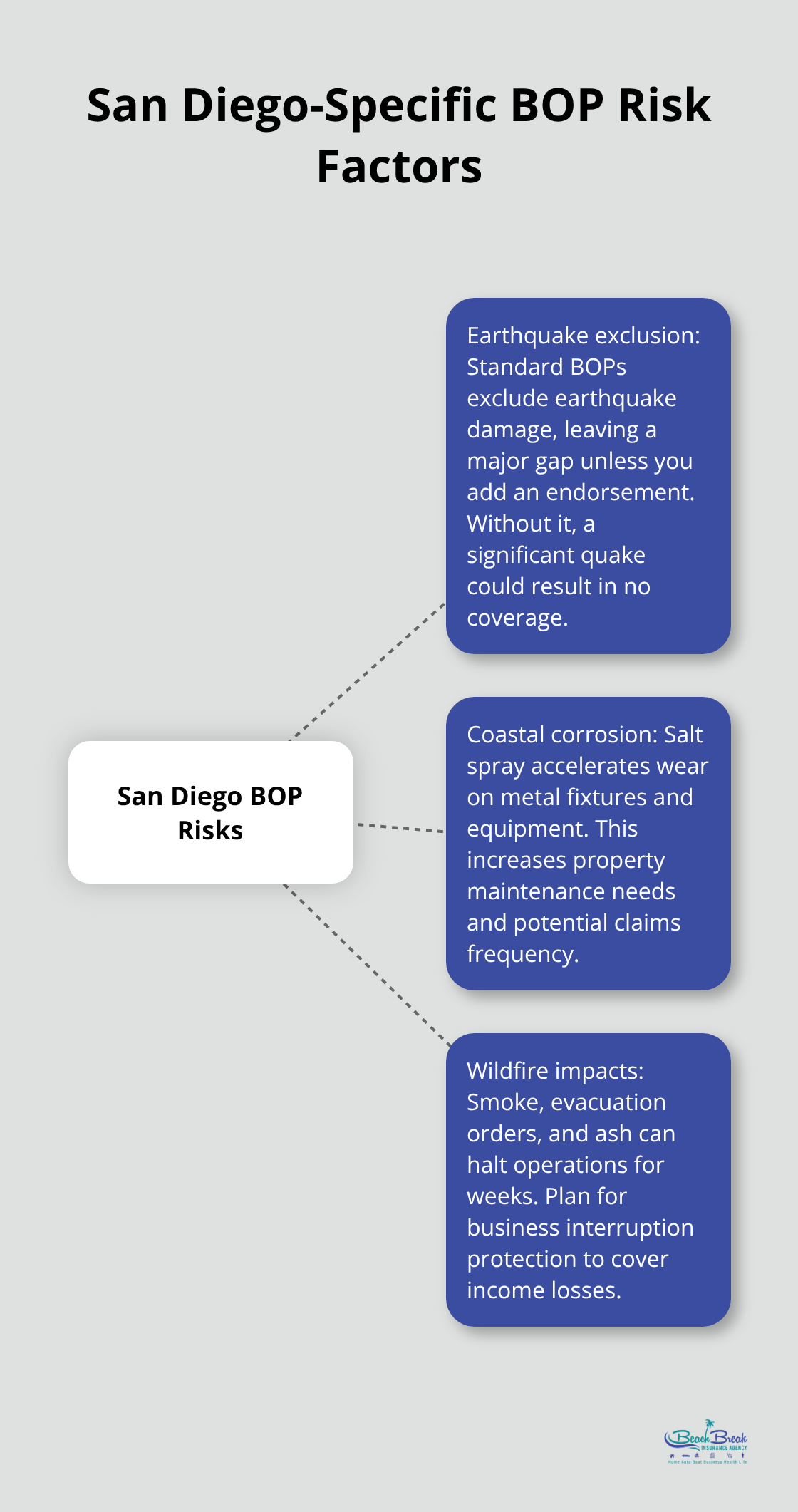
Infographic showing San Diego BOP risk factors like earthquakes, coastal corrosion, and wildfires. - San Diego BOP coverage

Property values in San Diego also tend to run higher than the national average, which means your inventory, equipment, and building improvements need adequate coverage limits to truly protect your investment. Many small business owners initially undervalue their property by 20 to 30 percent because they forget to include leasehold improvements, signage, tools stored off-site, and customer property in their possession. Accurate coverage limits from the start prevent a painful gap claim later.

How BOP Handles the Claims You Actually Face

Slip-and-fall injuries represent the most common liability coverage claim for retail and service businesses in San Diego, with settlements ranging from $5,000 to $25,000 depending on injury severity and negligence factors. Your BOP liability coverage handles the medical bills, legal defense costs, and settlement amounts when a customer legitimately gets hurt on your property.

Spoiled inventory claims hit restaurants, grocers, and food service businesses harder than most other industries, especially when equipment breakdowns or power outages destroy perishable stock. An equipment breakdown endorsement attached to your BOP costs roughly 10 to 15 percent more but protects against these scenarios that standard property coverage sometimes excludes.

Data breach claims have exploded across San Diego’s tech and professional services sectors, with notification costs alone running $5,000 to $15,000 per incident according to California data breach notification requirements. A cyber liability endorsement attached to your BOP fills this gap and covers breach notification, credit monitoring services, and public relations expenses when customer information gets compromised.

Assessing What Your Business Actually Needs

The right BOP starts with an honest evaluation of your assets and exposures. Your property value determines your coverage limits-underinsuring leaves you exposed, while overinsuring wastes premium dollars. Your industry shapes your liability risk profile; a consulting firm faces different exposures than a retail shop or restaurant. Your current policy may already cover some protections, or it may leave significant gaps that a BOP can address more efficiently than separate policies.

An independent agent can walk you through these factors and help you identify which endorsements make sense for your specific operation, ensuring your coverage actually matches your business rather than forcing you into a one-size-fits-all package.

How to Assess Your Business’s BOP Needs

Calculate Your Actual Property Value

Most San Diego business owners undercount what they own. You need to list everything your business would have to replace: the building itself if you own it, all equipment and machinery, inventory, furniture, signage, tools, and any leasehold improvements you’ve made to a rented space. Custom-built reception desks, upgraded flooring, or specialized shelving represent real dollars that need coverage, yet many owners overlook these items entirely. Walk through your space with a notebook and photograph everything, then obtain replacement cost quotes for major items. If you own the building, contact your property tax assessor’s office for the assessed value, though this typically runs lower than actual replacement cost in San Diego’s current market. For rented spaces, pull your lease document-it usually specifies what improvements you’ve made-and add those costs to your equipment list. Undervaluing property by even 20 percent triggers a coinsurance penalty when you file a claim, since most carriers reduce payouts proportionally when you haven’t insured to value. Businesses that properly value their assets experience claim payouts covering full losses, while underinsured businesses face out-of-pocket costs averaging 15 to 30 percent of the claim amount.
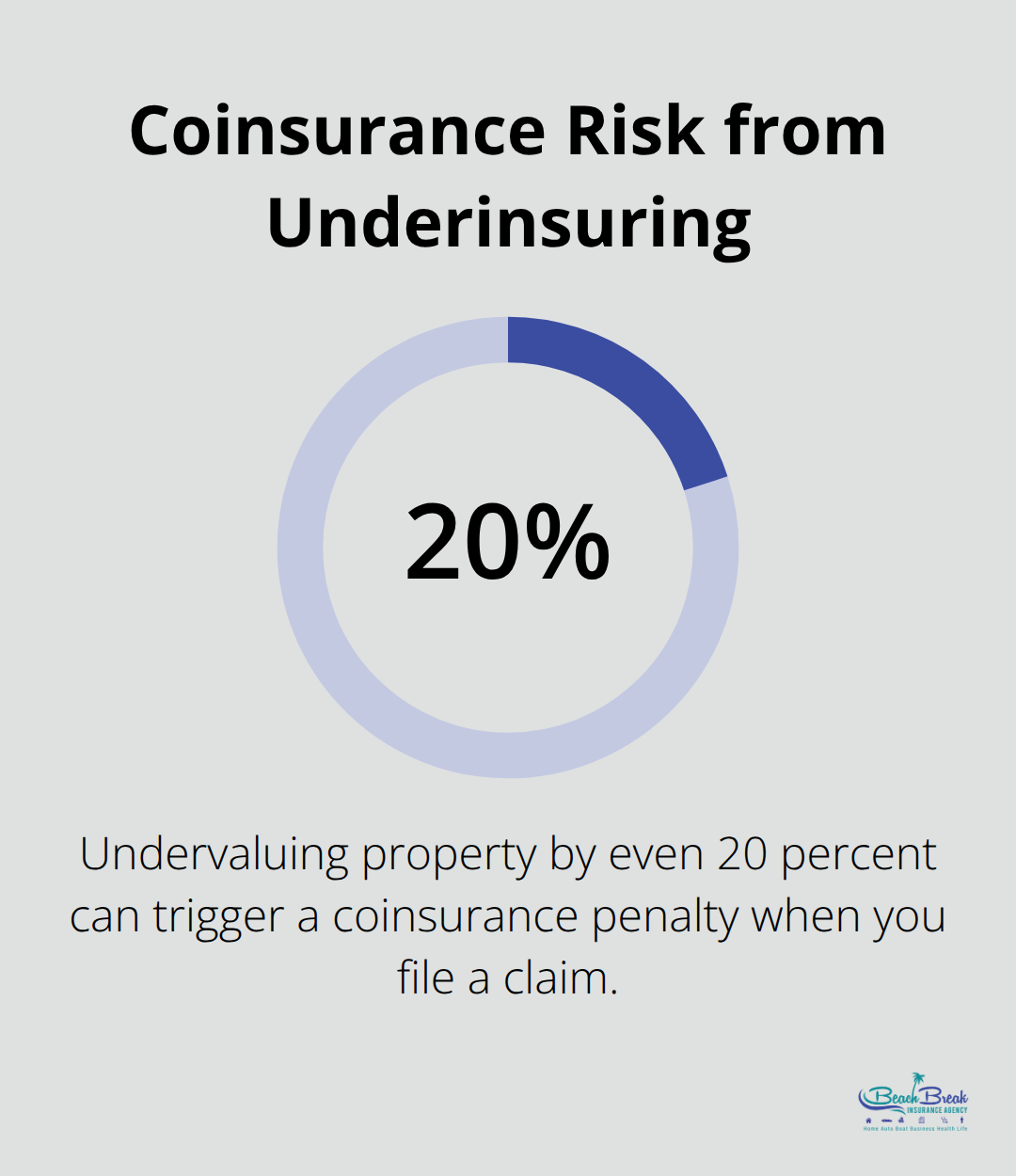
Chart highlighting that undervaluing property by 20% can trigger a coinsurance penalty. - San Diego BOP coverage

Identify Your Liability Exposure by Industry

Your liability exposure depends entirely on what your business does and who enters your space. A retail shop faces slip-and-fall risks and product liability claims, while a consulting firm’s main exposure comes from professional errors that damage a client’s business. A restaurant combines slip-and-fall risk with food poisoning exposure and liquor liability if you serve alcohol. Ask yourself what could realistically go wrong and what it would cost if someone sued. California requires minimum auto liability limits of $30,000 per person and $60,000 per accident for commercial vehicles, but San Diego businesses operating in higher-income areas often face settlements that exceed these minimums significantly.

Spot Coverage Gaps in Your Current Policy

Coverage gaps appear when your current policy excludes something your industry regularly encounters. If you operate near the coast, corrosion damage from salt spray isn’t typically covered under standard property policies without an endorsement. If you handle customer data, a standard BOP lacks cyber liability coverage entirely, yet California data breach notification laws require you to notify affected residents at your own expense. If equipment breakdowns would halt your operations, standard property coverage sometimes excludes this scenario unless you add business interruption with equipment breakdown protection. Pull your current policy declarations page and list exactly what coverages you have, then compare that against the specific risks your operation faces. An independent agent can help you spot these gaps quickly rather than discovering them during a claim.

Compare Your Current Coverage Against Real Risks

The honest assessment requires matching what you own and what could go wrong against what your policy actually covers. Coastal properties face salt spray damage that corrodes metal fixtures and equipment faster than elsewhere in California. Businesses near wildfire zones must contend with smoke damage, evacuation orders, and ash accumulation that can halt operations for weeks. Standard BOPs explicitly exclude earthquake damage-a significant seismic event could leave you with no coverage unless you purchase an earthquake endorsement. Property values in San Diego tend to run higher than the national average, which means your inventory, equipment, and building improvements need adequate coverage limits to truly protect your investment.

Take Action on Your Coverage Assessment

Once you’ve identified your property value, liability exposure, and coverage gaps, you’re ready to explore BOP options that actually match your business. An independent agent can walk you through these factors and help you identify which endorsements make sense for your specific operation, ensuring your coverage matches your business rather than forcing you into a one-size-fits-all package. At Beach Break Insurance Agency, we quickly compare quotes from multiple top-rated carriers to deliver tailored coverage that aligns with your actual needs and budget.

Finding the Right BOP Without Overpaying

Compare Quotes Across Multiple Carriers

Bundling policies with a single carrier typically saves San Diego small businesses between 10 and 25 percent on their total premium costs, according to Progressive Commercial data. If you already carry commercial auto or another business policy, adding a BOP to that same carrier often triggers automatic discounts that compound your savings. However, this bundling advantage only works if the carrier’s BOP pricing remains competitive for your specific industry and property profile.

Many San Diego business owners assume their current insurance provider offers the best BOP rates, then skip the comparison step entirely and leave hundreds of dollars annually on the table. The smarter approach involves requesting quotes from at least three different carriers before making a decision, since BOP pricing varies dramatically based on how each insurer assesses your particular risk. A restaurant owner might find Hartford’s rates significantly lower than Progressive’s, while a consulting firm sees the opposite pricing pattern.

Progressive Commercial underwrites over 300 business types and quotes online instantly, making initial comparison shopping fast and painless. Independent agents in San Diego represent multiple carriers including Nationwide, Hartford, Next, and Progressive, which means they can pull quotes from several companies simultaneously rather than forcing you to contact each carrier separately. This independent agent advantage saves you hours of phone calls and ensures you’re comparing apples to apples across similar coverage limits and deductibles.

Customize Coverage Limits to Match Your Operation

Customizing your BOP requires matching coverage limits and endorsements to your actual business size and risk profile rather than accepting whatever package the carrier suggests. A 2,000-square-foot retail shop needs vastly different property limits than a 10,000-square-foot warehouse, yet both might receive the same standard BOP template if you don’t push back during the quoting process.

Equipment breakdown endorsements typically cost 10 to 15 percent more than standard coverage but become essential if your operation depends on HVAC systems, refrigeration, or specialized machinery. Cyber liability endorsements run roughly $300 to $500 annually and should be non-negotiable for any San Diego business handling customer payment information or personal data. Earthquake endorsements cost 15 to 20 percent additional premium but prove invaluable given San Diego’s seismic activity, while flood coverage requires a completely separate policy since no BOP includes this protection.
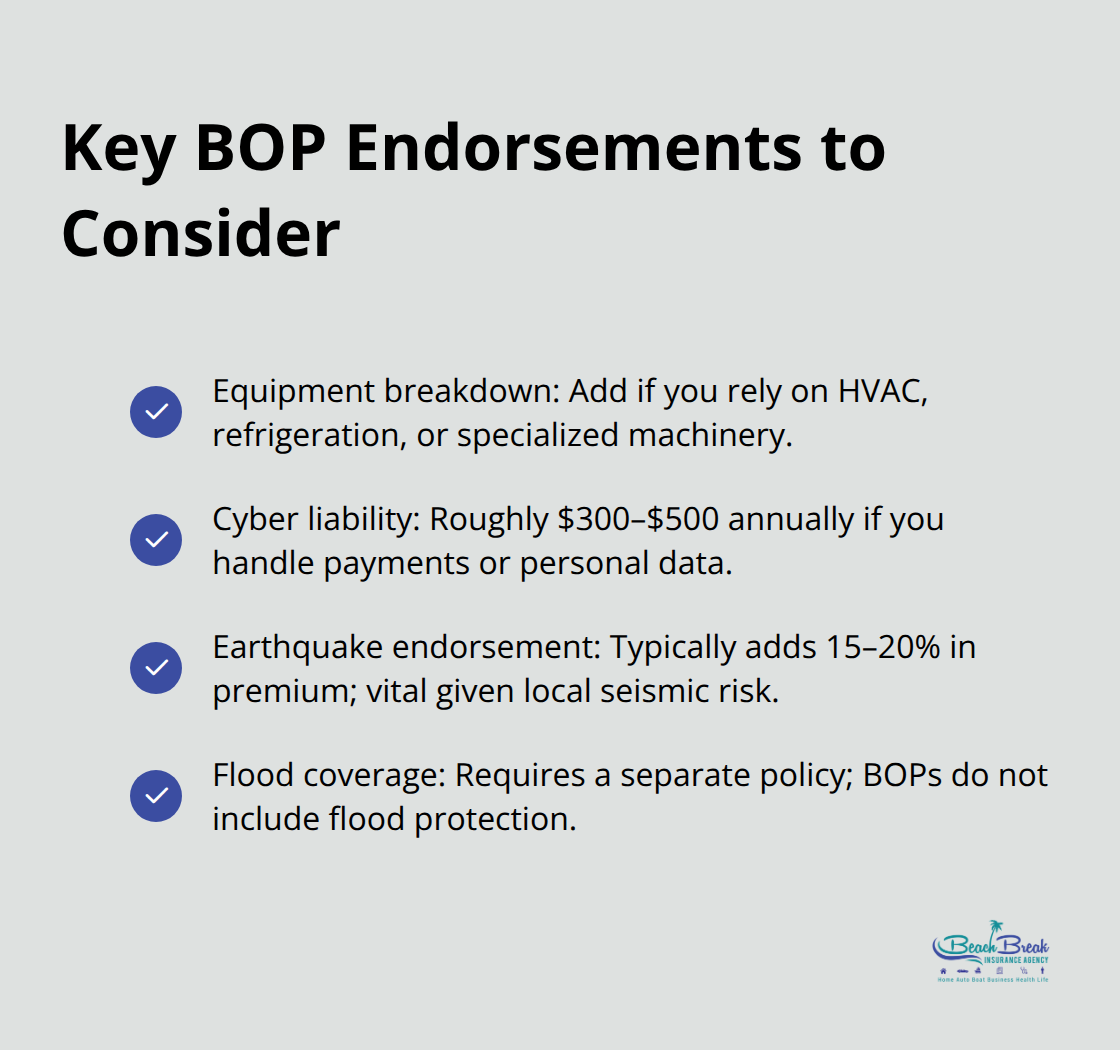
Checklist of important BOP endorsements and notes for San Diego businesses.

Adjust Your Deductible Strategy

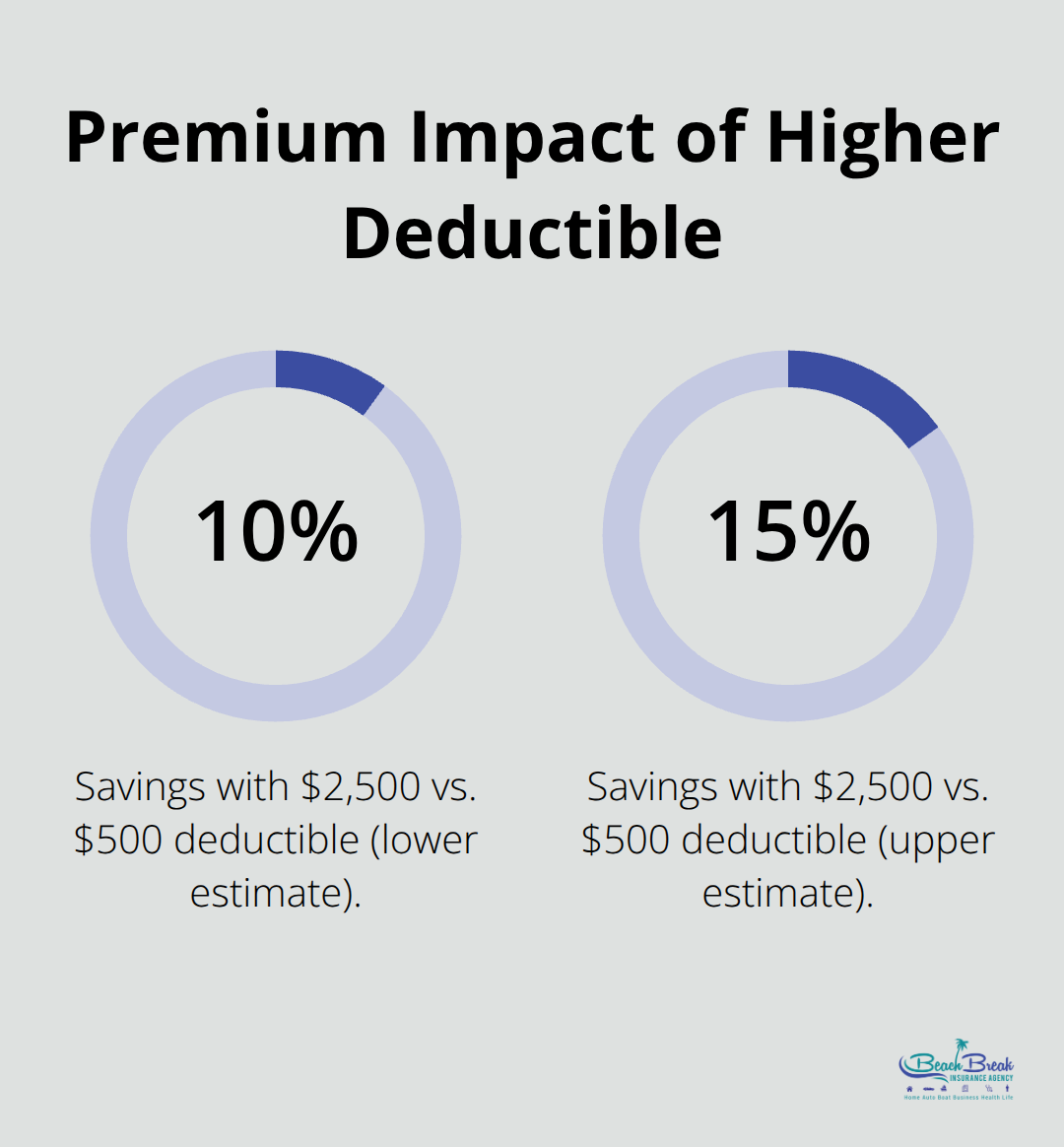
Your deductible choice directly impacts your monthly premium, with higher deductibles like $2,500 or $5,000 reducing costs by 20 to 30 percent compared to standard $1,000 deductibles. This strategy only makes sense if you can actually afford the higher out-of-pocket cost when a claim occurs. Test different deductible levels and endorsement combinations to find the sweet spot where coverage remains comprehensive without wasteful premium spending.

Final Thoughts

San Diego BOP coverage protects your business only when you match it to your actual needs. The businesses that recover fastest after a loss took time upfront to calculate their property value accurately, identify their liability exposure honestly, and close coverage gaps before disaster strikes. Skipping this assessment costs money twice over: first through inadequate coverage that leaves you exposed, then through claim denials when you discover what your policy excludes.

Your next step is straightforward-pull together your property inventory, review your current policy declarations page, and list the specific risks your industry faces. Then request quotes from multiple carriers using consistent coverage limits and deductibles so you can compare pricing fairly. This comparison process typically takes a few hours but saves hundreds or thousands annually while ensuring your coverage actually protects what you’ve built.

At Beach Break Insurance Agency, we compare quotes from multiple top-rated carriers to deliver tailored San Diego BOP coverage that aligns with your actual needs and budget. We help you avoid both underinsurance that leaves you exposed and overinsurance that wastes premium dollars. Contact us today to get started on coverage that protects your business without the complexity.

The information provided in this blog is for general informational purposes only and does not constitute legal, financial, or insurance advice. Coverage options, terms, and availability may vary. Please consult with a licensed professional for advice specific to your situation.
Artificial intelligence may have been used to generate text and images in some blog articles.
Restaurant Workers Comp: What Restaurant Owners Need to Know

Running a restaurant means managing countless moving parts, and worker safety is one of the most important. Restaurant workers comp isn’t just a legal requirement in California-it’s your safety net when injuries happen.

At Beach Break Insurance Agency, we’ve seen how the right coverage protects both your team and your bottom line. This guide walks you through what you need to know to keep your restaurant compliant and your workers protected.

What California Restaurants Must Carry for Workers Comp

California’s workers comp system leaves no room for negotiation. If you operate a restaurant in California and have even one employee on your payroll, you must carry workers compensation insurance. The state enforces this mandate strictly, and the penalties for non-compliance are severe. Uninsured employers face significant fines, plus potential criminal charges and civil liability for workplace injuries. This isn’t a gray area where you can cut corners or wait until something happens. You need coverage active before your first employee starts their shift.

Who counts as an employee for coverage purposes

The classification question trips up many restaurant owners because it determines whether someone needs to be covered. California has specific rules about who qualifies as an employee versus an independent contractor, and the state applies these rules aggressively. Owners, partners, and officers of corporations or LLCs can often exclude themselves from coverage, but you need proper documentation to prove their status. All other workers on your payroll must be covered, regardless of whether they work full-time, part-time, or seasonally. The California Labor Commissioner uses the ABC test to determine employment status, which means if a worker fails any part of the test (they’re under your control, they perform work integral to your business, or they lack an independent business), the state classifies them as an employee who needs coverage. Many restaurants misclassify kitchen staff, servers, or dishwashers as independent contractors to save money, but this exposes you to massive liability and back-payment obligations if the state audits you.

Coverage limits that protect your restaurant

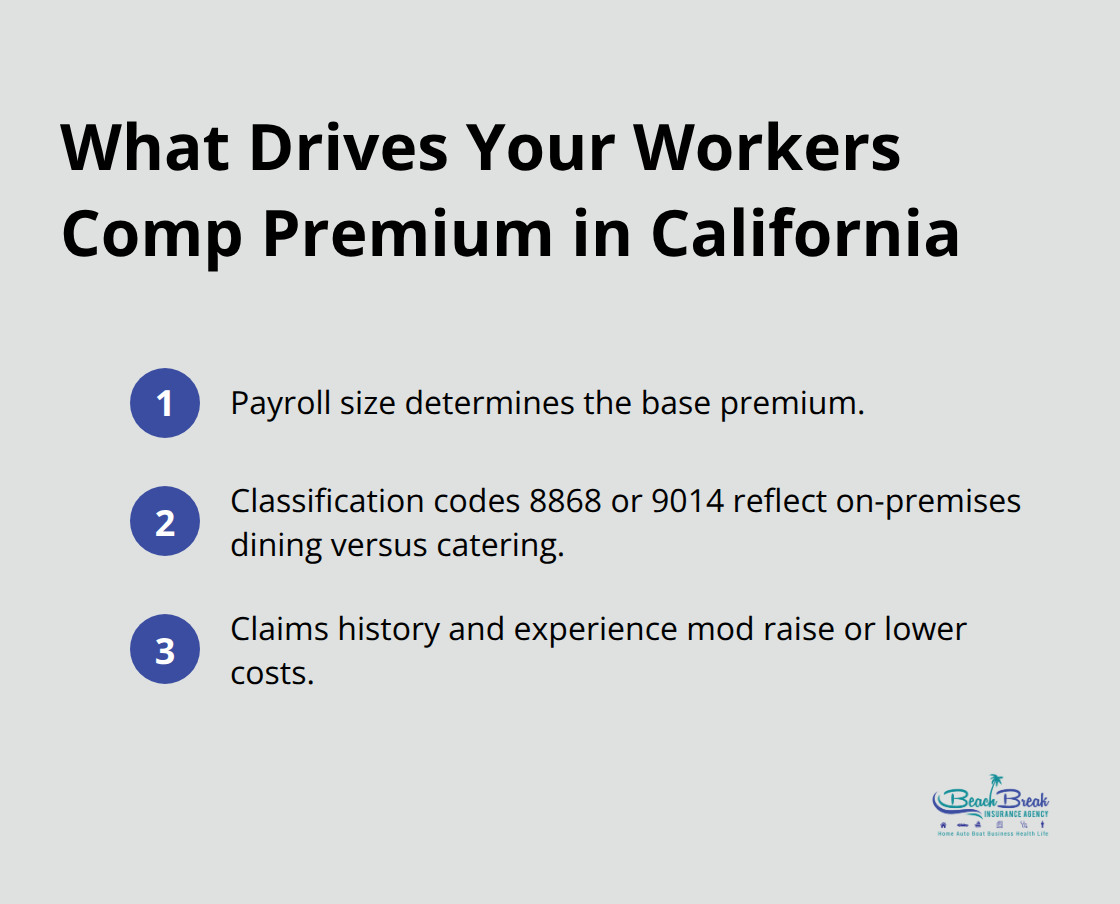
California doesn’t allow you to set your own coverage limits for workers comp. The state determines benefit levels based on the worker’s average weekly wage at the time of injury. Medical expenses have no monetary cap, which means your insurance covers all necessary treatment for a work-related injury. Temporary disability benefits replace a portion of lost wages while the worker recovers, and permanent disability benefits apply if the injury causes lasting damage. Death benefits go to the worker’s dependents if a workplace fatality occurs. Your insurance premium depends on your payroll, your industry classification code, and your claims history. Restaurants typically fall into classification codes 8868 or 9014, depending on whether you primarily serve food on-premises or handle catering operations. These codes carry higher premiums than many other industries because restaurant work involves significant injury risk.

Key factors that determine California restaurant workers comp premiums

Your actual cost depends on your specific operation and past claims.

What happens next with your coverage

Once you understand these requirements, the next step involves identifying which injuries occur most frequently in your operation. Restaurant workers face specific hazards that differ from other industries, and knowing these risks helps you prepare your team and your insurance strategy.

Why Restaurant Injuries Cost More Than You Think

Restaurant work carries injury rates that outpace most other industries. The Bureau of Labor Statistics reports that food service workers experience 5.9 injuries per 100 full-time workers annually, compared to 3.5 across all private industries. This gap matters because each injury raises your workers comp premiums, increases your experience modification rate, and disrupts your operations.

Slips, Falls, and Burns Lead the Injury List

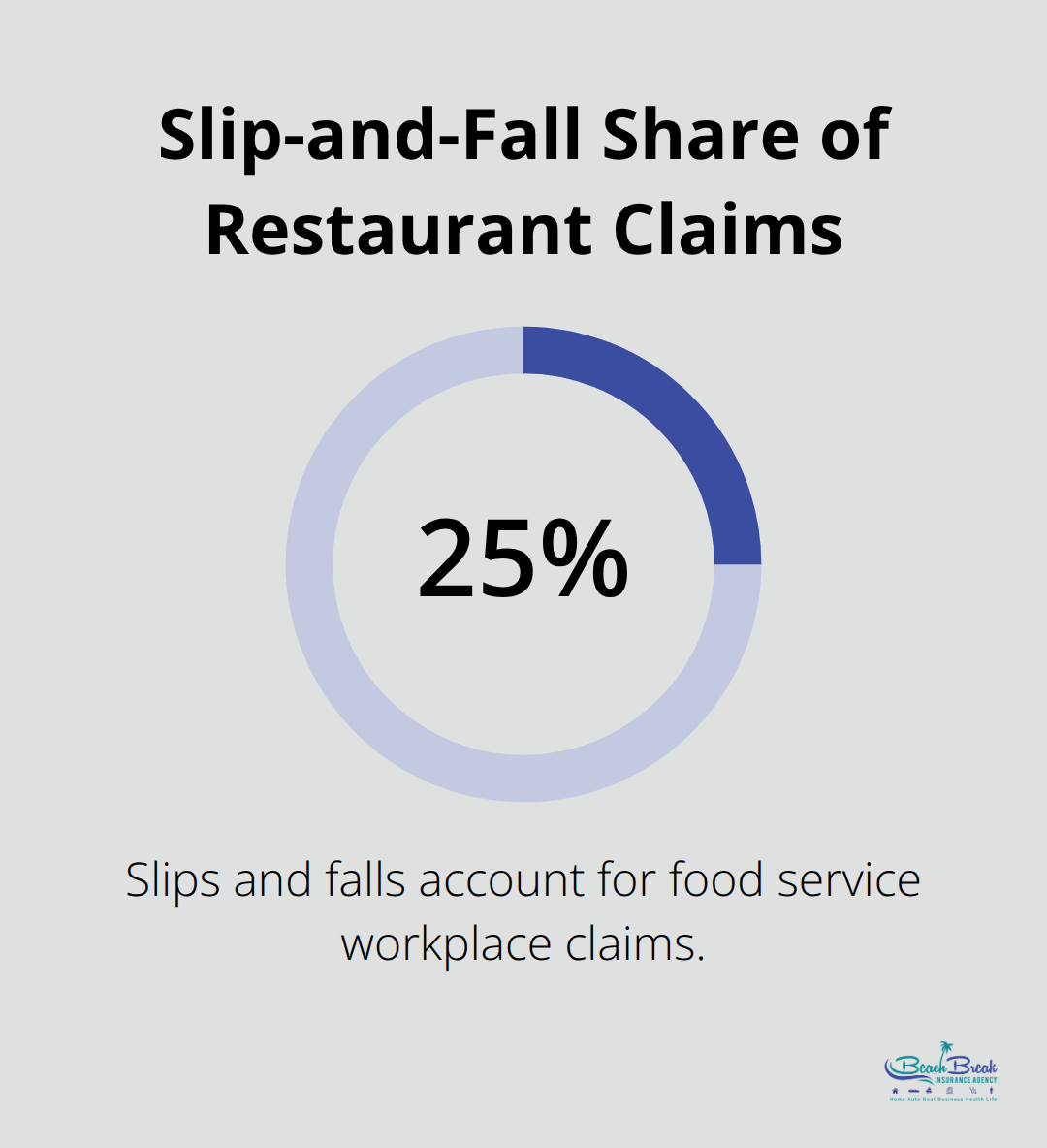
Slips and falls dominate the injury landscape in restaurants, accounting for roughly 25% of all workplace claims in food service. These incidents happen on wet kitchen floors, in walk-in coolers, and near prep stations where speed and multitasking create hazards. A single slip that fractures an ankle can sideline a server or line cook for weeks, forcing you to hire temporary staff or ask remaining workers to cover shifts.

Percentage of restaurant workplace claims caused by slips and falls

Burns represent the second major category, particularly among kitchen staff working near fryers, grills, and hot surfaces. Most burn injuries occur when workers move quickly between stations or when someone bumps into a colleague holding hot pans or liquids. Thermal burns account for a significant portion of hospitality-related emergency room visits.

Back Injuries and Repetitive Strain

Back injuries and repetitive strain develop more slowly but cause longer absences. Cooks lift heavy stock pots, servers carry full trays, and dishwashers stand for eight-hour shifts, all facing cumulative stress on their lower backs and shoulders. These injuries often result in chronic pain that keeps workers out for months or forces them into lighter-duty roles, reducing your kitchen’s capacity.

Cuts and lacerations round out the major injury types, stemming from knife work, broken glass, and sharp edges on equipment. While many cuts seem minor in the moment, infections and nerve damage can turn a small laceration into a significant claim.

Prevention Strategies That Lower Your Costs

Installing non-slip flooring in high-traffic areas reduces fall claims substantially, and commercial kitchens with proper drainage and regular floor maintenance see fewer incidents. Organizing your prep stations to minimize reaching and twisting cuts repetitive strain claims. Providing proper training on knife skills and knife handling, along with requiring cut-resistant gloves during prep work, reduces laceration frequency.

Kitchen equipment maintenance matters too because worn handles, loose parts, and malfunctioning safety guards increase injury risk. Many restaurants skip regular equipment inspections, but catching a fryer’s broken thermostat before someone gets burned saves money and prevents suffering. Staffing levels directly influence injury rates as well-understaffed shifts push workers to move faster and take shortcuts, multiplying accident risk.

Using Your Claims Data to Drive Improvements

When you track your own claims history, patterns emerge about when and where injuries occur most frequently. This data becomes valuable when you work with your insurance provider to identify specific improvements that reduce your premiums over time. Your experience modification rate (the factor that adjusts your base premium up or down based on claims history) responds directly to injury prevention efforts. Carriers reward restaurants that demonstrate commitment to safety through documented training programs, equipment maintenance logs, and incident response procedures. Understanding which injuries plague your operation most frequently allows you to target your prevention efforts where they matter most. The next step involves building a comprehensive safety program that addresses these specific hazards and protects your team from day one.

Reducing Restaurant Workers Comp Costs Starts With Prevention

The best way to lower your workers comp premiums isn’t waiting for injuries to happen and then managing claims. Stop injuries before they occur through deliberate, measurable prevention programs. Restaurants that implement structured safety training see injury rates drop by 20-30% within the first year, according to data from the National Safety Council. This matters because your experience modification rate directly ties to your claims history, meaning fewer injuries translate into lower premiums within 12-24 months. Restaurant owners who reduce their experience mod from 1.15 to 0.85 through consistent safety efforts cut their annual premiums by thousands of dollars. The investment in prevention pays back quickly when you measure it against the true cost of a single serious injury claim.

Kitchen design and layout prevent injuries before they start

Your physical kitchen layout either works for you or against you when it comes to injury prevention. Restaurants with cluttered walkways, poorly organized prep stations, and inadequate spacing between work areas generate more slip, fall, and strain injuries than those with deliberate design. Start by measuring your high-traffic zones and remove obstacles that force workers to navigate around equipment or supplies. Wet floors cause most slip-and-fall incidents, so install commercial-grade non-slip flooring in areas where water accumulates, particularly near dishwashing stations and under ice machines. The upfront cost of non-slip flooring typically ranges from $8-15 per square foot, but one prevented ankle fracture claim worth $15,000-40,000 justifies the investment immediately.

Next, organize your prep stations so workers access frequently used items at waist height rather than bending or reaching overhead. This simple change cuts repetitive strain claims significantly because it removes the cumulative stress that builds up across dozens of shifts. Position your fryers, grills, and hot surfaces away from main traffic pathways so workers carrying hot liquids or pans don’t collide with colleagues moving through the kitchen. Many restaurant injuries happen when someone bumps into a coworker holding something dangerous, and thoughtful spacing prevents this entirely.

Training programs need specificity and regular reinforcement

Generic safety training accomplishes almost nothing because workers tune out abstract concepts that don’t connect to their actual job. Conduct monthly safety huddles focused on the specific injuries your restaurant experiences most frequently. If your claims data shows that back injuries dominate, spend 15 minutes teaching proper lifting technique for stock pots and cases of supplies, then have workers demonstrate the technique. If burns rank high, walk through the specific near-miss incidents that almost happened during the previous month and discuss what went differently.

Safety training works best when it’s job-specific and repeated regularly rather than delivered once during onboarding. Document these training sessions with attendance sheets and brief notes about what was covered because this documentation becomes valuable when you work with your insurance carrier to demonstrate your safety commitment and potentially earn premium discounts. New employees should receive kitchen-specific safety training within their first week, not buried in generic HR materials. Show them exactly where hazards exist in your kitchen, how to move safely on wet floors, proper knife handling for your specific equipment, and what to do when they witness a near-miss or injury.

Incident reporting and data tracking reveal patterns

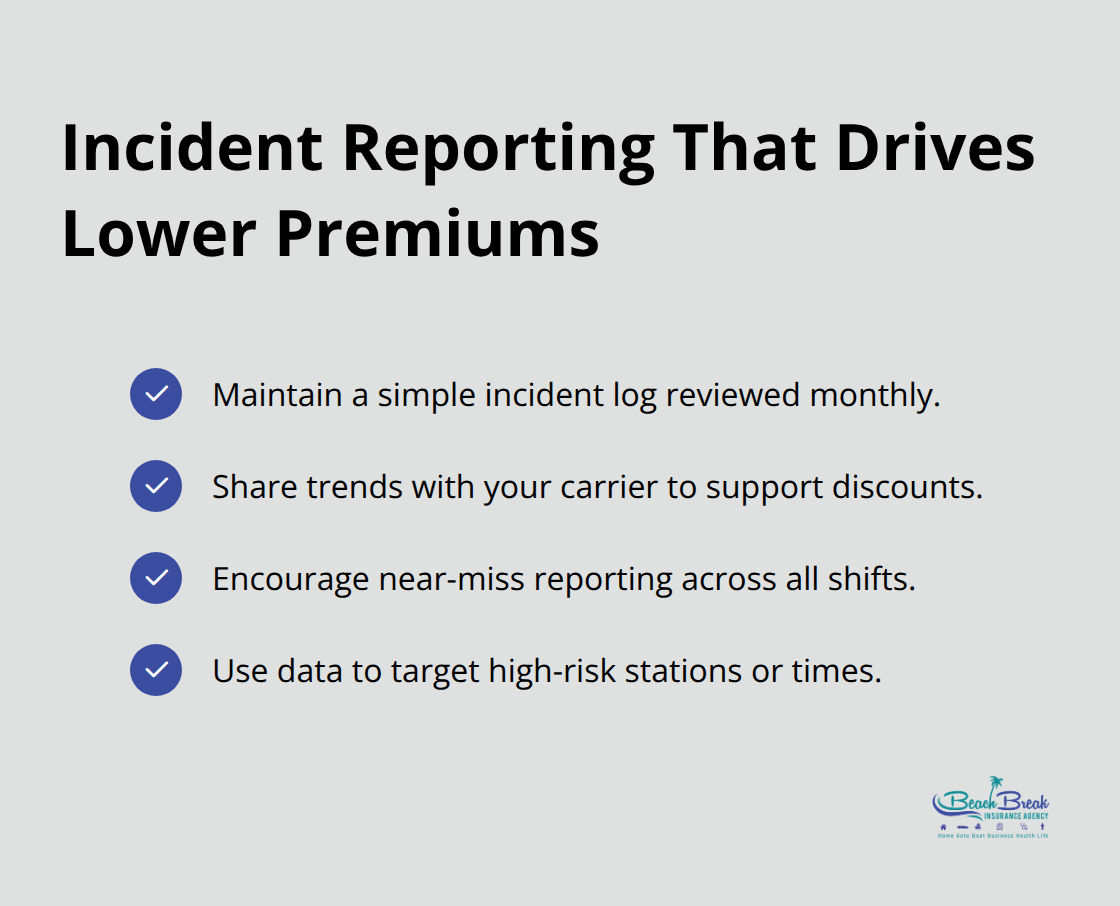
Most restaurants respond to injuries reactively, treating each incident as isolated rather than part of a pattern. Create a simple incident log that captures when, where, and how each injury occurred, then review this log monthly to identify trends. If you notice that Friday nights generate twice as many injuries as other shifts, understaffing is likely the culprit.

Checklist of reporting practices that reduce restaurant workers comp costs

If most cuts happen at a specific prep station, that equipment might have a design flaw or maintenance issue. This data becomes your roadmap for targeted prevention.

When you report this information to your insurance carrier, they see a restaurant owner actively managing risk, which influences their willingness to offer premium discounts or better terms at renewal. Near-miss reporting matters equally because it catches hazards before someone gets hurt. Train your team to report when they almost slipped, nearly cut themselves, or narrowly avoided a burn. These near-misses reveal exactly where your prevention efforts should focus next, and they happen far more frequently than actual injuries, giving you abundant data to work with.

Final Thoughts

Restaurant workers comp protects your team and your business, but only when you treat it as an active priority rather than a checkbox item. Prevention directly reduces your claims, lowers your experience modification rate, and cuts your annual premiums substantially. Start by reviewing your claims history to identify which injuries plague your operation most, then target your prevention efforts specifically at those hazards instead of spreading resources across generic safety initiatives.

California’s workers comp requirements are non-negotiable, and operating without proper coverage exposes you to severe penalties, fines, and personal liability. You need a partner who understands restaurant-specific risks and can help you navigate coverage limits, classification codes, and premium optimization. Beach Break Insurance Agency works with restaurant owners throughout San Diego to compare quotes from multiple top-rated carriers and deliver tailored workers comp coverage that fits your operation.

Contact us to review your current coverage or get a quote for your restaurant today.

The information provided in this blog is for general informational purposes only and does not constitute legal, financial, or insurance advice. Coverage options, terms, and availability may vary. Please consult with a licensed professional for advice specific to your situation.
Artificial intelligence may have been used to generate text and images in some blog articles.
Vacation Rental BOP Insurance: Streamlined Coverage for Hosts

Running a vacation rental means managing guest safety, property protection, and income stability all at once. Vacation rental BOP insurance handles these concerns with one streamlined policy instead of juggling multiple coverage types.

At Beach Break Insurance Agency, we’ve seen hosts avoid costly gaps in protection by choosing the right business owner’s policy early. This guide walks you through what coverage you actually need and how to pick a policy that fits your operation.

Why Vacation Rental Hosts Need Real Coverage Now

Guest injuries create immediate financial exposure

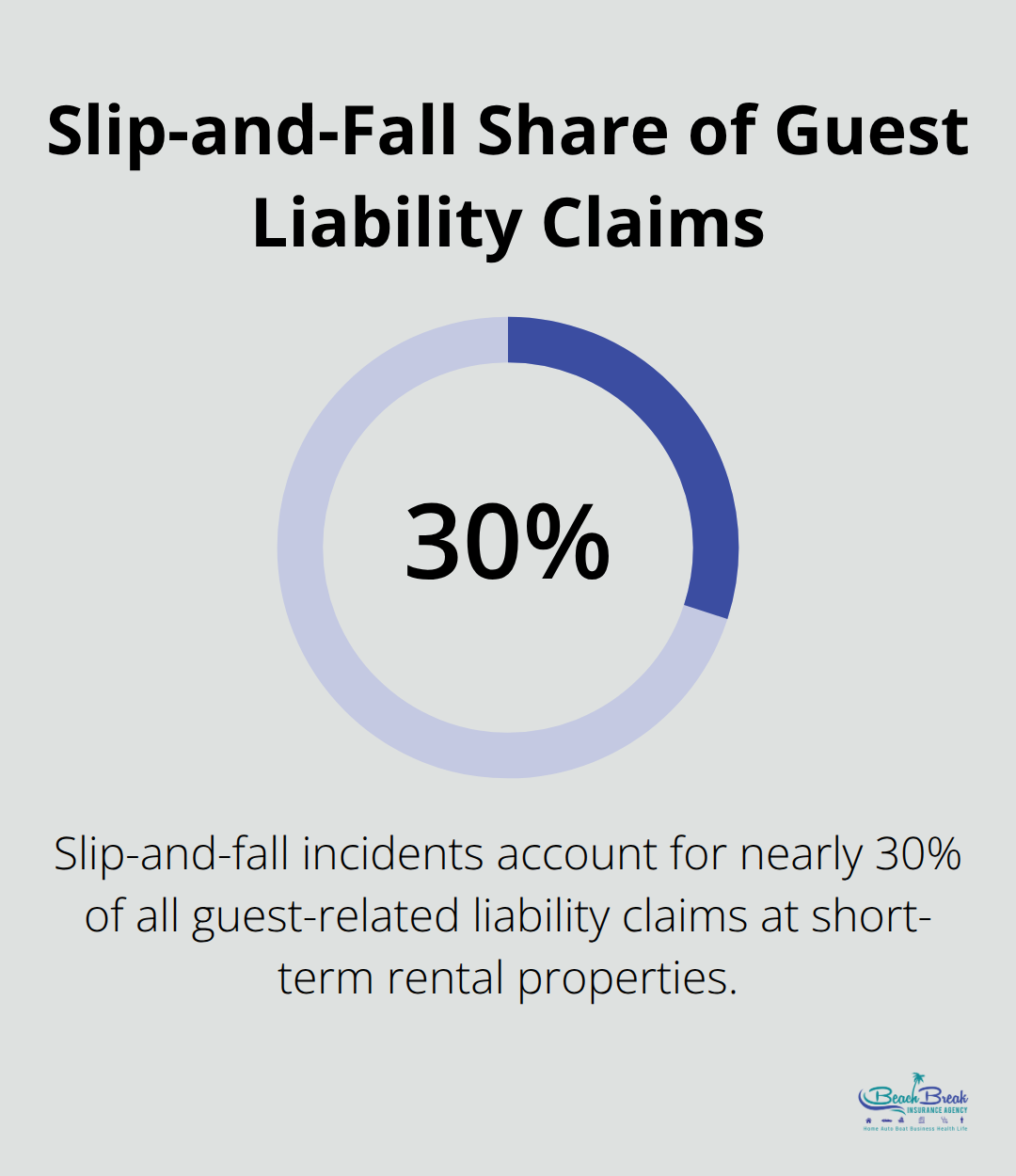
Guest injuries happen more often than most hosts expect. The American Hotel & Lodging Association reports that slip-and-fall incidents account for nearly 30% of all guest-related liability claims at short-term rental properties. A single incident where a guest fractures their leg on your stairs or sustains an injury in a hot tub malfunction can trigger medical bills exceeding $50,000, plus legal fees that stretch beyond $30,000 even if you win the case.

Slip-and-fall incidents comprise nearly 30% of guest-related liability claims at U.S. short-term rentals. - Vacation rental BOP insurance

Standard homeowners policies explicitly exclude rental income and guest liability, leaving you personally responsible for these costs. Without proper business owner’s policy coverage, your personal assets become the target when litigation follows.

Property damage claims drain unprotected hosts fast

Your vacation rental property faces constant risk from guest negligence. Broken windows, damaged furniture, stained carpets, and plumbing disasters from misuse occur regularly at rental properties. Property damage, including theft, accounted for 97.3 percent of homeowners insurance claims in 2023. Fire damage, theft, and weather events also create gaps in standard coverage. A comprehensive BOP policy covers these scenarios directly, protecting your physical investment and the equipment inside it. Without this protection, you absorb every repair cost and replacement expense from your own pocket.

Lost income during closures destroys your cash flow

Forced closures hit rental hosts hard financially. When your property requires repairs after fire, flood, or weather damage, you lose rental income during the recovery period. If your property generates $3,000 monthly in rental income, a 60-day closure costs you $6,000 in lost revenue before repairs even begin. Business income coverage within a BOP policy replaces this lost income, keeping your cash flow stable while you handle property restoration.

Legal obligations often demand coverage

Many rental agreements and platform requirements (Airbnb, VRBO, and similar services) mandate that hosts carry business liability insurance. Violating these terms exposes you to account suspension or removal from the platform entirely. Local regulations in some jurisdictions also require proof of commercial coverage before you legally operate a vacation rental. Checking your rental agreement and local ordinances reveals exactly what coverage levels you must maintain. A BOP policy satisfies these obligations while protecting you from the financial realities that standard homeowners policies ignore.

What a Vacation Rental BOP Policy Actually Protects

A vacation rental BOP policy combines three distinct coverage types into one streamlined package, eliminating the gaps that standard homeowners insurance leaves wide open. General liability coverage handles guest injuries and property damage claims that guests initiate. Property coverage protects your building, furnishings, appliances, and equipment from damage or theft. Business income coverage replaces lost rental revenue when your property becomes uninhabitable due to covered damage. Understanding exactly what each component covers prevents you from purchasing redundant coverage or discovering mid-claim that you lack protection.

General liability covers what guests actually sue for

General liability protection responds when a guest sustains an injury at your property and holds you legally responsible. General liability coverage covers medical expenses and legal defense costs. A guest slips on wet tile in your bathroom, suffers a fall from a defective railing, or experiences food poisoning from improperly stored items-all trigger general liability claims. Most BOP policies start with liability limits between $300,000 and $1,000,000, though your actual exposure depends on your property size and guest capacity. If your rental sleeps eight guests instead of four, you face proportionally higher injury risk and should consider limits at the higher end. General liability also covers damage your guests cause to neighboring properties, such as a fire that spreads to an adjacent building. This protection separates your personal assets from business liability, meaning a judgment against your rental business doesn’t automatically attach to your primary residence or savings accounts.

Property coverage handles damage from guests and natural events

Property damage coverage within your BOP reimburses you for physical damage to your building and its contents. Guest negligence causes the majority of property claims at vacation rentals-broken windows from careless handling, damaged furniture from improper use, stained carpets from spilled drinks, and plumbing disasters from clogged drains all fall under this coverage. Fire, theft, and weather events like hail or wind damage also trigger property claims. Your coverage limit should reflect your actual property value plus furnishings and equipment inside it. An undervalued policy leaves you exposed if a major loss occurs. Most hosts calculate this by listing every item in their rental (from kitchen appliances to bedroom furniture to outdoor equipment), then add 15% for items they overlooked. Deductibles typically range from $500 to $2,500 per claim, so selecting a higher deductible lowers your premium but increases your out-of-pocket expense when damage occurs.

Business income coverage replaces revenue during recovery periods

Business income coverage activates when a covered loss forces your property to close temporarily. If fire, flood, or severe weather damage makes your rental uninhabitable, this coverage reimburses you for the rental income you would have earned during the repair and restoration period. Most policies cover this lost income for a defined period, commonly 12 months, though you should verify this timeframe with your policy documents. The coverage amount is typically based on your average monthly rental income, so accurate income documentation matters significantly when you file a claim. If your property generated $4,000 monthly in rental revenue before a fire forced a 90-day closure, business income coverage replaces that $12,000 in lost revenue, allowing you to manage your mortgage and maintenance expenses without draining personal savings. This protection proves especially valuable for hosts in fire-prone regions or flood zones where extended closures become realistic scenarios rather than worst-case outliers.

Coverage limits and deductibles shape your actual protection

The limits and deductibles you select directly impact both your premium costs and your financial exposure when claims occur. Higher liability limits cost more but protect you against larger judgments, while higher deductibles reduce your premium but require you to pay more out-of-pocket when damage happens. Your property value, guest volume, and local risk factors should all influence these decisions. Hosts operating in high-fire zones or areas prone to flooding need different coverage strategies than those in stable climates. Your rental agreement and platform requirements may also specify minimum coverage amounts you must maintain. Comparing multiple quotes from different carriers reveals how these variables affect your total cost, helping you find the right balance between affordability and adequate protection for your specific situation.

How to Choose the Right BOP Policy for Your Rental

Calculate your property value and guest capacity first

Start by listing every item in your rental-kitchen appliances, bedroom furniture, outdoor equipment, televisions, bedding, dishes, and decorative pieces-then add 15% for items you overlooked. This total becomes your property coverage baseline. Your typical guest count directly determines the liability limits you need, since injury probability increases with occupancy. A four-person beach cottage faces lower liability exposure than a ten-bedroom vacation home hosting multiple families simultaneously. Your rental agreement and platform requirements specify minimum coverage amounts you must maintain, so verify these numbers before comparing quotes. Matching your coverage limits to your actual operations protects you far better than accepting generic policy defaults that leave some hosts overinsured and others dangerously exposed.

Identify exclusions and necessary endorsements for your situation

Most standard BOP policies exclude damage from poor maintenance, guest negligence you could have prevented with proper upkeep, and business interruption claims that allow you to cover fixed expenses while your property is closed for repairs. If your property sits in a high-fire zone, you need specific fire damage coverage and may need to add it through endorsements since standard policies sometimes limit fire coverage. Flood damage requires separate flood insurance in most cases, so hosts in flood-prone areas must purchase this independently. Review your policy documents carefully to understand what protection you actually receive and what gaps remain.

Compare deductibles across multiple carriers

Deductibles typically range from $500 to $2,500 per claim-choosing $1,000 instead of $500 might reduce your annual premium by 10-15%, but you absorb that extra $500 out-of-pocket when damage occurs. Your risk tolerance and cash reserves should influence this decision. Hosts with substantial emergency funds can afford higher deductibles and lower premiums, while those with tighter cash flow benefit from lower deductibles despite higher annual costs.

Evaluate quotes from multiple carriers

Compare three to five quotes from different carriers to see how coverage limits, deductibles, and endorsements affect your total cost. The cheapest quote often excludes important protections your situation requires, while the most expensive quote may include unnecessary coverage you’ll never use. Your actual need sits somewhere between these extremes, determined by your property specifics and risk tolerance. As an independent San Diego-based agency, we quickly compare quotes from multiple top-rated carriers to help you find tailored coverage that matches your rental operation without wasting money on unnecessary add-ons.

Final Thoughts

Vacation rental BOP insurance eliminates the guesswork from protecting your business. You now understand why standard homeowners policies fail vacation rental hosts, what coverage actually matters, and how to compare policies that fit your specific operation. The financial exposure from guest injuries, property damage, and forced closures is real and substantial-protecting yourself early prevents catastrophic losses that drain personal savings and destroy your rental income.

Gather your property details, verify your platform requirements and rental agreement obligations, then request quotes from multiple carriers. This comparison takes a few hours but reveals significant premium differences based on your coverage choices. Higher liability limits cost more but protect you against larger judgments, while higher deductibles lower your premium but increase your out-of-pocket expense when claims occur.

Beach Break Insurance Agency compares quotes from multiple top-rated carriers to deliver tailored coverage that matches your rental operation without wasting money on unnecessary add-ons. As an independent San Diego-based agency, we help vacation rental hosts access solutions for high-fire areas and keep policies aligned with changing needs. Contact us today to protect your investment and gain peace of mind knowing your business is covered when unexpected events occur.

The information provided in this blog is for general informational purposes only and does not constitute legal, financial, or insurance advice. Coverage options, terms, and availability may vary. Please consult with a licensed professional for advice specific to your situation.
Artificial intelligence may have been used to generate text and images in some blog articles.
SoCal Coastal Home Insurance: Understanding Wildfire Risk and Coverage

Wildfire season in Southern California is getting more intense, and it’s reshaping how homeowners think about insurance. If you own a coastal home here, your standard policy might not cover what you actually need.

We at Beach Break Insurance Agency help homeowners navigate SoCal coastal home insurance options when fire risk is high. The right coverage can make the difference between financial security and devastating loss.

How Wildfire Risk Reshapes SoCal Home Insurance

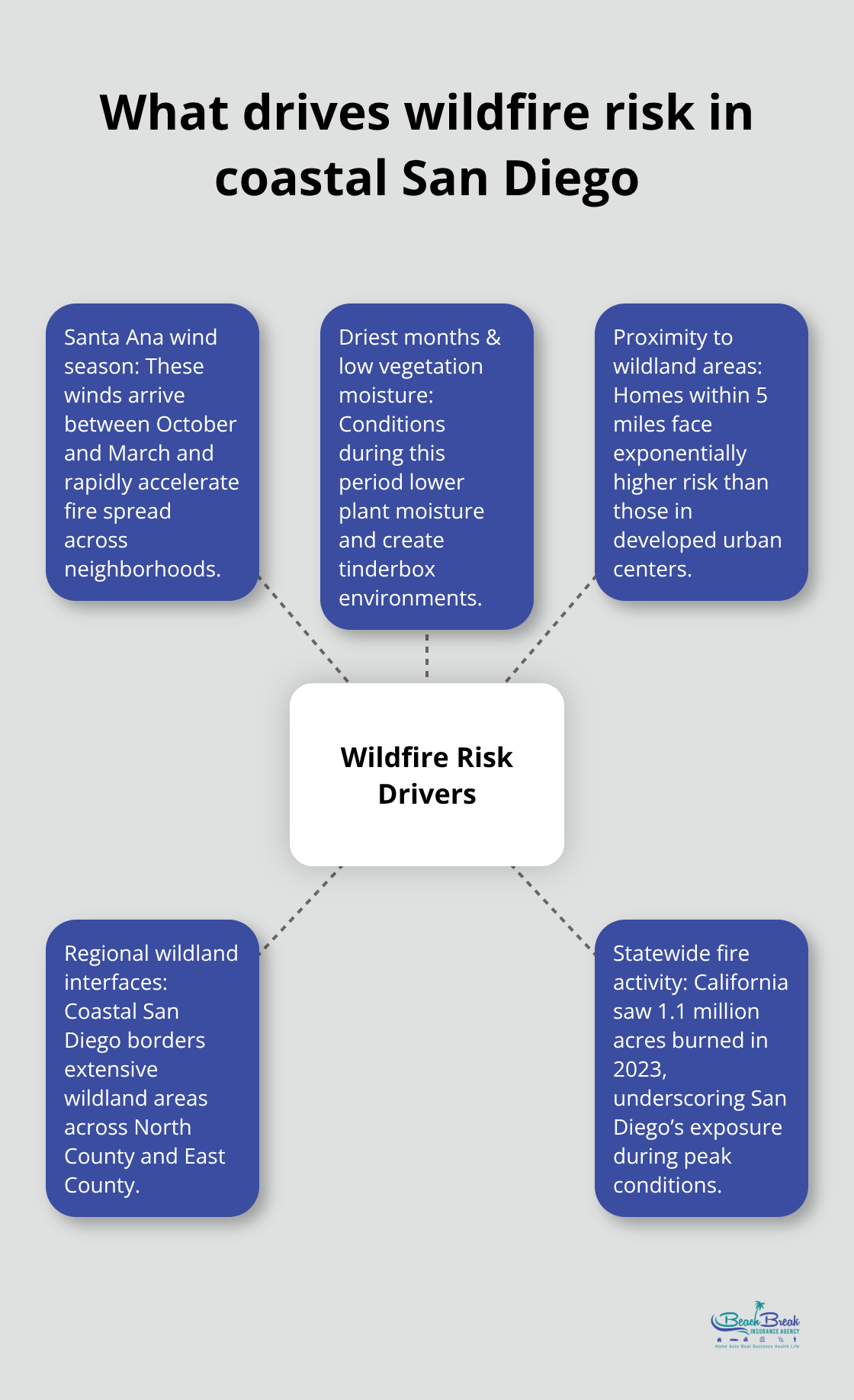
Wildfire frequency in Southern California has accelerated dramatically over the past two decades. The state experienced 7,603 fires in 2023 alone, according to Cal Fire data, burning over 632,000 acres. What’s more alarming is the geographic shift-fires no longer stay confined to remote areas. The 2023 Lilac Fire burned 4,300 acres in San Diego County, and the 2021 Dixie Fire became California’s largest wildfire on record at 963,000 acres. These aren’t outliers anymore. Insurance companies now treat coastal Southern California properties as moderate to high-risk zones based on proximity to known fire corridors, vegetation density, and historical burn patterns. This reality directly impacts your premium costs and what insurers will actually cover.

Insurance Rates Reflect Fire Proximity and Home Characteristics

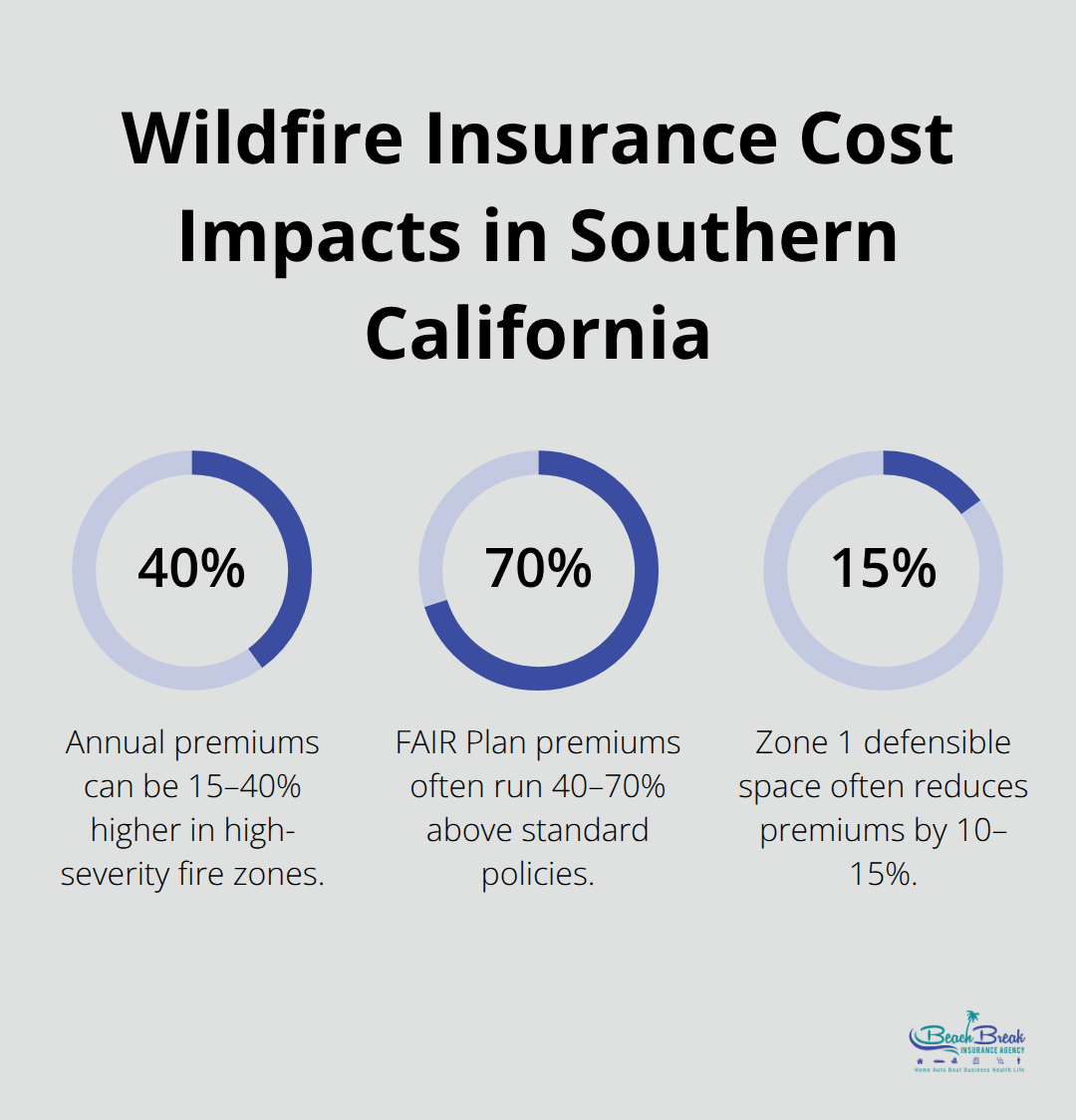
Insurers calculate wildfire premiums using multiple risk factors beyond just location. Cal Fire’s Fire and Resource Assessment Program maps identify fire threat zones, and insurance companies cross-reference these maps with individual property data. A home in a high-severity zone typically costs 15 to 40 percent more in annual premiums than an identical home just outside that zone, depending on your carrier. The specific risk assessment also considers your roof material (composition shingles versus metal or tile), distance to the nearest fire station, and whether defensible space exists around your home. Some carriers have completely withdrawn from high-risk California markets, creating gaps in availability.

Percentage comparison of premium increases and savings related to wildfire risk in Southern California. - SoCal coastal home insurance

Others have implemented stricter underwriting standards, meaning they’ll deny coverage or demand specific home improvements before offering a policy. An independent agent who accesses multiple carriers can match your specific property to insurers still actively writing in your area rather than accepting a denial from one company.

High-Risk Zones Extend Beyond Simple Location Checks

Identifying whether your coastal home sits in a high-risk fire zone requires more than checking a map. Cal Fire’s Fire Hazard Severity Zones classify land into areas of varying fire risk, but insurance companies also layer on additional data. They examine vegetation type, slope, elevation, and proximity to previous fire perimeters. A property on a hillside with dense chaparral faces higher risk than a similar home on level ground in the same neighborhood. Elevation matters too-homes above 3,000 feet in San Diego County often trigger stricter underwriting. Additionally, your home’s age and construction materials significantly influence risk assessment. A 1970s home with wooden eaves and a composition roof will face higher premiums and stricter requirements than a 2015 home with metal gutters and a fire-resistant roof. The coastal areas of San Diego County, particularly inland regions near Ramona, Julian, and the foothills, carry elevated fire risk classifications that directly translate to coverage availability and cost.

Your Property’s Specific Characteristics Drive Coverage Decisions

Your address alone doesn’t tell the full story-the specific characteristics of your property and its surroundings determine whether you’ll find affordable coverage or face limited options. Insurance underwriters examine how your home sits on the land, what materials surround it, and how quickly fire could reach it. A property with mature trees close to the structure presents different risk than one with cleared space. The type of vegetation matters significantly (chaparral burns faster than coastal sage scrub). Your home’s defensible space-or lack of it-becomes a major factor in whether carriers will write a policy at all. Properties that lack adequate clearance around structures often face denial or substantial rate increases. Understanding these specific factors helps you take targeted action before shopping for coverage, which we’ll address in the next section.

What Coverage Actually Works for Fire-Prone Coastal Homes

Standard Policies Fall Short in High-Risk Areas

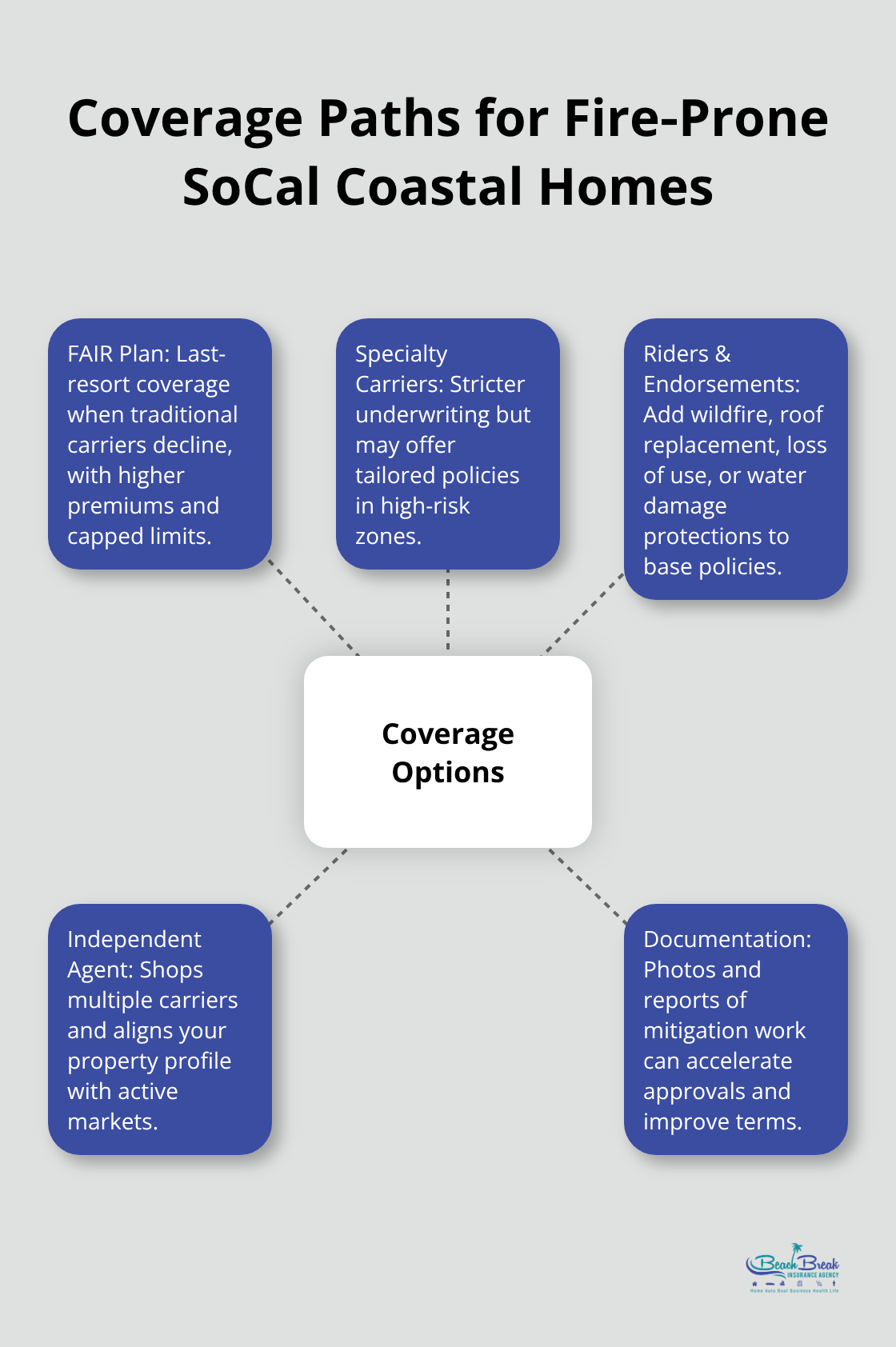
Standard homeowners insurance policies sold in California contain a critical limitation that most homeowners discover only after a loss: they exclude or severely restrict coverage for wildfire damage in high-risk zones. Insurance carriers writing standard HO-3 policies in Southern California increasingly use exclusions or non-renewal to manage wildfire exposure. If your home sits in a Cal Fire Fire Hazard Severity Zone, many insurers will either decline to renew your policy or impose such high premiums that coverage becomes economically unrealistic. This leaves coastal property owners in a difficult position.

The FAIR Plan: Protection When Traditional Carriers Won’t Cover You

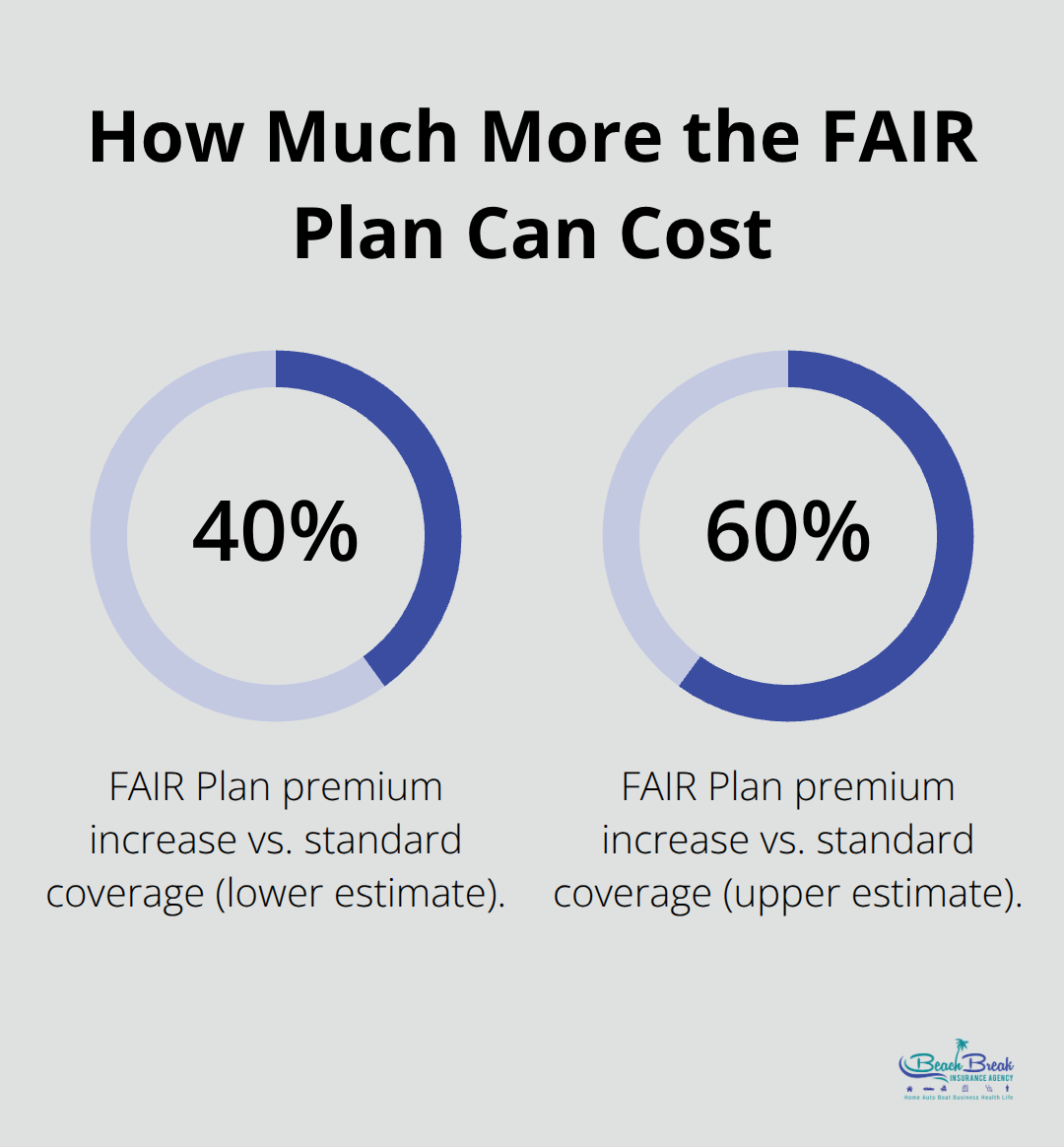
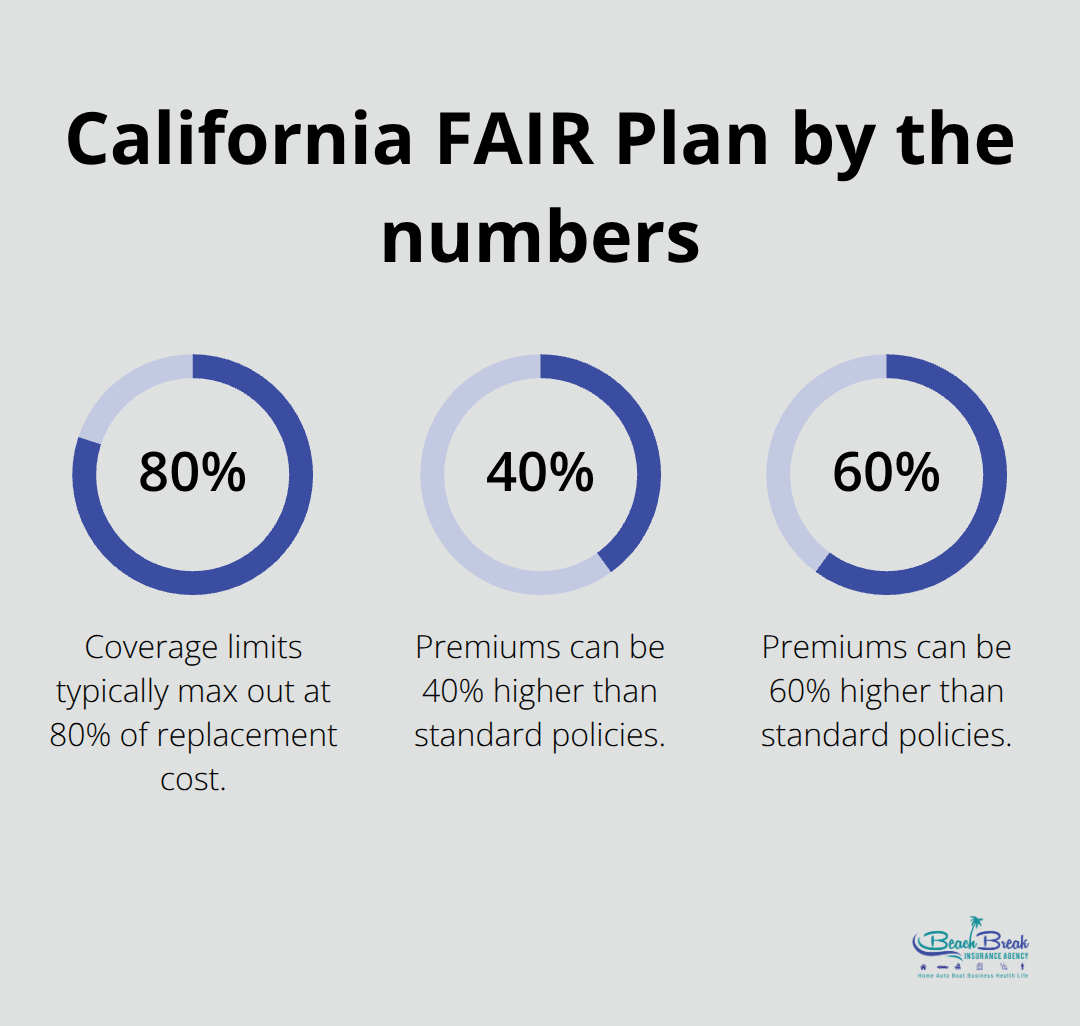
California created the FAIR Plan (Fair Access to Insurance Requirements) in 1968 specifically to address this gap. The FAIR Plan enrollment and growth statistics show a 212% increase since September 2022, with the FAIR Plan operating as an insurer of last resort, accepting policies that traditional carriers reject. Premiums run substantially higher than standard policies, typically 40 to 70 percent above what you’d pay through a traditional carrier. Coverage limits are capped, and the policy excludes certain protections like loss of use coverage that standard policies include. For many coastal Southern California homeowners, the FAIR Plan represents temporary protection while you work to improve your property’s fire-resistance characteristics or find an agent with access to specialty carriers still active in high-risk zones.

Specialty Carriers and Riders Fill Coverage Gaps

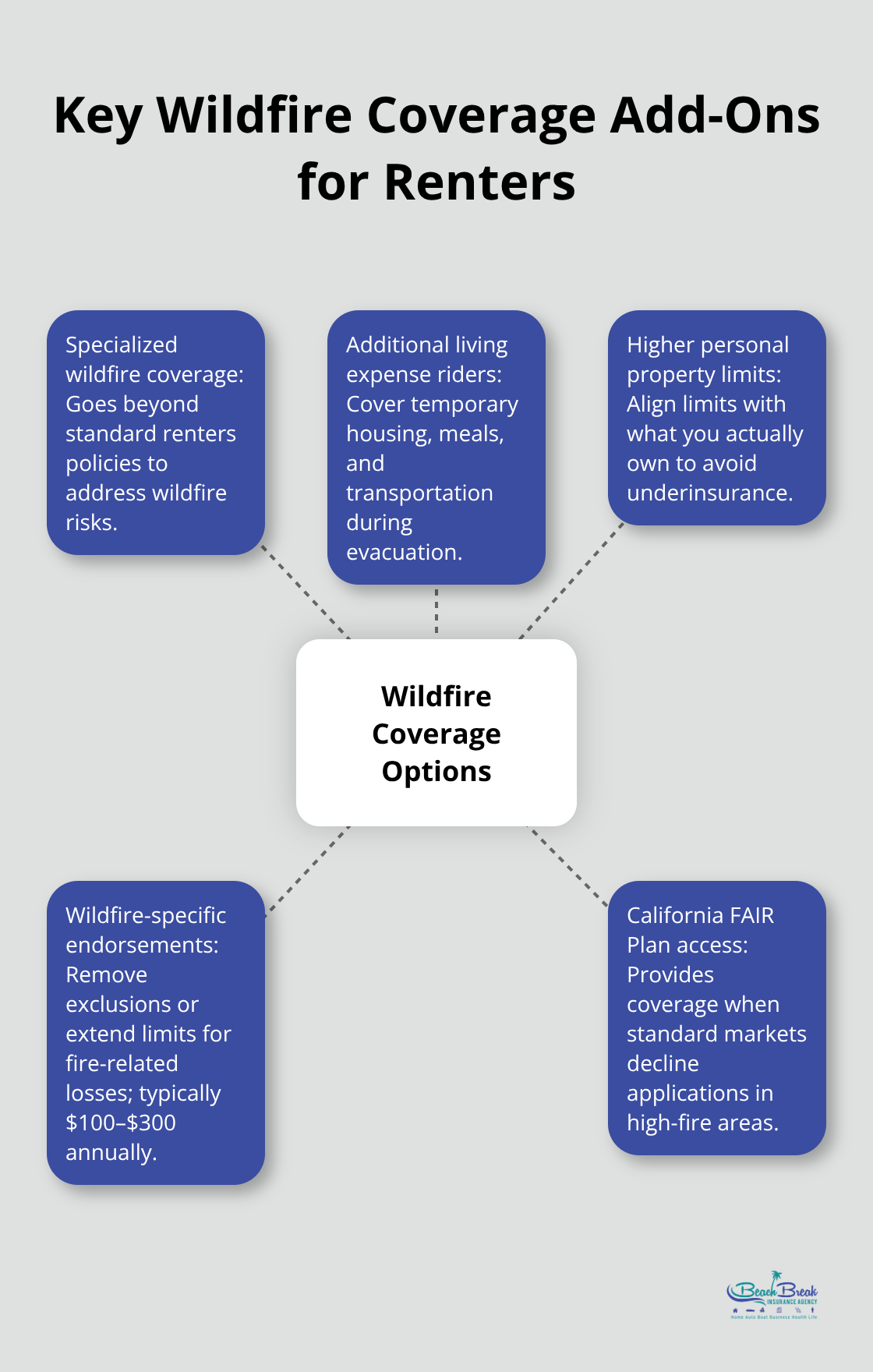
Specialty insurers and regional carriers continue writing policies in California’s fire-prone areas, though they maintain stricter underwriting standards than historical norms. An independent agent can access multiple carriers simultaneously, identifying which ones still write in your specific zip code and fire zone. Some carriers offer fire-specific riders or endorsements that add wildfire coverage to base policies at reasonable costs.

Hub-and-spoke diagram showing coverage options for wildfire-exposed coastal homes in Southern California. - SoCal coastal home insurance

Roof coverage riders cover roof replacement after fire damage at replacement cost rather than depreciated value, costing between $15 and $50 annually and saving thousands after a loss. Loss of use coverage, sometimes called additional living expenses, reimburses temporary housing and meals if your home becomes uninhabitable following a fire, typically costing $200 to $400 per year for adequate limits. Water damage coverage riders become essential in coastal fire zones because wildfires increase flooding risk when burn scars prevent soil absorption during heavy rains. The 2023 fires in San Diego County were followed by debris flow events that caused significant water damage to homes miles from the burn perimeter.

Multiple Carriers Offer Dramatically Different Terms

Comparing quotes across multiple carriers reveals dramatic differences in what they’ll cover, at what price, and under what conditions. A property that one carrier rejects might qualify for standard coverage through another, or qualify for the FAIR Plan at a lower rate through a different agent accessing additional specialty carriers. The specific characteristics of your home-roof material, defensible space, construction age, and proximity to previous fire perimeters-determine which carriers will write policies and at what cost. Taking action to improve these characteristics before shopping for coverage can shift you from the FAIR Plan into standard market options with better rates and broader protection. Your next step involves identifying which specific improvements your property needs and how those changes affect your insurance options.

How to Lower Your Rates and Get Coverage Approved

Defensible Space Creates Immediate Insurance Impact

Improving your property’s fire resistance directly determines whether insurers will cover you and what they’ll charge. Insurance underwriters evaluate specific physical improvements and adjust terms accordingly. The most effective approach combines defensible space work with structural hardening, then shops with an agent who documents these changes to multiple carriers. Carriers like State Farm and Allstate have published specific requirements for high-risk zones, and meeting those standards shifts your property from rejection to approval.

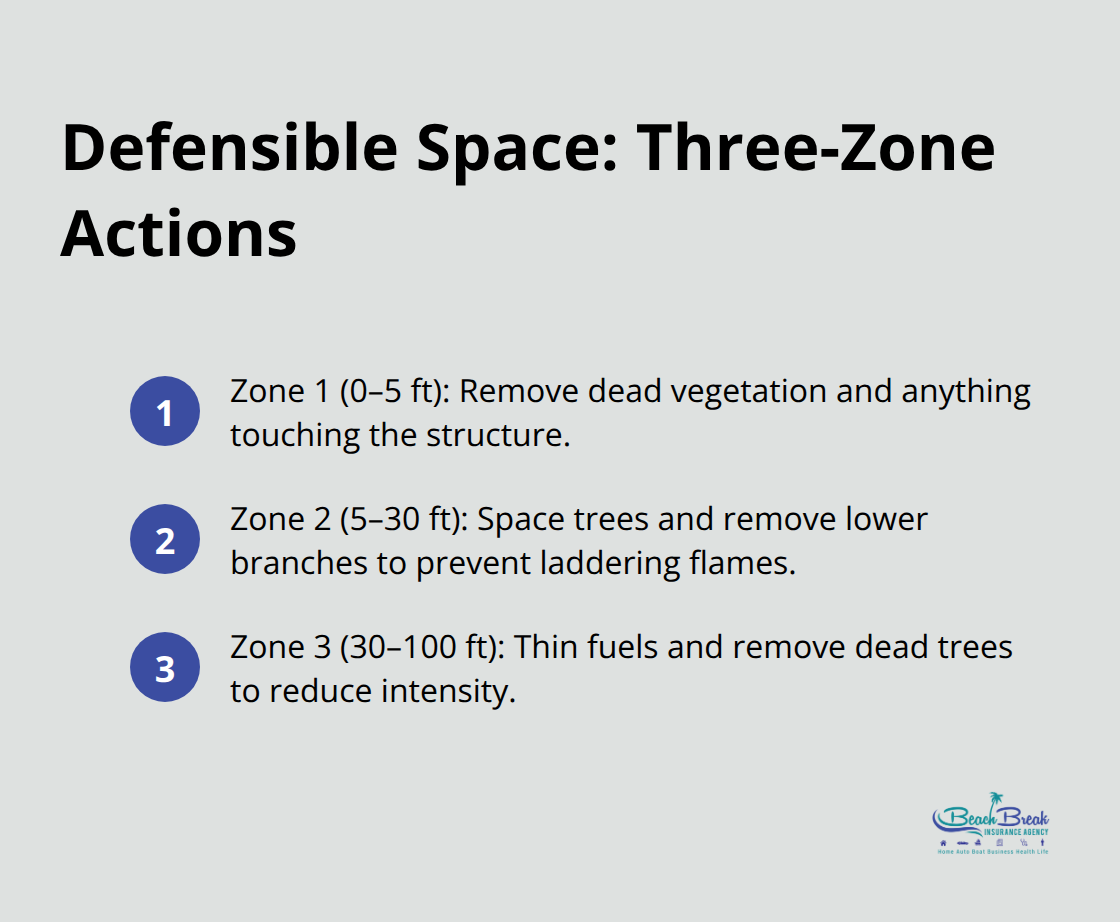
Cal Fire’s defensible space guidelines recommend 100 feet of defensible space in high-severity zones, though practical results appear in three distinct zones. Zone 1 (0 to 5 feet from your home) requires removal of all dead vegetation, leaves, and branches touching the structure-this zone alone prevents embers from igniting your home during a fire’s approach. Zone 2 (5 to 30 feet) demands spacing between trees and removal of lower branches so flames can’t climb into canopies.

Compact checklist of Zone 1–3 defensible space actions for wildfire mitigation.

Zone 3 (30 to 100 feet) focuses on reducing fuel density and removing dead trees entirely.

Completing Zone 1 work costs between $500 and $2,000 for most coastal properties and typically reduces premiums by 10 to 15 percent. Adding Zone 2 work costs another $1,500 to $4,000 but can shift approval from specialty carriers who previously declined coverage. Professional fire mitigation companies in San Diego County charge $75 to $150 per hour and will photograph completed work, providing documentation that insurers require during underwriting.

Structural Improvements Deliver Long-Term Value

Structural improvements matter equally and sometimes more than landscaping. Metal gutters, Class A fire-rated roofing materials, and enclosed eaves prevent ember penetration during wildfires. Insurance companies offer substantial incentives for these upgrades-a metal roof installation costing $8,000 to $12,000 can lower annual premiums by $400 to $800, paying for itself in 12 to 18 years while simultaneously making your home more insurable.

Tempered glass windows and metal screening on vents cost $2,000 to $5,000 but address specific vulnerabilities underwriters flag in high-risk zones. These improvements reduce your property’s exposure to the ember storms that precede active flames, a factor that carriers weight heavily in their underwriting decisions.

Documentation Accelerates Carrier Approval

After completing either defensible space work or structural improvements, contact an independent agent immediately to re-shop your coverage before the next renewal. An independent agent can access multiple carriers simultaneously and present specific documentation of your improvements to underwriters who previously rejected your property. Timing matters significantly-many carriers process underwriting decisions within 48 hours when an agent submits complete documentation, meaning you could shift from FAIR Plan coverage to standard market rates within days rather than waiting for your policy renewal date.

Final Thoughts

Wildfire risk in Southern California is real, and it reshapes what coverage looks like for coastal homeowners. The statistics are clear: fires occur more frequently, burn larger areas, and reach closer to populated neighborhoods than ever before. Your standard homeowners policy will not protect you in high-risk zones, and waiting until renewal time to address coverage gaps leaves you vulnerable.

You must act on two fronts to secure affordable SoCal coastal home insurance. First, improve your property’s fire resistance through defensible space work and structural upgrades-these changes determine whether carriers will write policies at reasonable rates. Zone 1 defensible space work costs $500 to $2,000 and typically reduces premiums by 10 to 15 percent, while a metal roof pays for itself through premium savings over 12 to 18 years. Second, work with an independent agent who accesses multiple carriers simultaneously, since one carrier’s rejection does not mean you must accept the FAIR Plan (different insurers maintain different underwriting standards, and specialty carriers still write in high-risk zones).

Beach Break Insurance Agency specializes in comparing quotes from multiple carriers to find tailored coverage for coastal San Diego properties. They understand fire risk in your specific area and can access solutions like the California FAIR Plan while simultaneously shopping specialty carriers for better rates and broader protection. Contact them to review your current coverage and identify which improvements will shift your property toward standard market options with lower costs.

The information provided in this blog is for general informational purposes only and does not constitute legal, financial, or insurance advice. Coverage options, terms, and availability may vary. Please consult with a licensed professional for advice specific to your situation.
Artificial intelligence may have been used to generate text and images in some blog articles.
Home Wildfire Insurance Quotes: Quick Comparisons for Coastal Homes

Coastal homeowners face wildfire risks that standard insurance often doesn’t cover. Getting accurate home wildfire insurance quotes is the first step toward real protection.

At Beach Break Insurance Agency, we help property owners understand what they’re actually covered for-and what gaps exist in their policies. The right comparison can save you thousands while keeping your coastal home properly protected.

Why Your Coastal Home Needs Different Wildfire Coverage

Standard Policies Leave Coastal Homes Exposed

Coastal properties sit in a uniquely vulnerable position. Wildfires in California burned over 1.3 million acres in 2023 alone, and coastal communities increasingly face exposure to wind-driven fires that push inland from nearby wildland areas. Standard homeowners policies were never designed to handle this specific risk. Most traditional policies either exclude wildfire damage entirely or cap coverage so low that rebuilding becomes impossible after a major fire.

Many coastal homeowners discover massive gaps between what they thought was covered and what their standard policy actually pays. The difference can mean the gap between a full rebuild and a partial loss recovery that leaves you responsible for tens of thousands in out-of-pocket costs.

Why Coverage Limits Matter in High-Risk Areas

Standard policies often fail coastal homeowners because insurers priced them for lower-risk regions. When a major fire strikes, the coverage limits simply don’t stretch far enough to cover reconstruction costs in today’s market. Coastal property values have climbed significantly, yet many homeowners never updated their coverage limits to match. This mismatch creates a dangerous situation where you think you’re protected but actually face substantial financial exposure.

The California FAIR Plan: Your Safety Net

The California FAIR Plan exists precisely because regular insurers have largely abandoned high-risk coastal and wildfire-prone areas. This state-run insurer of last resort covers your home and personal property, but comes with higher premiums and lower coverage limits than you’d get through a private carrier. FAIR Plan policies also don’t cover loss of use or additional living expenses, which matters significantly if you need temporary housing after evacuation.

If you live within five miles of a fire zone or have a history of claims, you’ll likely find standard quotes disappearing fast. That’s when specialized wildfire coverage becomes practically necessary.

Finding Better Alternatives to FAIR Plan Rates

Carriers that specialize in coastal and wildfire-prone properties understand fire dynamics and can offer competitive rates on policies specifically designed for your situation, often at better terms than FAIR Plan alternatives if your home qualifies. An independent agent can access multiple carriers at once, comparing what each one offers for your specific property and risk profile. This approach (comparing multiple quotes simultaneously) typically uncovers options that standard online searches miss entirely.

The carriers available to you depend on your home’s exact location, construction type, and claims history. Getting accurate quotes requires detailed information about your property-which is exactly what the next section covers.

Comparing Wildfire Insurance Quotes That Actually Fit Your Home

Gather Complete Property Information First

Coastal homeowners often request quotes without providing complete property information, which means the quotes they receive don’t reflect their actual risk profile. Insurers need specifics: the exact distance from your home to the nearest wildland interface, your roof material and age, whether you’ve installed ember-resistant vents, the square footage of your home, construction year, and your claims history from the past five years. Missing any of these details means insurers either inflate their quotes to cover unknown risk or decline to quote you altogether.

Checklist of property details insurers need for accurate wildfire insurance quotes - home wildfire insurance quotes

Start by collecting your home documentation before contacting carriers. Have your property deed, recent home inspection reports, and roof certification available. If you’ve made fire-hardening improvements like installing Class A-rated roofing or clearing defensible space, document those too-they directly lower your premiums.

Understand Coverage Limits and Deductibles

Coverage limits and deductibles create the biggest confusion when comparing quotes. A $500,000 dwelling limit sounds adequate until you price replacement costs in today’s market, where coastal home reconstruction averages $400 to $500 per square foot according to RSMeans data. A 2,500-square-foot home would cost roughly $1 million to rebuild, yet many coastal homeowners carry $600,000 in coverage.

Deductibles also vary dramatically across carriers, ranging from 1% to 5% of your home’s insured value. On a $1 million home, that’s the difference between a $10,000 and $50,000 out-of-pocket cost when you file a claim. Request quotes with identical coverage limits and deductibles so you’re comparing apples to apples.

Evaluate Loss of Use and Additional Coverage

Loss of use coverage pays for temporary housing and living expenses if evacuation becomes necessary. Most FAIR Plan policies exclude this entirely, which matters significantly if a wildfire forces you from your home for weeks or months. This protection can mean the difference between manageable disruption and financial strain during recovery.

When reviewing multiple carriers side-by-side, create a simple spreadsheet listing the premium, deductible, dwelling limit, personal property coverage, and loss of use provisions for each quote. This visual comparison makes it obvious which carriers offer the best value for your specific situation.

Access Multiple Quotes Without the Runaround

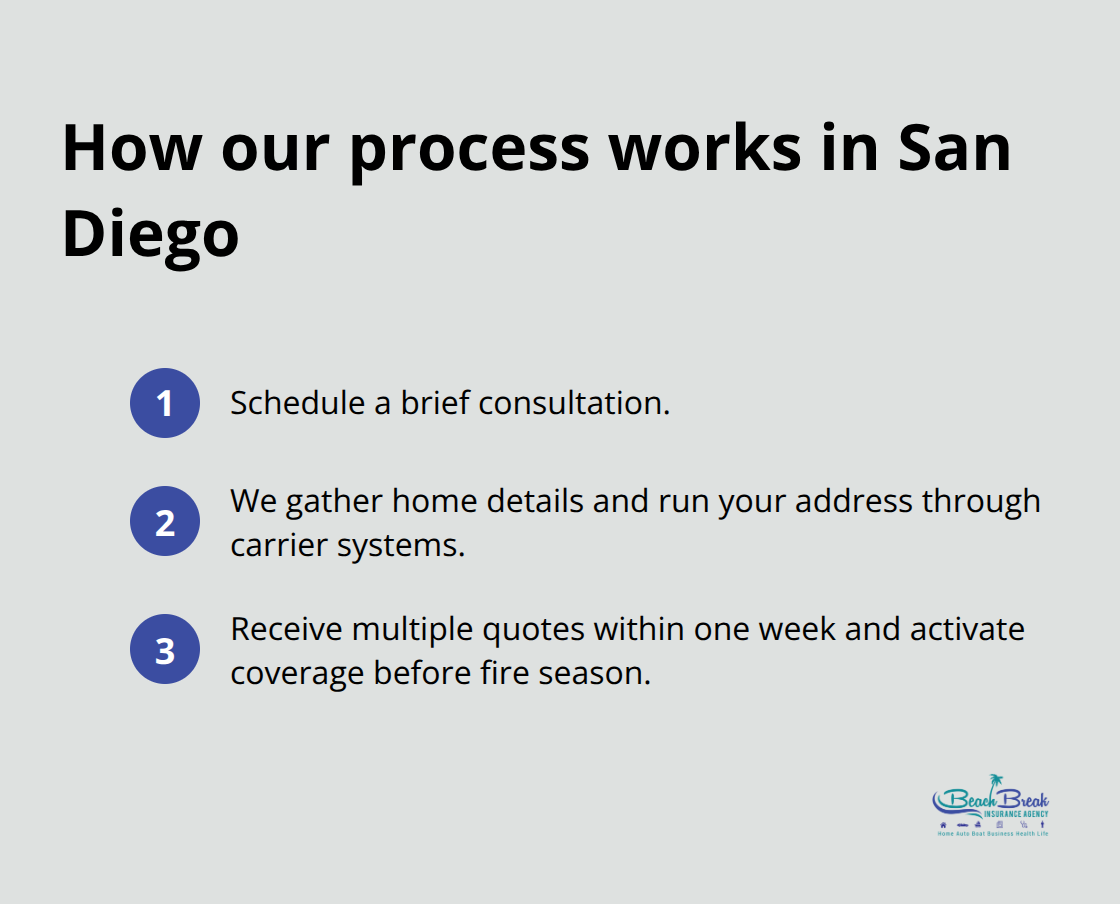
An independent agent can access multiple carriers simultaneously and present you with these comparisons without the back-and-forth email chains that waste weeks of your time. At Beach Break Insurance Agency, we quickly compare quotes from multiple top-rated carriers to help you find tailored coverage that fits your coastal property. This approach uncovers options that standard online searches miss entirely, and the carriers available to you depend on your home’s exact location, construction type, and claims history.

Factors That Impact Your Wildfire Insurance Rate

Location Determines Your Base Premium

Your wildfire insurance rate depends on factors that directly predict whether your home will burn and how much it will cost to rebuild. Insurers aren’t guessing here-they’re using decades of fire data to calculate risk. Your location matters most.

Hub-and-spoke diagram showing key factors that determine wildfire insurance pricing

Homes in the wildland-urban interface pay substantially higher premiums than homes farther away. The specific fire hazard severity zone your property sits in determines whether standard carriers will quote you at all. If you’re in a very high fire hazard severity zone, you’ll face limited options and higher costs across the board. California’s Department of Forestry and Fire Protection maps these zones publicly, so you can check your exact zone before requesting quotes. Proximity to previous fire burn areas also influences rates-homes in communities that burned within the last decade face steeper premiums because insurers view them as higher risk for future fires.

Construction Materials Lower or Raise Your Cost

Your construction materials directly impact your premium because they determine whether your home survives or burns. Class A-rated roofing (like asphalt shingles, metal, or concrete tiles) costs less to insure than wood shake roofs because fires spread slower across Class A materials. Ember-resistant vents, metal gutters, and Class A siding materials all lower your rate because they prevent embers from igniting your home during a fire. If you’ve installed these hardening features, get documentation from the contractor and provide it when requesting quotes-some carriers offer discounts up to 15% for fire-resistant improvements. Homes built after 2008 often qualify for better rates because building codes tightened significantly that year, requiring better fire resistance standards.

Claims History and Credit Score Affect Your Rate

Your claims history and credit score round out the calculation. A single fire claim in the past five years signals future risk to insurers and typically increases your premium by 25% to 40%. Multiple claims can make you uninsurable through standard carriers.

Percentage impacts on wildfire insurance premiums from claims, credit score, and mitigation discounts - home wildfire insurance quotes

Credit score affects rates because insurers view payment history as predictive of risk behavior-a score below 650 can increase your premium by 20% or more.

Final Thoughts

Protecting your coastal home from wildfire risk requires action beyond hoping your standard policy covers everything. Start by collecting your property documentation and checking your fire hazard severity zone through California’s Department of Forestry and Fire Protection, then request home wildfire insurance quotes from multiple carriers using identical coverage limits and deductibles. If you’ve made fire-hardening improvements to your roof or vents, have that documentation ready because those upgrades directly lower your costs.

The biggest mistake coastal homeowners make is settling for whatever quote arrives first or defaulting to the California FAIR Plan without exploring alternatives. Specialized carriers understand coastal wildfire risk and often offer better rates and coverage than FAIR Plan policies if your home qualifies. An independent agent can access multiple carriers simultaneously and present you with side-by-side comparisons in days instead of weeks of back-and-forth emails.

Contact Beach Break Insurance Agency to start comparing home wildfire insurance quotes for your coastal property. We understand San Diego’s specific fire dynamics and can access solutions like the California FAIR Plan for high-fire areas when standard options fall short. The time you invest now prevents financial devastation later.

The information provided in this blog is for general informational purposes only and does not constitute legal, financial, or insurance advice. Coverage options, terms, and availability may vary. Please consult with a licensed professional for advice specific to your situation.
Artificial intelligence may have been used to generate text and images in some blog articles.
Workers Compensation Policy Guide: Choose The Right Coverage

Workers compensation protects your employees when they get hurt on the job, but choosing the right policy isn’t straightforward. Many small business owners either buy too little coverage or miss critical add-ons that could save them thousands.

At Beach Break Insurance Agency, we’ve seen firsthand how the wrong workers compensation policy guide decisions cost businesses money and expose them to legal risk. This guide walks you through what you actually need.

Workers Compensation Basics

What Workers Compensation Actually Covers

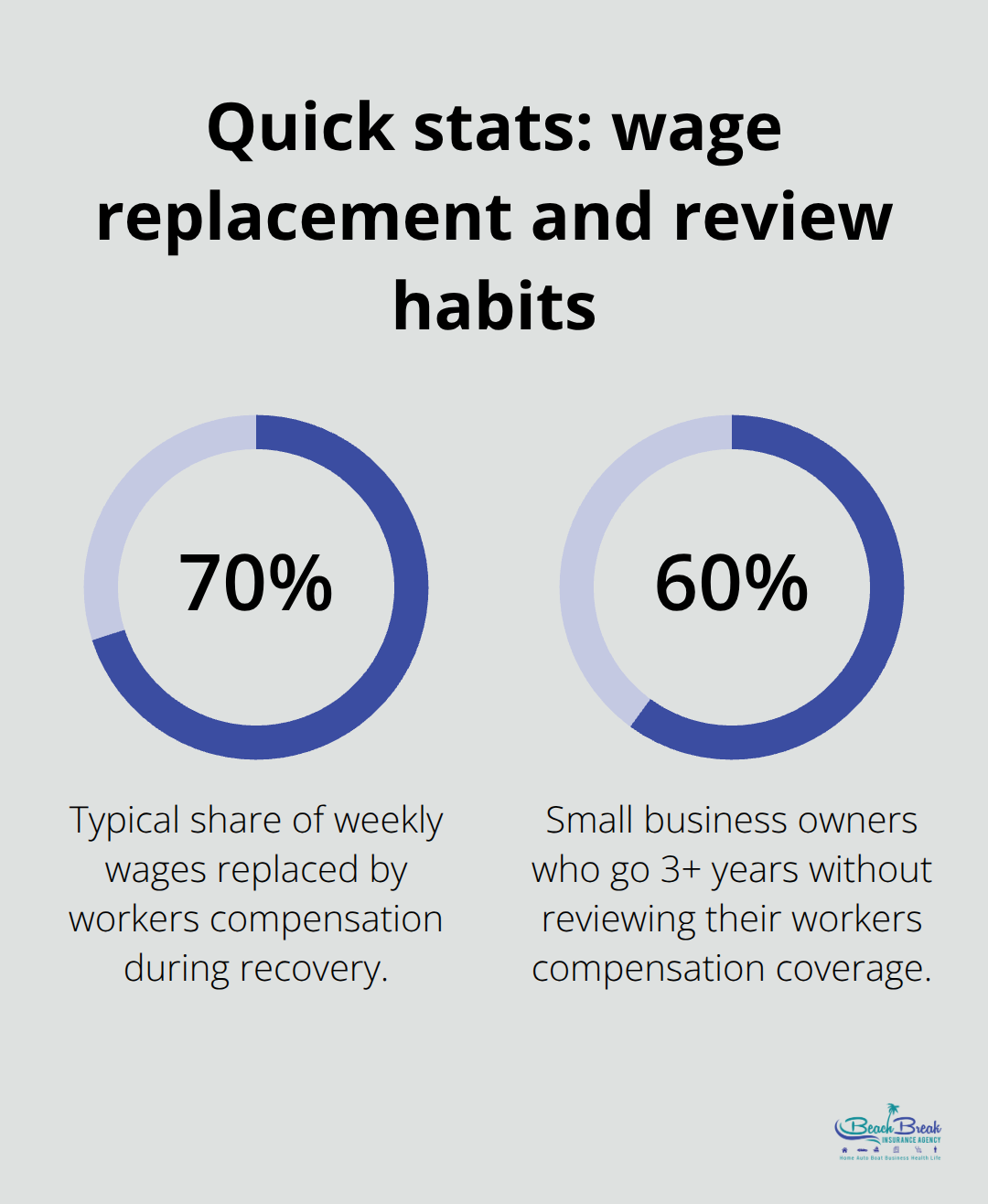
Workers compensation covers medical expenses, rehabilitation costs, and lost wages when an employee gets injured or becomes ill because of work. This includes emergency room visits, surgery, physical therapy, prescription medications, and ongoing treatment related to the injury. If an employee cannot work during recovery, workers compensation replaces a portion of their lost income-typically 60 to 70 percent of their average weekly wage. In 2023, total benefits paid amounted to $64.1 billion, covering roughly 140 million workers across the United States. Death benefits also fall under workers compensation, protecting employees’ families if a work-related fatality occurs.

The policy does not cover injuries that happen outside work or conditions that develop over time without a specific incident. Many small business owners misunderstand what’s included, leading them to think their coverage is broader than it actually is.

Why State Law Requires This Coverage

Most states legally require workers compensation if you have employees, and violations carry steep penalties. California, for example, fines employers up to 10,000 dollars per uninsured employee per year, plus potential criminal charges. Beyond legal requirements, workers compensation protects your business from lawsuits. Without it, an injured employee can sue you directly for damages, medical bills, and lost earnings-costs that could exceed your annual revenue.

How This Coverage Protects Your Bottom Line

Workers compensation reduces your insurance costs through experience rating, which rewards businesses with fewer claims by lowering future premiums. Your employees also benefit from knowing they’re protected if an accident happens, which improves retention and morale. A single serious injury without proper coverage can create financial devastation that threatens your business operations.

Understanding what your policy covers and why you need it sets the foundation for selecting the right limits and add-ons for your specific situation.

Matching Coverage to Your Business Reality

Identify Your Industry’s Actual Hazards

Your industry determines your workers compensation costs more than anything else. A software developer working at a desk faces minimal injury risk compared to a construction worker or warehouse supervisor, yet many small business owners apply a one-size-fits-all approach to coverage limits. The National Academy of Social Insurance reports that construction workers file claims at substantially higher rates than office workers, and when they do, costs run substantially higher due to lost-time injuries and permanent disabilities. Your first step involves identifying where your employees actually work and what tasks create genuine hazards. If you run a salon, your stylists face repetitive strain injuries and chemical exposures. If you operate a delivery service, your drivers face traffic accidents and heavy lifting incidents. These specific risks should drive your coverage decisions, not generic industry benchmarks or what your competitor down the street carries.

Calculate Coverage Limits Based on Payroll

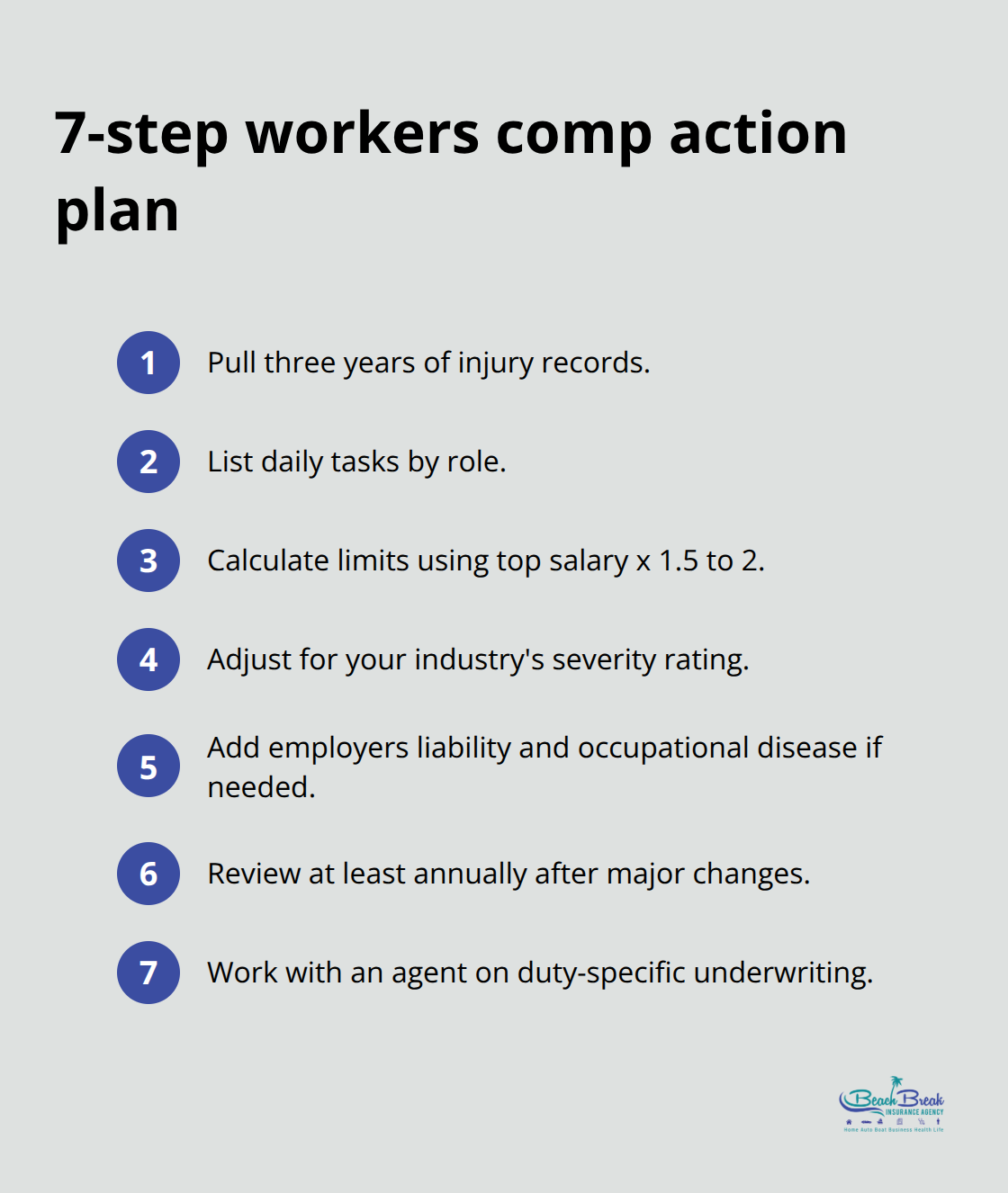
Coverage limits require calculation based on payroll, not guesswork. Most states use a formula tied to your average weekly wage, but determining the right limit means understanding your worst-case scenario. A catastrophic injury resulting in permanent disability or death can trigger benefits extending years into the future. The Council of Insurance Agents and Brokers suggests calculating limits by multiplying your highest-paid employee’s annual salary by 1.5 to 2, then adjusting for your industry’s severity rating. If your payroll exceeds $500,000 annually, this calculation becomes even more critical because underinsurance exposes you to significant out-of-pocket liability.

Review Your Actual Injury History

Pull your actual injury history for the past three years, if you have it, and discuss specific job duties with your insurance agent rather than describing your business in broad terms. This specificity prevents you from overpaying for unnecessary coverage or, worse, discovering gaps when a claim arrives.

Add Endorsements That Close Coverage Gaps

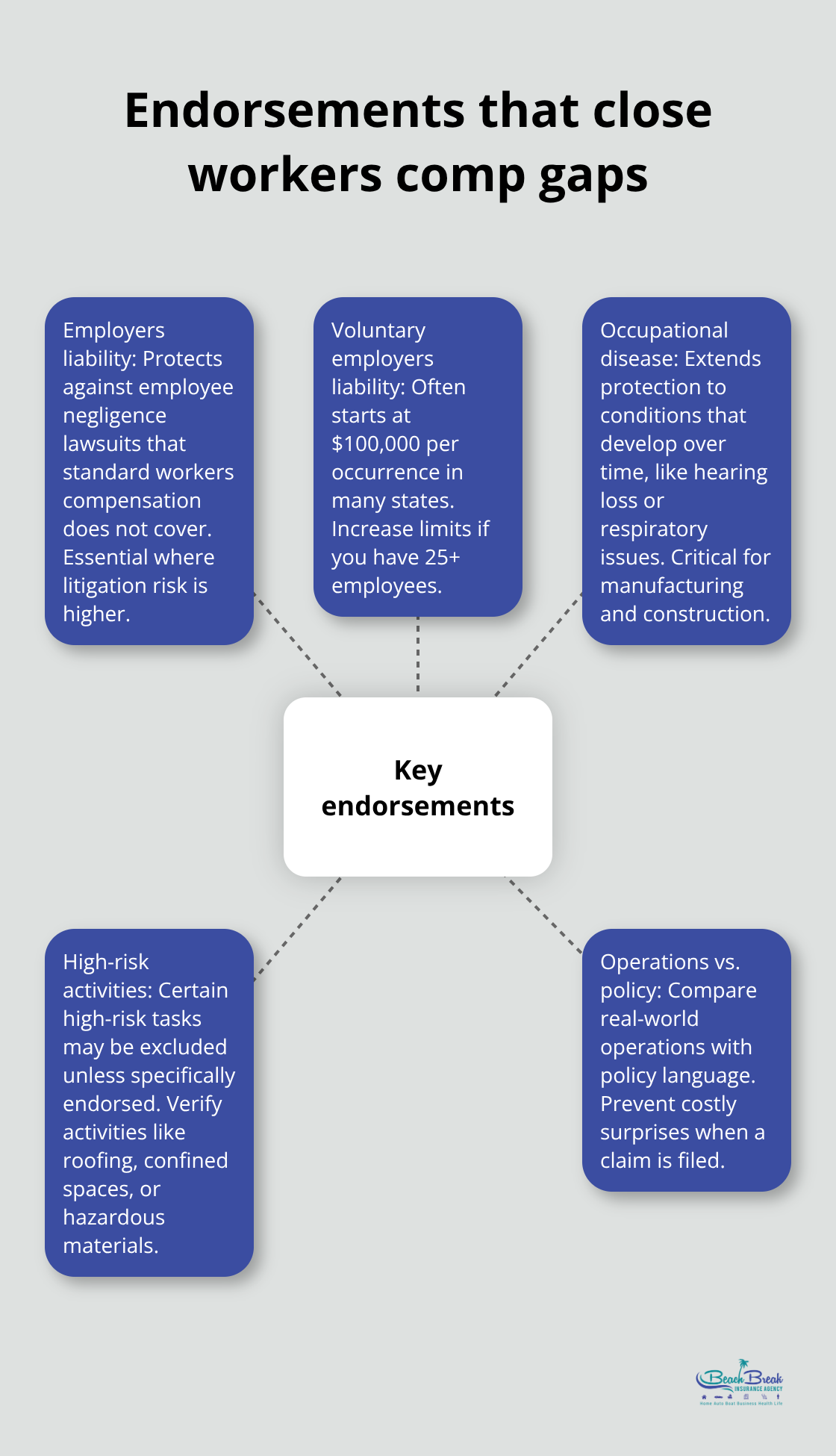
Beyond basic medical and wage replacement coverage, endorsements and add-ons address gaps that standard policies leave open. Employers liability coverage protects against lawsuits from employees claiming negligence, which standard workers compensation doesn’t cover. Voluntary employers liability starts around $100,000 per occurrence in most states but should increase if you have 25 or more employees.

Visual map of key workers compensation endorsements and why they matter

Occupational disease endorsements extend coverage to conditions developing over time, such as hearing loss in manufacturing or respiratory issues in construction. Many policies exclude certain high-risk activities unless you purchase specific endorsements, so reviewing your actual operations against policy language prevents costly surprises when claims arrive.

What Most Small Business Owners Get Wrong About Workers Comp

The Hidden Costs That Insurance Doesn’t Cover

Most small business owners severely underestimate what an injury actually costs their business. You might think workers compensation covers everything, but it doesn’t cover your lost productivity, temporary staffing, equipment downtime, or the administrative overhead of managing a claim. Indirect costs from workplace injuries run two to five times higher than the direct medical and wage replacement expenses covered by your policy.

If a key employee suffers a back injury that sidelines them for three months, workers compensation replaces roughly 70 percent of their wages, but you still absorb the cost of hiring temporary coverage, retraining, and the revenue your business loses while production slows. This gap between what insurance pays and what an injury actually costs your bottom line forces many small business owners to realize they’re massively underinsured only after a serious claim arrives.

Industry-Specific Risks Demand Tailored Coverage

You also miscalculate your actual exposure when you ignore how your specific job duties create injury patterns unique to your operation. A plumbing business with three employees working residential service calls faces entirely different risks than a plumbing company with 30 employees managing commercial construction projects, yet both might carry identical coverage limits based on payroll alone. Your policy should reflect the actual work environment, not a generic template.

The National Academy of Social Insurance reports that construction workers file claims at substantially higher rates than office workers, and when they do, costs run substantially higher due to lost-time injuries and permanent disabilities. Your coverage limits must account for these industry-specific realities, not industry averages.

Policies That Drift Out of Sync With Your Business

Most small business owners set their workers compensation policy once and never revisit it, even when their business fundamentally changes. You might add a new department, shift to heavier equipment, hire younger or older workers with different injury susceptibility, or expand your geographic territory into higher-risk areas. The Council of Insurance Agents and Brokers reports that roughly 60 percent of small business owners go three or more years without reviewing their workers compensation coverage, meaning their policies drift further from their actual operations with each passing year.

Percentage highlights on wage replacement and policy review among U.S. small businesses - Workers compensation policy guide

Your payroll grows, your job duties evolve, your employee demographics shift, but your coverage stays frozen in time. This mismatch creates dangerous gaps that expose you to significant financial liability.

Final Thoughts

Selecting the right workers compensation policy guide requires matching your coverage to your actual business operations, not industry templates or what competitors carry. Start by pulling your injury records from the past three years and listing the specific tasks your employees perform daily, then calculate your coverage limits based on your highest-paid employee and your industry’s severity rating. Add endorsements like employers liability and occupational disease coverage if your operations warrant them, and schedule a policy review at least annually when you’ve added employees, changed job duties, or expanded into new service areas.

Compact checklist to right-size workers compensation coverage - Workers compensation policy guide

The three mistakes we outlined-underestimating injury costs, ignoring industry-specific risks, and letting policies drift out of sync with your business-account for most of the coverage gaps we see among small business owners. Your workers compensation policy should reflect your payroll, your specific job duties, your injury history, and the endorsements that close gaps in standard coverage. The cost of reviewing your coverage takes a few hours; the cost of discovering gaps after a serious claim arrives can threaten your business.

We at Beach Break Insurance Agency specialize in comparing workers compensation quotes from multiple carriers to find coverage that actually fits your operation. Contact us to discuss your current coverage and identify any gaps before an injury forces the conversation.

The information provided in this blog is for general informational purposes only and does not constitute legal, financial, or insurance advice. Coverage options, terms, and availability may vary. Please consult with a licensed professional for advice specific to your situation.
Artificial intelligence may have been used to generate text and images in some blog articles.
Wildfire Coverage for Renters: Protecting Home and Belongings

Wildfire season brings real danger to renters across high-risk areas. Standard renters insurance often leaves gaps when flames threaten, leaving your belongings and finances exposed.

At Beach Break Insurance Agency, we help renters understand what wildfire coverage for renters actually protects and how to build a solid defense before fire season arrives. This guide walks you through your options and the practical steps that matter most.

Why Standard Renters Insurance Falls Short in Wildfire Season

The Coverage Gap Most Renters Miss

Most renters believe their insurance protects them during wildfires, but the reality is far different. Standard renters policies cover fire damage to the building itself-your landlord’s insurance handles that, not your policy. What your renters insurance actually covers is your personal property inside the unit, but only if that property burns directly. When evacuation orders arrive, you leave. Your belongings stay behind, exposed to smoke, ash, and heat damage that standard policies often exclude. Many renters policies contain wildfire exclusions or sub-limits that cap payouts at levels far below what you’d need to replace everything.

What Actually Gets Destroyed in a Wildfire

Wildfires destroy far more than what flames touch directly. Smoke penetrates walls and damages electronics, furniture, and clothing. Ash corrodes metal and ruins appliances. Heat warps wood and melts plastics without any visible fire damage. Standard policies often deny claims for smoke and heat damage because they classify these as indirect losses. Your laptop, your clothes, your kitchen appliances-all vulnerable to destruction that your basic renters policy may refuse to cover.

The Real Financial Cost of Wildfire Loss

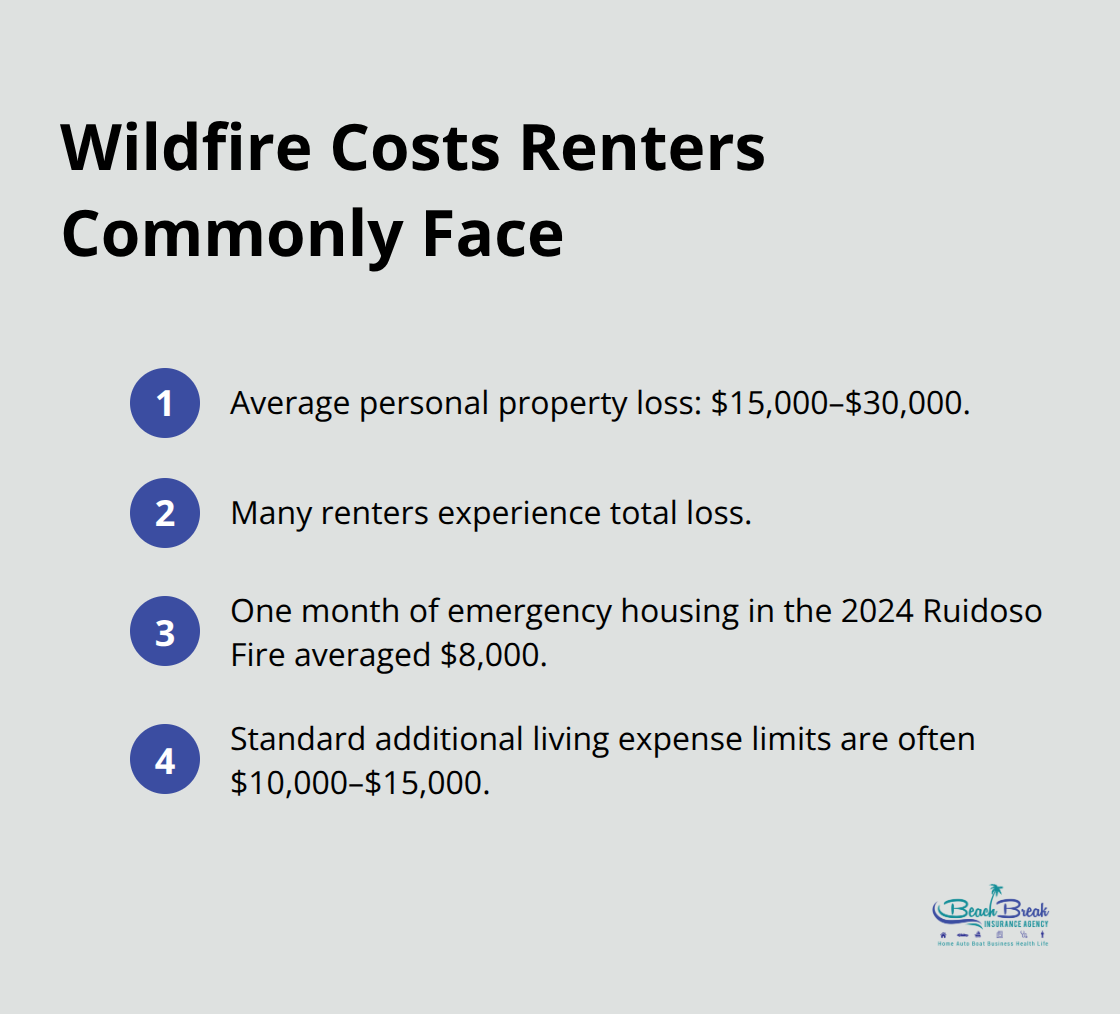
The financial stakes are substantial. In high-risk areas like California and Arizona, the average renter loses between $15,000 and $30,000 in personal property during a wildfire event. Many renters face total loss.

Key out-of-pocket costs renters encounter during wildfire displacement in the United States - Wildfire coverage for renters

Beyond immediate property damage, wildfire events trigger additional living expenses-temporary housing, meals, and transportation-that standard policies may not fully reimburse. In 2024, renters displaced by the New Mexico Ruidoso Fire spent an average of $8,000 on emergency accommodations within the first month alone.

How Wildfire Losses Compound Over Time

The financial impact extends beyond replacement costs. Evacuation prevents you from working, income stops, and stress-related health expenses climb. Arizona, where poverty affects 19.1 percent of children and ranks 12th nationally for poverty rates, shows how wildfire losses compound hardship. A single evacuation can push renters from financial stability into crisis. The gap between what renters think they have and what they actually have in coverage leaves them facing catastrophic out-of-pocket losses that take years to recover from.

Understanding Your Coverage Options

The solution starts with understanding what coverage options exist beyond standard renters policies. Specialized wildfire coverage, additional living expense riders, and higher personal property limits address the gaps that standard policies leave open. Knowing which options apply to your situation and your belongings determines whether you recover quickly or struggle for years.

Visual map of coverage options beyond standard renters policies for U.S. renters

The next section walks you through the coverage options available and how to evaluate which ones fit your needs.

Choosing the Right Wildfire Coverage for Your Rental

Calculate Your Personal Property Needs

Personal property coverage sits at the core of wildfire protection for renters, but the standard limit of $30,000 to $40,000 falls dangerously short in most high-risk areas. When you add up electronics, furniture, clothing, and kitchen equipment, renters typically own $50,000 to $75,000 in replaceable goods. A wildfire that destroys everything means you absorb the gap yourself. Calculate your actual belongings value and request a coverage limit that matches it, not the default option your insurer offers.

Secure Adequate Additional Living Expense Coverage

Additional living expense coverage becomes critical during evacuation. This rider covers temporary housing, meals, and transportation while you cannot occupy your rental. Standard policies typically include $10,000 to $15,000 in additional living expenses, but evacuation costs run higher in practice. In the 2024 Ruidoso Fire, displaced renters paid $8,000 in emergency accommodations within one month alone, meaning many policies exhaust their limits before you even return home. Try requesting at least $25,000 in additional living expense coverage if you live in a wildfire-prone area.

Evaluate Deductibles Strategically

Deductibles matter more in wildfire scenarios than in standard claims. A $1,000 deductible feels manageable until you file a claim for $40,000 in smoke damage and realize you lose that thousand immediately. Evaluate whether a higher deductible makes financial sense for your situation-sometimes accepting a $2,500 deductible in exchange for lower premiums backfires when partial losses occur. The math changes when fire threatens your home.

Identify and Address Policy Exclusions

Policy exclusions are where renters discover their coverage actually stops. Many standard policies exclude or severely limit coverage for smoke damage, heat damage, and evacuation-related losses. Read the exclusions section carefully and ask your agent which specific wildfire scenarios your policy covers and which it does not. Some insurers offer wildfire-specific endorsements that remove exclusions or extend coverage limits specifically for fire-related losses. These endorsements typically cost $100 to $300 annually but provide the protection that standard policies refuse to grant.

Explore Specialized Coverage Options

As a San Diego-based independent agency, we at Beach Break Insurance Agency work with multiple carriers to find options that fit your wildfire risk profile. For renters in high-fire areas, access to solutions like the California FAIR Plan provides coverage when standard markets decline your application. Your agent can compare quotes across carriers and identify which policies offer the strongest wildfire protections for your specific rental location and belongings. The right coverage depends on your actual risk level and what you own-not on what insurers push as their default offering.

How to Prepare Before Fire Season Arrives

Document Everything in Your Rental

Start with a complete home inventory before wildfire season peaks. Photograph or video every room, every closet, and every drawer in your rental. Document serial numbers for electronics, note purchase dates for furniture, and list brand names for appliances. Store this inventory on your phone or in cloud storage where you can access it during evacuation-not just on a laptop you might leave behind. To prevent fraud, insurers generally require that every claimant fully document their losses to get paid in full. Your inventory becomes the proof insurers need to pay you fairly. Include receipts if you have them, but descriptions and photos work when receipts disappeared years ago. Walk through each room slowly and treat this as a financial protection task, not an administrative chore.

Prepare Your Evacuation Kit and Documents

Evacuation orders come with minutes of notice in fast-moving fires, so your plan must be automatic, not something you figure out during panic. Identify which items matter most-important documents, irreplaceable photos, medications, and financial records-and keep them in a grab-and-go bag ready during fire season. The Red Cross recommends a 15-minute evacuation kit that includes copies of insurance policies, identification documents, and a USB drive with your home inventory and photos.

Grab-and-go items renters should prepare for wildfire evacuation in the U.S. - Wildfire coverage for renters

This preparation means you leave with proof of what you own and where to find shelter immediately after evacuation.

Coordinate with Your Landlord on Fire Hardening

Your rental agreement with your landlord matters for wildfire protection. Coordinate with your landlord on defensible space around the building, vegetation clearance, and any property-level fire hardening they might pursue. Some landlords install metal gutters, remove tree branches near the roof, or clear brush from the perimeter-improvements that reduce wildfire risk for everyone in the building. Request these conversations happen before June when fire season intensifies. If your landlord resists, document their refusal in writing because it establishes that you took action within your control.

Plan Multiple Evacuation Routes and Shelter Options

Verify that your evacuation route has alternatives. If the main road out closes during an evacuation, which secondary route do you take? Test this mentally or on a map. Know where you’d stay if you couldn’t return home for weeks-a friend’s house, a hotel, or an evacuation center. Additional living expense coverage reimburses these costs, but only if you have somewhere to go immediately. The gap between evacuation order and having shelter costs money you shouldn’t absorb yourself.

Final Thoughts

Wildfire coverage for renters protects what matters most when evacuation orders arrive. Standard renters policies leave dangerous gaps that cost thousands in out-of-pocket losses when fire threatens your home. The financial stakes are real, especially in high-risk areas where renters already face economic pressure, and a single evacuation can push you from stable housing into years of financial recovery.

Your action plan starts now, before fire season intensifies. Document your belongings with photos and descriptions stored in cloud storage where evacuation won’t separate you from proof of what you own, calculate your actual personal property value and request coverage limits that match reality, and secure adequate additional living expense coverage so temporary housing doesn’t drain your savings. Read your policy exclusions carefully, prepare an evacuation kit with important documents and insurance information ready to grab within minutes, and coordinate with your landlord on defensible space and property-level fire hardening.

We at Beach Break Insurance Agency help renters in high-fire areas find the right wildfire coverage without wasting time comparing policies alone. As an independent San Diego-based agency, we compare quotes from multiple top-rated carriers to deliver tailored coverage that matches your actual risk and belongings. Contact us before fire season arrives so your protection is solid when evacuation orders come.

The information provided in this blog is for general informational purposes only and does not constitute legal, financial, or insurance advice. Coverage options, terms, and availability may vary. Please consult with a licensed professional for advice specific to your situation.
Artificial intelligence may have been used to generate text and images in some blog articles.
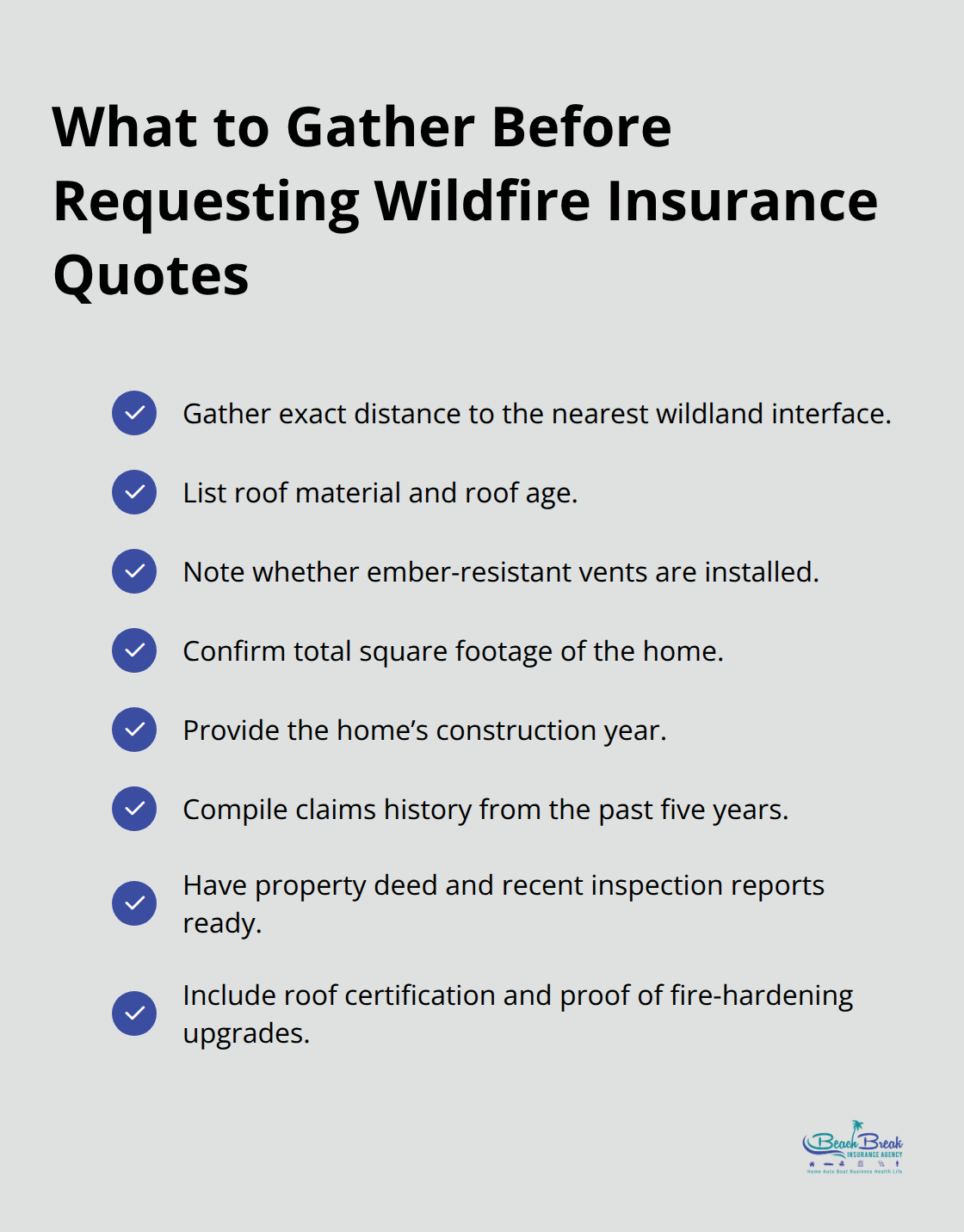
California BOP Insurance Options: A Quick Rundown

Running a small business in California means protecting your assets from real risks. A Business Owner’s Policy bundles general liability, property, and other coverage into one package-and it’s often more affordable than buying policies separately.

At Beach Break Insurance Agency, we’ve helped countless California business owners find the right BOP that fits their specific needs and budget. This guide walks you through your California BOP insurance options so you can make an informed decision.

What a BOP Actually Covers

The Three Core Components

A Business Owner’s Policy combines three essential protections into one package: general liability coverage, property coverage, and business interruption insurance. General liability protects you if a customer gets injured on your premises or claims your product caused them harm. Property coverage pays to repair or replace your building, equipment, inventory, and fixtures if fire, theft, or weather damage strikes.

Overview of the three core coverages in a Business Owner's Policy: general liability, property, and business interruption. - California BOP insurance options

Business interruption coverage replaces lost income when you cannot operate due to a covered event.

Additional Protections Most BOPs Include

Most California BOPs also include commercial crime coverage for employee theft and cyber liability for data breaches, though coverage limits vary by carrier. The appeal is straightforward: bundling these protections costs less than buying each policy separately. Small business owners typically save on group disability insurance rates compared to individual policies, according to the National Association of Insurance Commissioners.

Why Consolidation Matters for Your Business

Individual policies force you to manage multiple renewals, different deductibles, and separate agents. A BOP consolidates everything under one policy with one deductible and one renewal date, which simplifies administration and reduces the chance you’ll accidentally let coverage lapse. California small business owners choose BOPs because the format matches how they actually operate. You’re not buying theoretical coverage for risks that don’t exist in your business; you’re getting the protections that matter most bundled at a price that works for a lean operation.

The combination of affordability, simplicity, and relevant coverage makes BOPs the preferred option for restaurants, retail shops, professional services, and contractors across California. The coverage isn’t one-size-fits-all, though. A boutique retail store needs different limits than a plumbing contractor, and coastal businesses face fire risks that inland operations don’t. That’s where the specifics of your industry and location become critical to getting a BOP that actually protects your business instead of just looking good on paper.

What Makes California BOPs Different

Fire Risk Shapes Your Coverage Options

California’s insurance landscape forces business owners to think differently about coverage than operators in most other states. Fire risk dominates the conversation, particularly for coastal and mountain properties. The 2023 wildfire season destroyed over 632,000 acres across California, and insurance carriers responded by tightening coverage or exiting the market entirely. If standard carriers deny your property coverage application, you land in the California FAIR Plan, which offers basic property protection at significantly higher premiums. A FAIR Plan policy costs roughly 40 to 60 percent more than standard commercial coverage, making it an expensive safety net rather than a competitive option.

Estimated premium increase for California FAIR Plan compared to standard commercial property coverage. - California BOP insurance options

Your BOP quote depends heavily on your property’s location, construction materials, and distance from fire zones. A restaurant in downtown San Diego faces different underwriting scrutiny than one in the foothills. You need to understand your fire rating before comparing quotes, because it directly impacts your premium and eligibility with standard carriers.

Industry Type and Location Drive Coverage Needs

Industry type and location combine to create wildly different coverage requirements across California’s diverse business landscape. A tech startup in San Francisco needs cyber liability limits that protect against data breaches affecting thousands of customers, while a landscaping contractor in Sacramento needs equipment coverage and commercial auto bundled into the package. Premium variations reflect these differences precisely.

Small business owners in high-fire zones pay significantly more for identical coverage than those in low-risk areas. Coastal properties pay higher premiums due to salt spray damage to equipment and structures. You cannot apply a single BOP template across California and expect appropriate protection.

Preparing Your Business for Quote Comparison

Get your property assessed for fire risk, document your specific equipment and inventory value, and identify which coverage limits matter most for your operation before requesting quotes. This preparation prevents you from overpaying for unnecessary coverage or discovering critical gaps after a loss occurs. Comparing three to five quotes from different carriers reveals how dramatically premiums fluctuate based on your specific risk profile and location.

The differences between your options become clear only when you gather concrete information about your business. Once you understand your fire risk, industry requirements, and actual asset values, you’re ready to evaluate which BOP structure works best for your operation.

How to Choose the Right BOP for Your California Business

Assess Your Coverage Needs with Precision

Start by listing every asset your business owns and every liability risk your operation creates. Walk through your physical location and document equipment, inventory, fixtures, and building improvements with replacement costs, not current depreciated value. A restaurant owner needs to account for kitchen equipment, furniture, POS systems, and signage. A contractor tracks tools, vehicles, and materials stored on-site. This inventory becomes your baseline for property coverage limits.

Next, identify your actual liability exposure by considering customer interactions, product handling, and employee activities. A salon has slip-and-fall risks; a consulting firm has professional liability concerns; a retail store faces product liability if customers suffer injury from merchandise. Your industry determines which risks matter most, and your specific operation determines the limits you actually need.

Most California business owners underestimate replacement costs according to the Insurance Information Institute, which means they discover coverage gaps only after losses occur. Spend time getting the numbers right because inadequate limits create financial exposure that a cheap premium cannot justify.

Compare Quotes from Multiple Carriers

Request detailed quotes from at least three different carriers rather than accepting the first offer. Carriers price California BOPs differently based on their risk appetite and underwriting criteria. One carrier might specialize in restaurant coverage and offer competitive rates while another charges premiums 40 percent higher for identical risks.

Ask each carrier for a complete breakdown showing property limits, liability limits, deductible options, and what specific coverages they include or exclude. An independent agent can gather multiple quotes simultaneously and explain how each policy differs, saving you hours of phone calls and preventing confusion when comparing options.

Select the Right Deductible for Your Situation

Deductible selection matters more than most owners realize because it directly impacts both your premium and out-of-pocket costs during a claim. A $2,500 deductible saves roughly 10 to 15 percent on premiums compared to a $500 deductible, but that difference only benefits you if you actually avoid filing small claims.

Estimated premium savings when choosing a $2,500 deductible instead of a $500 deductible.

Calculate your cash position and loss tolerance honestly before selecting a deductible that looks good on paper but strains your finances when you need to use it. Request quotes with multiple deductible options so you see exactly how much you save and can make an informed choice rather than guessing.

Work with an Independent Agent

An independent agent like those at Beach Break Insurance Agency compares quotes from multiple top-rated carriers and explains how each policy differs for your specific situation. This approach saves you time navigating carrier websites and prevents you from missing important coverage differences buried in policy documents.

Independent agents also help you understand how fire risk, location, and industry type affect your premium and coverage options. They answer questions about what happens if a standard carrier denies your application and you need FAIR Plan coverage (which costs 40 to 60 percent more than standard policies). Having someone explain your actual options prevents costly mistakes and ensures your BOP matches your real business needs.

Final Thoughts

California BOP insurance options work best when you match coverage to your actual business risks rather than accepting whatever a carrier offers first. Your specific industry, location, and fire risk determine whether a standard BOP protects you adequately or leaves gaps that cost money when you need coverage most. Comparing quotes from multiple carriers reveals how dramatically premiums vary for identical risks, with one carrier offering competitive rates for your industry while another charges significantly more based on their underwriting criteria.

Deductible selection impacts both your premium and your out-of-pocket costs during a claim, so request quotes with multiple deductible options before deciding. Fire risk shapes California’s insurance landscape in ways that don’t apply elsewhere, which means your BOP quote depends on factors most business owners don’t consider until they start shopping. A restaurant owner’s coverage needs differ fundamentally from a contractor’s needs, and a coastal property faces different underwriting scrutiny than an inland location.

Your next step involves gathering information about your property, assets, and liability risks, then reaching out to Beach Break Insurance Agency to compare your California BOP insurance options. We help California business owners navigate these decisions by comparing quotes from multiple top-rated carriers and explaining how each policy differs for your specific situation. Professional guidance ensures your coverage matches your real business needs rather than just looking good on paper.

The information provided in this blog is for general informational purposes only and does not constitute legal, financial, or insurance advice. Coverage options, terms, and availability may vary. Please consult with a licensed professional for advice specific to your situation.
Artificial intelligence may have been used to generate text and images in some blog articles.
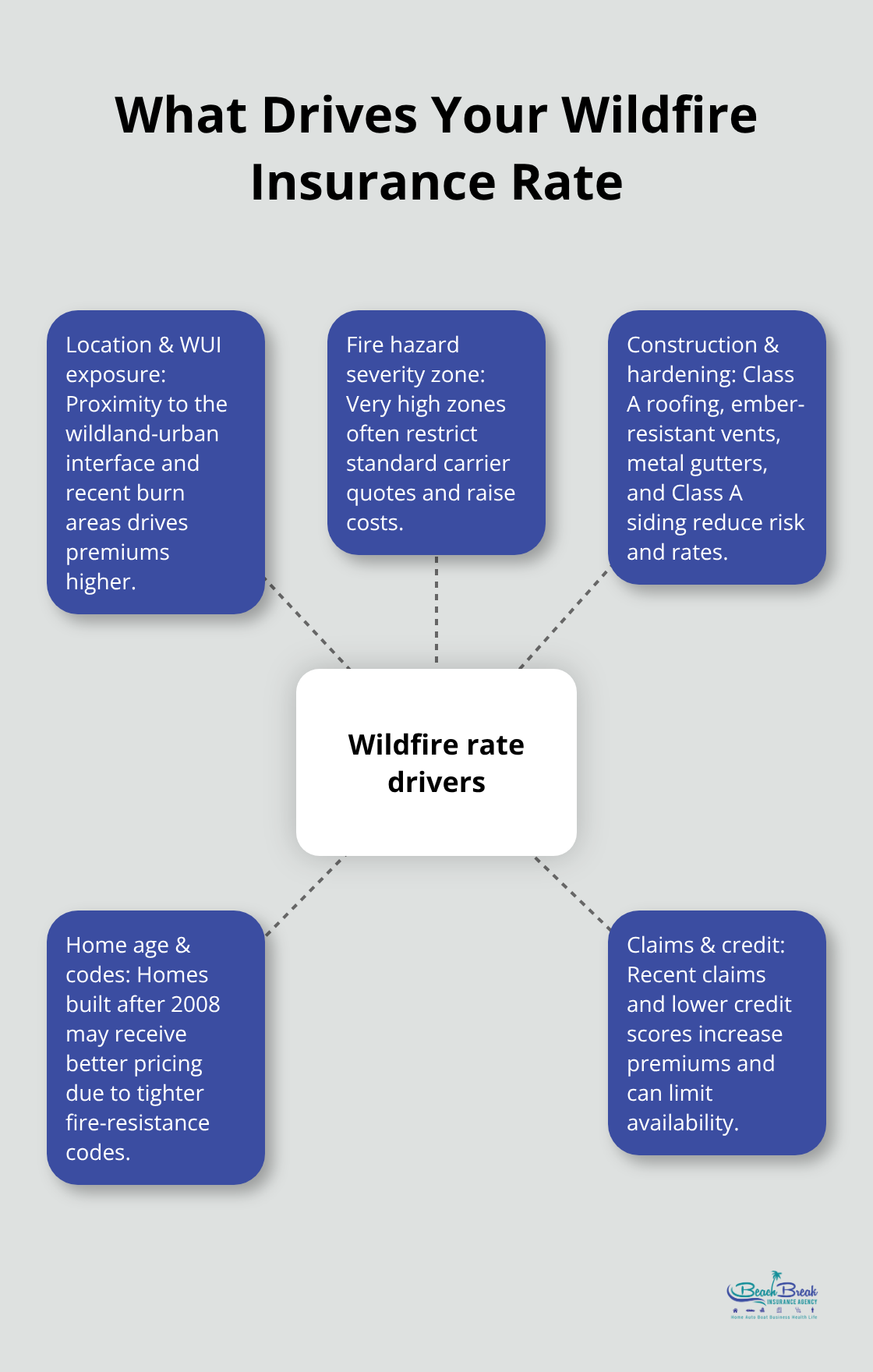
San Diego Wildfire Insurance: Protecting Coastal Homes

San Diego’s wildfire season grows more intense each year, putting coastal homes at serious risk. Property damage from wildfires in San Diego County has exceeded $3 billion over the past decade, and many homeowners discover their standard policies don’t cover fire losses adequately.

We at Beach Break Insurance Agency help San Diego residents find the right wildfire insurance protection before disaster strikes. This guide walks you through your options and shows you how to secure coverage that actually protects your investment.

Understanding Wildfire Risk in San Diego

Why Coastal San Diego Properties Face Extreme Wildfire Risk

Coastal San Diego properties sit in a perfect storm of fire danger. Santa Ana winds bring hot, dry weather and push flames across neighborhoods in hours rather than days. These winds typically arrive between October and March, coinciding with the driest months of the year when vegetation moisture drops to dangerous levels. The National Interagency Fire Center reported that California experienced 1.1 million acres burned in 2023 alone, with San Diego County accounting for significant portions of that total. Your home’s location matters enormously-properties within 5 miles of wildland areas face exponentially higher risk than those in developed urban centers, and coastal San Diego has extensive wildland interfaces throughout North County and East County regions.

Infographic showing the main drivers of wildfire risk for coastal San Diego homes - San Diego wildfire insurance

Geography Makes San Diego a Fire Magnet

San Diego’s terrain amplifies wildfire danger in specific ways. Canyons funnel wind and flames upward with increased intensity, while dense chaparral vegetation that covers hillsides burns with extreme heat. The county’s elevation changes create microclimates where fire behaves unpredictably. Areas like Ramona, Escondido, and Poway sit at higher elevations where vegetation dries faster and burns hotter than coastal flatlands. The 2007 Witch Creek Fire destroyed 1,644 structures and burned 197,990 acres, demonstrating how rapidly fires spread through San Diego’s topography. The 2014 Cocos Fire and 2017 Lilac Fire followed similar patterns, each destroying hundreds of homes. If your property sits in a canyon, on a hillside, or within a mile of dry brush, your risk level jumps substantially compared to homes in established neighborhoods surrounded by maintained landscaping.

The Numbers Tell a Blunt Story

San Diego County has experienced 19 major fires burning over 10,000 acres each since 2000. Property damage from wildfires in San Diego County exceeded $3 billion over the past decade, according to data tracked by the California Department of Forestry and Fire Protection. Individual fires have caused losses exceeding $500 million. The average wildfire in San Diego now burns twice as fast as fires from the 1980s, giving residents less evacuation time. Standard homeowners insurance policies frequently exclude wildfire damage or cap coverage at inadequate levels, leaving owners with massive financial exposure. These gaps in protection make finding the right coverage essential before fire season arrives.

Insurance Solutions for High-Risk Fire Areas

Why Standard Policies Fall Short in San Diego’s Fire Zones

Standard homeowners insurance becomes unavailable or inadequate in high-fire zones, leaving San Diego property owners facing a critical protection gap. Private insurers simply decline to write new policies for properties within 5 miles of wildland areas, forcing homeowners to look elsewhere for coverage. This market withdrawal affects thousands of San Diego residents annually, particularly those in North County and East County regions where fire risk runs highest.

The California FAIR Plan: Basic Protection with Real Limitations

The California FAIR Plan fills the coverage void by offering protection to property owners who cannot obtain insurance through traditional carriers. FAIR Plan policies cover dwelling, other structures, and personal property against fire and related perils, though coverage limits typically max out at 80 percent of replacement cost. Premiums run 40 to 60 percent higher than standard policies, and San Diego County represents a substantial portion of the plan’s over 850,000 statewide policies as of 2024.

Chart highlighting FAIR Plan coverage limits and premium differences

However, FAIR Plan policies intentionally provide basic protection only. They exclude liability coverage, water damage from firefighting efforts, and loss of use expenses that leave families without housing during evacuations. These gaps create serious financial exposure for homeowners who accept FAIR Plan coverage as their final answer.

Comparing Carriers Reveals Better Options

Independent agencies compare quotes from multiple carriers that still write in high-fire areas, identifying policies that provide actual liability protection, additional living expenses during evacuations, and coverage for debris removal costs. Some carriers offer specialized wildfire endorsements that reduce deductibles specifically for fire losses or provide extended replacement cost coverage that pays beyond policy limits when construction costs spike after major fires.

Carriers evaluate whether your property qualifies for preferred rates based on defensible space improvements, roof condition, and distance from vegetation-factors that individual insurers weight differently. Properties with Class A fire-rated roofing, maintained defensible zones, and updated electrical systems often qualify for standard rates even in high-risk zones, potentially saving thousands annually compared to FAIR Plan premiums.

The Real Savings from Exploring Your Options

The difference between choosing FAIR Plan alone versus exploring available carrier options can mean saving $800 to $2,000 per year while gaining substantially better protection. An independent San Diego-based agency like Beach Break Insurance Agency quickly compares quotes from multiple top-rated carriers to identify which insurers will still write your property and at what rates. This comparison process reveals coverage options and pricing that individual homeowners cannot access on their own, transforming what appears to be a limited market into genuine choices.

With carrier options identified and FAIR Plan limitations understood, the next step involves assessing your specific property’s fire risk and determining which coverage types actually protect your investment.

Securing the Right Coverage for Your San Diego Home

Assess Your Property’s Fire Risk Zone and Physical Characteristics

Start with your property’s fire hazard severity zone rating from the California Department of Forestry and Fire Protection website. This official designation determines which insurers will consider your home and at what rates. Properties in very high fire hazard severity zones face immediate carrier rejection, while those in high or moderate zones may qualify for standard or slightly elevated rates depending on other factors.

Next, measure your defensible space. Properties with 100 feet of cleared brush and trees from structures qualify for better rates than homes surrounded by dense vegetation. Check your roof material and age, since Class A fire-rated roofing installed within the last 10-15 years significantly improves your insurability. Homes with older composition roofs or wood shakes face automatic premium increases or carrier denial regardless of other improvements.

Document your electrical system’s condition and whether your home has updated wiring rather than outdated aluminum or knob-and-tube systems. Insurance companies prioritize these physical characteristics because they directly correlate with survival rates during wildfires. The California Department of Insurance reports that homes meeting defensible space and structural standards face 80 percent lower loss rates than non-compliant properties.

Identify Coverage Gaps in Your Current Policy

Review your current policy’s fine print for wildfire exclusions and coverage limits on debris removal, loss of use, and liability. Standard homeowners policies often cap wildfire-related additional living expenses at 10-20 percent of dwelling coverage, leaving families in evacuation zones without adequate housing funds during extended fire events.

Check whether your policy covers temporary housing costs during mandatory evacuations, since San Diego County has issued mass evacuation orders affecting tens of thousands of residents during major fire years. Compare your current deductible structure against carriers that offer reduced deductibles specifically for fire losses, which can lower out-of-pocket costs substantially when disaster strikes.

Compare Carriers to Find Better Protection and Savings

An independent San Diego agency can quickly identify which carriers still write your specific property, what rates each offers based on your home’s characteristics, and which policies include the coverage gaps your current policy leaves exposed. This comparison typically takes one week and reveals savings ranging from $800 to $2,000 annually while providing substantially better protection than FAIR Plan-only coverage.

Carriers evaluate whether your property qualifies for preferred rates based on defensible space improvements, roof condition, and distance from vegetation (factors that individual insurers weight differently). Properties with Class A fire-rated roofing, maintained defensible zones, and updated electrical systems often qualify for standard rates even in high-risk zones, potentially saving thousands annually compared to FAIR Plan premiums. The difference between choosing FAIR Plan alone versus exploring available carrier options can mean substantial savings while gaining better liability protection, additional living expenses coverage, and debris removal benefits.

Final Thoughts

Waiting until fire season arrives leaves your San Diego home exposed to catastrophic financial loss. Wildfires move faster than evacuation timelines, and standard policies frequently deny claims or cap payouts far below actual replacement costs. Taking action now means your family has protection in place before Santa Ana winds arrive and fire danger peaks. We at Beach Break Insurance Agency understand that navigating San Diego wildfire insurance feels overwhelming when carriers reject your property and FAIR Plan policies offer only basic protection.

Our independent agency compares quotes from multiple top-rated carriers that still write in high-fire zones, identifying coverage options and pricing that individual homeowners cannot access alone. This comparison process typically reveals $800 to $2,000 in annual savings while providing substantially better liability protection, additional living expenses coverage, and debris removal benefits than FAIR Plan policies alone. The process moves quickly because we handle the carrier research and quote comparison for you, delivering multiple options within days.

Contact Beach Break Insurance Agency to schedule a brief consultation about your property’s fire risk and current coverage. We gather basic information about your home, run your address through carrier systems to identify which insurers will still write your policy, and provide quotes within one week. From there, you select the coverage that fits your budget and protection needs, and your policy activates before fire season intensifies.

Three-step overview to secure wildfire insurance coverage - San Diego wildfire insurance

The information provided in this blog is for general informational purposes only and does not constitute legal, financial, or insurance advice. Coverage options, terms, and availability may vary. Please consult with a licensed professional for advice specific to your situation.
Artificial intelligence may have been used to generate text and images in some blog articles.
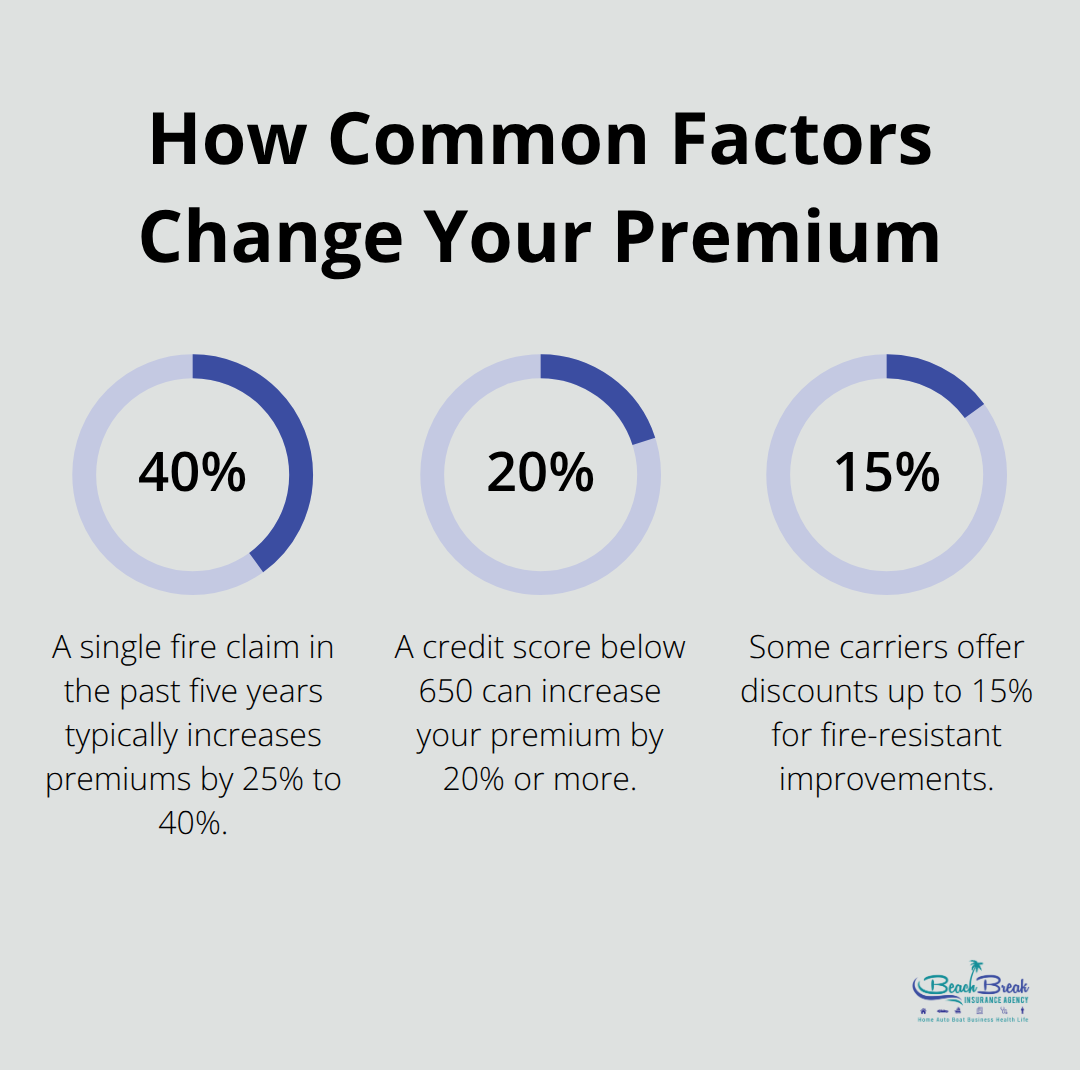
Restaurant Insurance California: A Practical Overview

Running a restaurant in California means managing dozens of risks daily-from customer injuries to equipment failures to employee accidents. The right restaurant insurance California coverage protects your business from financial devastation when something goes wrong.

At Beach Break Insurance Agency, we’ve helped countless restaurant owners find policies that actually match their operations. This guide walks you through the coverage types you need and how to choose the right protection for your specific situation.

Why Restaurant Owners Need Comprehensive Insurance in California

Customer Injuries Create Immediate Financial Exposure

Restaurant owners face liability exposure that most other small businesses don’t encounter. A customer slips on a wet floor and sues for medical bills plus lost wages. Your establishment becomes responsible for settlements that can reach $250,000 or more depending on injury severity. The National Restaurant Association reports that food service establishments face an average of 2.5 liability claims annually, with settlements ranging from $15,000 to $250,000. Without general liability insurance, a single incident drains your operating capital or forces temporary closure.

Equipment Failures and Inventory Loss Threaten Operations

Your walk-in freezer fails and spoils $8,000 in inventory overnight. A fire damages your kitchen equipment and forces you to shut down for weeks. Property coverage protects your building, equipment, and inventory from fire, theft, and weather damage-critical in California where wildfire season creates genuine risk for many locations. Your lease likely requires this coverage anyway, but the real value emerges when disaster strikes and you need to rebuild quickly without depleting savings.

Workers Compensation Protects Both Employees and Your Assets

An employee gets burned on the line and files a workers compensation claim. California requires workers compensation insurance for any restaurant with employees, and the penalties for operating without it reach $10,000 per uninsured worker per week. When employees get injured, this insurance covers their medical treatment and wage replacement, preventing lawsuits that could otherwise target your personal assets. California’s Division of Labor Enforcement conducts workplace audits regularly, and uninsured operators face immediate fines plus mandatory back-payment of premiums.

Food-Related Claims Happen More Often Than Expected

Food poisoning claims, allergen reactions, and contamination incidents create liability exposure specific to restaurants. General liability insurance handles these food-related claims, which occur more frequently than many owners anticipate. A single food poisoning outbreak can affect multiple customers and generate multiple claims simultaneously, making this coverage essential for any food service operation.

Multiple Risks Require Layered Protection

Restaurant operations combine customer-facing risks, employee safety hazards, valuable equipment, and inventory exposure in one location. No single insurance policy covers all these exposures-you need multiple coverage types working together. Understanding which risks your specific operation faces helps you build the right protection strategy, which leads directly to selecting the appropriate coverage types for your restaurant.

Diagram showing key restaurant insurance coverages working together for California restaurants

Types of Restaurant Insurance Coverage Available

General Liability and Product Liability Form Your Foundation

General liability and product liability operate differently, yet both protect your restaurant from customer-related claims. General liability covers bodily injury when a customer slips on your floor or gets hit by a server carrying hot plates. Product liability specifically handles food-related incidents like allergic reactions or food poisoning, which matters far more than many owners realize.

The CDC tracks foodborne illness outbreaks regularly across the country, and a single outbreak affecting multiple customers generates claims totaling $100,000 or more when medical expenses and legal fees combine. Your general liability policy covers legal fees, settlements, and judgments, but you should verify the specific limits because some carriers cap food-related claims separately from other bodily injury claims. Many restaurant owners mistakenly assume general liability handles everything, then discover their policy excludes certain food-related scenarios when a claim arrives.

Property Insurance Protects Your Physical Assets

Property insurance protects your building, kitchen equipment, inventory, and furniture from fire, theft, vandalism, and weather damage-which matters enormously in California where wildfire risk affects many locations. Equipment breakdown coverage, often added as a rider, reimburses you when your refrigeration fails or your HVAC system breaks down, preventing the inventory loss and operational shutdown that can cripple cash flow for weeks.

Liquor Liability Addresses Alcohol-Specific Risks

Liquor liability applies specifically to alcohol-related incidents, covering situations where an intoxicated customer injures themselves or others and claims your establishment served them while visibly drunk. California’s Dram Shop law holds establishments liable for serving alcohol to obviously intoxicated persons, making this coverage mandatory if you serve beer, wine, or spirits.

Workers Compensation and Commercial Auto Insurance Complete Your Coverage

California law requires workers compensation for any restaurant with employees, and the cost typically ranges from 5 to 15 percent of payroll depending on your specific operations and claims history. Commercial auto insurance becomes necessary if your restaurant operates delivery vehicles or uses company cars for business purposes, since personal auto policies exclude commercial use.

Many restaurant owners overlook this coverage until they face a delivery accident, then discover their personal policy denies the claim because the vehicle was being used for business. Understanding which specific risks your operation faces helps you build the right protection strategy, which leads directly to selecting the appropriate coverage limits and comparing quotes from multiple carriers.

How to Choose the Right Restaurant Insurance Policy

Start by documenting your specific operational details rather than picking coverage based on what other restaurants carry. Your seating capacity, whether you serve alcohol, if you operate a delivery service, your annual payroll, and your equipment value all directly determine which coverage types you actually need and what limits make sense. A 50-seat restaurant with no bar faces completely different risks than a 150-seat establishment with full liquor service and delivery operations.

Request Quotes from Multiple Carriers

Request quotes from at least three different carriers rather than relying on online calculators or estimates from a single agent. Each carrier prices restaurant risk differently based on their claims experience and underwriting appetite, so the difference between the cheapest and most expensive quote often reaches 30 to 40 percent for identical coverage. When you request quotes, provide identical information to each carrier so the numbers remain comparable.

Chart highlighting percentage differences in insurance quotes and potential discounts for California restaurants - Restaurant insurance California

Ask specifically about any discounts available for loss control measures like fire suppression system maintenance, food safety certifications, or safety training programs, since these sometimes reduce premiums by 10 to 15 percent. California restaurants that complete food safety certifications through programs like ServSafe often qualify for carrier discounts, yet many owners never ask about this reduction. Get the quotes in writing and compare the actual coverage limits, deductibles, and exclusions side by side rather than focusing only on the premium amount.

Match Coverage Limits to Your Financial Exposure

Your general liability limit should reflect what a serious injury claim could actually cost, not just what sounds reasonable. California settlements for restaurant-related injuries frequently reach $100,000 to $500,000+ when medical costs, lost wages, and legal fees combine, so a $500,000 limit provides meaningful protection without excessive premium cost.

Property insurance limits should cover the full replacement cost of your building, equipment, and typical inventory levels, which means getting a professional assessment of your actual equipment value rather than guessing. Many owners undershoot their property limits to save premium dollars, then face a shortfall when rebuilding becomes necessary after fire or theft.

Calculate Workers Compensation and Deductible Amounts

Your workers compensation coverage amount is determined by your payroll, so this calculation becomes straightforward once you have your annual wage information. Choose deductibles that your business can actually afford to pay out of pocket without creating cash flow problems, since higher deductibles do reduce premiums but only provide savings if you can cover the out-of-pocket cost when a claim occurs.

Insurance brokers often ask detailed questions about your operations specifically because a policy built for your actual business costs less and covers you better than a generic package. An independent agent compares quotes from multiple top-rated carriers to match coverage directly to how your restaurant actually operates, which means you avoid paying for protection you don’t need while preventing gaps in areas where you face genuine exposure.

Final Thoughts

Your restaurant faces genuine financial risk from customer injuries, equipment failures, employee accidents, and food-related incidents. Restaurant insurance California protects your business when disaster strikes and keeps operations running through the recovery process. General liability, property coverage, workers compensation, and liquor liability work together to address the specific exposures your operation faces daily.

Start by documenting what your restaurant actually looks like-your seating capacity, whether you serve alcohol, your annual payroll, and your equipment value all determine which coverage types matter most. Request quotes from multiple carriers using identical information so you can compare options fairly rather than making decisions based on premium alone. Many restaurant owners delay this process because insurance feels complicated, but the real complexity disappears once you work with someone who understands restaurant operations.

Compact checklist of steps for selecting restaurant insurance in California - Restaurant insurance California

Contact Beach Break Insurance Agency to start comparing quotes today. We compare quotes from multiple top-rated carriers to deliver coverage tailored specifically to how your restaurant operates, and we keep your policies aligned with your changing needs as your business grows. Your restaurant deserves protection built for your actual operations, not generic coverage that leaves gaps or wastes money on unnecessary limits.

The information provided in this blog is for general informational purposes only and does not constitute legal, financial, or insurance advice. Coverage options, terms, and availability may vary. Please consult with a licensed professional for advice specific to your situation.
Artificial intelligence may have been used to generate text and images in some blog articles.