
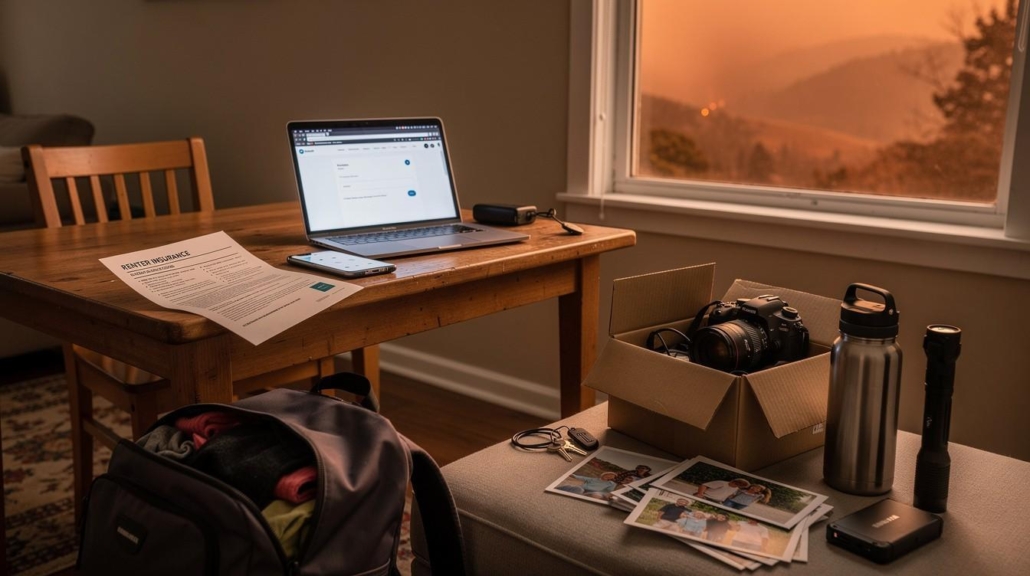
Wildfire Coverage for Renters: Protecting Home and Belongings
Wildfire season brings real danger to renters across high-risk areas. Standard renters insurance often leaves gaps when flames threaten, leaving your belongings and finances exposed.
At Beach Break Insurance Agency, we help renters understand what wildfire coverage for renters actually protects and how to build a solid defense before fire season arrives. This guide walks you through your options and the practical steps that matter most.
Why Standard Renters Insurance Falls Short in Wildfire Season
The Coverage Gap Most Renters Miss
Most renters believe their insurance protects them during wildfires, but the reality is far different. Standard renters policies cover fire damage to the building itself-your landlord’s insurance handles that, not your policy. What your renters insurance actually covers is your personal property inside the unit, but only if that property burns directly. When evacuation orders arrive, you leave. Your belongings stay behind, exposed to smoke, ash, and heat damage that standard policies often exclude. Many renters policies contain wildfire exclusions or sub-limits that cap payouts at levels far below what you’d need to replace everything.
What Actually Gets Destroyed in a Wildfire
Wildfires destroy far more than what flames touch directly. Smoke penetrates walls and damages electronics, furniture, and clothing. Ash corrodes metal and ruins appliances. Heat warps wood and melts plastics without any visible fire damage. Standard policies often deny claims for smoke and heat damage because they classify these as indirect losses. Your laptop, your clothes, your kitchen appliances-all vulnerable to destruction that your basic renters policy may refuse to cover.
The Real Financial Cost of Wildfire Loss
The financial stakes are substantial. In high-risk areas like California and Arizona, the average renter loses between $15,000 and $30,000 in personal property during a wildfire event. Many renters face total loss.
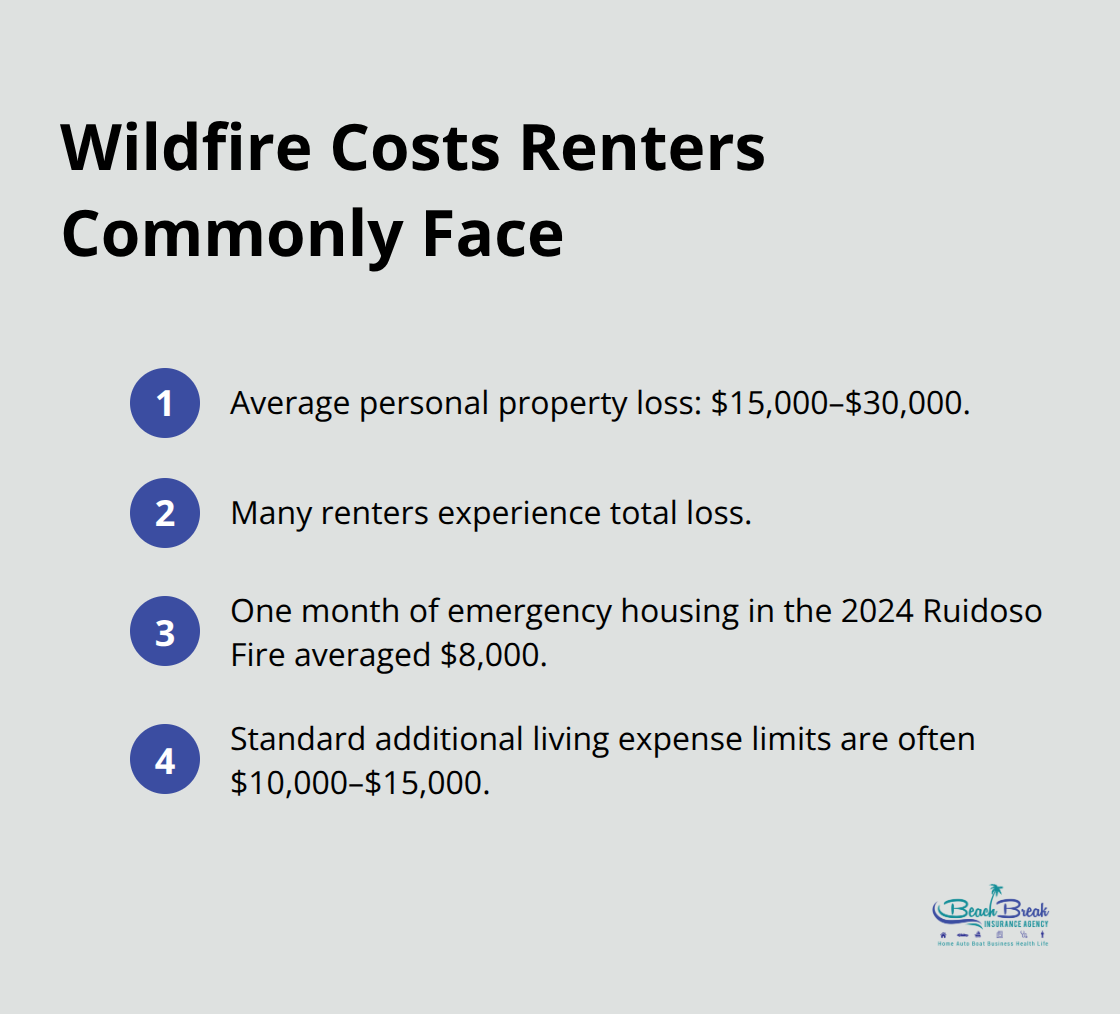
Beyond immediate property damage, wildfire events trigger additional living expenses-temporary housing, meals, and transportation-that standard policies may not fully reimburse. In 2024, renters displaced by the New Mexico Ruidoso Fire spent an average of $8,000 on emergency accommodations within the first month alone.
How Wildfire Losses Compound Over Time
The financial impact extends beyond replacement costs. Evacuation prevents you from working, income stops, and stress-related health expenses climb. Arizona, where poverty affects 19.1 percent of children and ranks 12th nationally for poverty rates, shows how wildfire losses compound hardship. A single evacuation can push renters from financial stability into crisis. The gap between what renters think they have and what they actually have in coverage leaves them facing catastrophic out-of-pocket losses that take years to recover from.
Understanding Your Coverage Options
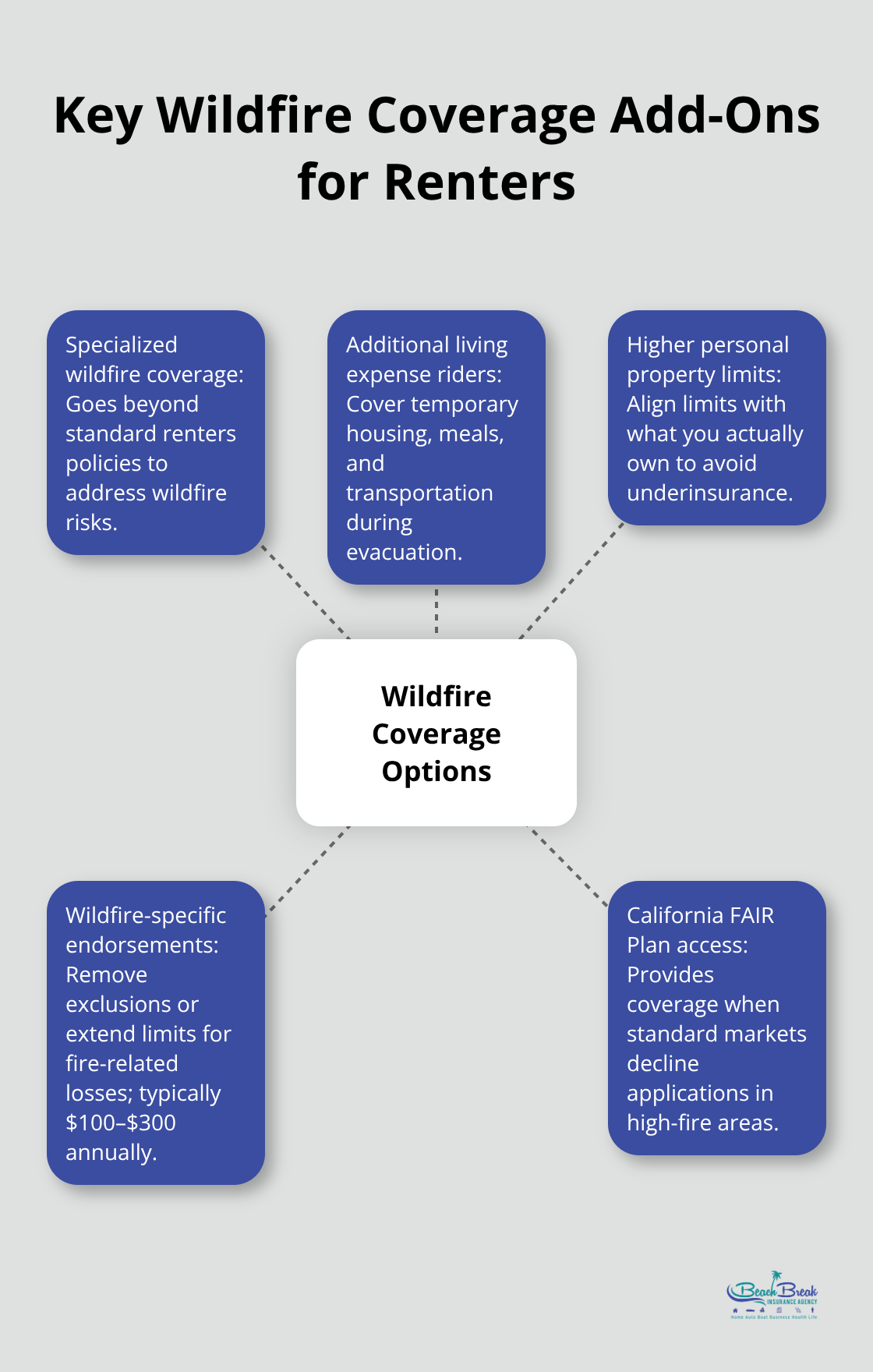
The solution starts with understanding what coverage options exist beyond standard renters policies. Specialized wildfire coverage, additional living expense riders, and higher personal property limits address the gaps that standard policies leave open. Knowing which options apply to your situation and your belongings determines whether you recover quickly or struggle for years.
The next section walks you through the coverage options available and how to evaluate which ones fit your needs.
Choosing the Right Wildfire Coverage for Your Rental
Calculate Your Personal Property Needs
Personal property coverage sits at the core of wildfire protection for renters, but the standard limit of $30,000 to $40,000 falls dangerously short in most high-risk areas. When you add up electronics, furniture, clothing, and kitchen equipment, renters typically own $50,000 to $75,000 in replaceable goods. A wildfire that destroys everything means you absorb the gap yourself. Calculate your actual belongings value and request a coverage limit that matches it, not the default option your insurer offers.
Secure Adequate Additional Living Expense Coverage
Additional living expense coverage becomes critical during evacuation. This rider covers temporary housing, meals, and transportation while you cannot occupy your rental. Standard policies typically include $10,000 to $15,000 in additional living expenses, but evacuation costs run higher in practice. In the 2024 Ruidoso Fire, displaced renters paid $8,000 in emergency accommodations within one month alone, meaning many policies exhaust their limits before you even return home. Try requesting at least $25,000 in additional living expense coverage if you live in a wildfire-prone area.
Evaluate Deductibles Strategically
Deductibles matter more in wildfire scenarios than in standard claims. A $1,000 deductible feels manageable until you file a claim for $40,000 in smoke damage and realize you lose that thousand immediately. Evaluate whether a higher deductible makes financial sense for your situation-sometimes accepting a $2,500 deductible in exchange for lower premiums backfires when partial losses occur. The math changes when fire threatens your home.
Identify and Address Policy Exclusions
Policy exclusions are where renters discover their coverage actually stops. Many standard policies exclude or severely limit coverage for smoke damage, heat damage, and evacuation-related losses. Read the exclusions section carefully and ask your agent which specific wildfire scenarios your policy covers and which it does not. Some insurers offer wildfire-specific endorsements that remove exclusions or extend coverage limits specifically for fire-related losses. These endorsements typically cost $100 to $300 annually but provide the protection that standard policies refuse to grant.
Explore Specialized Coverage Options
As a San Diego-based independent agency, we at Beach Break Insurance Agency work with multiple carriers to find options that fit your wildfire risk profile. For renters in high-fire areas, access to solutions like the California FAIR Plan provides coverage when standard markets decline your application. Your agent can compare quotes across carriers and identify which policies offer the strongest wildfire protections for your specific rental location and belongings. The right coverage depends on your actual risk level and what you own-not on what insurers push as their default offering.
How to Prepare Before Fire Season Arrives
Document Everything in Your Rental
Start with a complete home inventory before wildfire season peaks. Photograph or video every room, every closet, and every drawer in your rental. Document serial numbers for electronics, note purchase dates for furniture, and list brand names for appliances. Store this inventory on your phone or in cloud storage where you can access it during evacuation-not just on a laptop you might leave behind. To prevent fraud, insurers generally require that every claimant fully document their losses to get paid in full. Your inventory becomes the proof insurers need to pay you fairly. Include receipts if you have them, but descriptions and photos work when receipts disappeared years ago. Walk through each room slowly and treat this as a financial protection task, not an administrative chore.
Prepare Your Evacuation Kit and Documents
Evacuation orders come with minutes of notice in fast-moving fires, so your plan must be automatic, not something you figure out during panic. Identify which items matter most-important documents, irreplaceable photos, medications, and financial records-and keep them in a grab-and-go bag ready during fire season. The Red Cross recommends a 15-minute evacuation kit that includes copies of insurance policies, identification documents, and a USB drive with your home inventory and photos.
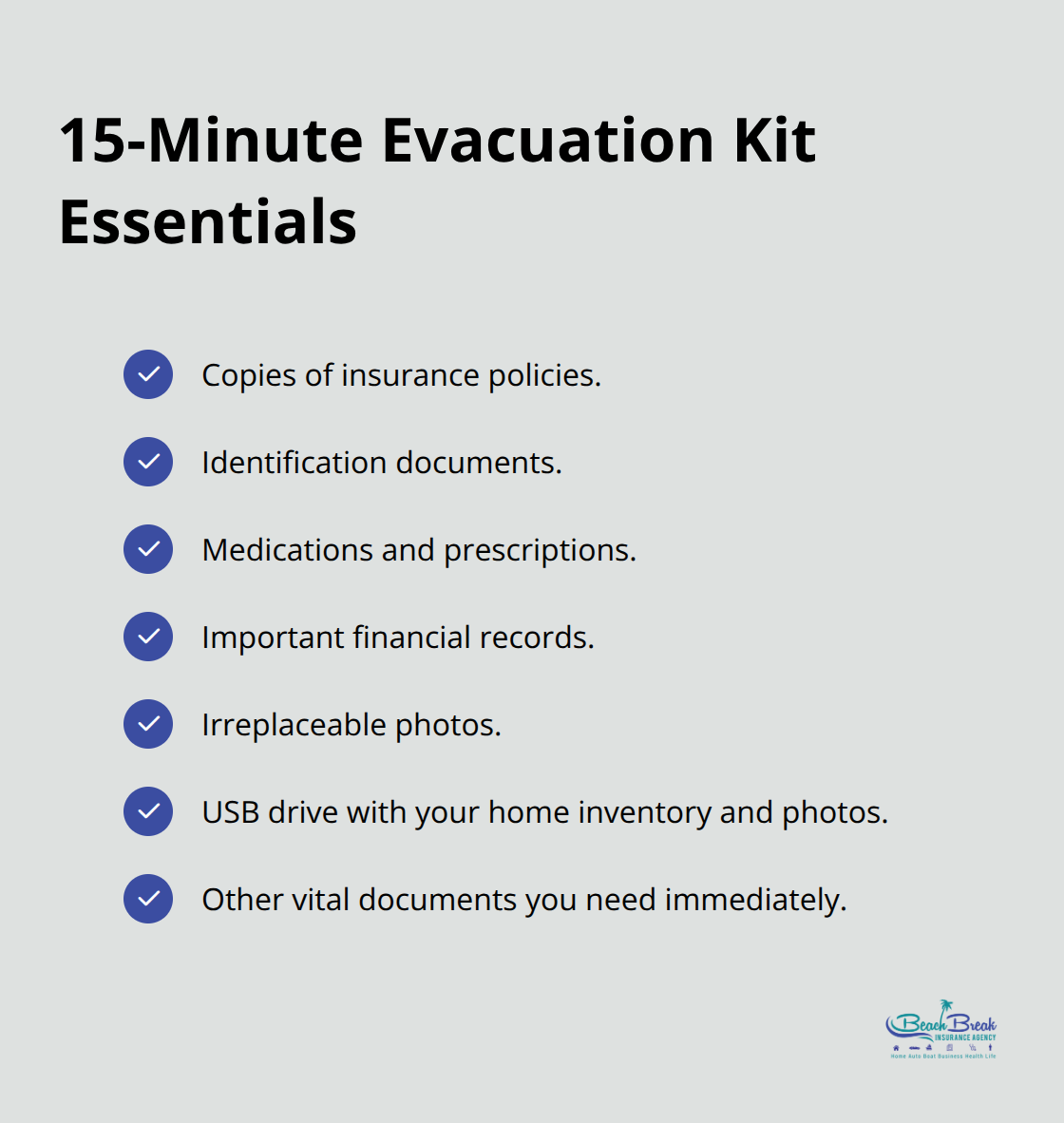
This preparation means you leave with proof of what you own and where to find shelter immediately after evacuation.
Coordinate with Your Landlord on Fire Hardening
Your rental agreement with your landlord matters for wildfire protection. Coordinate with your landlord on defensible space around the building, vegetation clearance, and any property-level fire hardening they might pursue. Some landlords install metal gutters, remove tree branches near the roof, or clear brush from the perimeter-improvements that reduce wildfire risk for everyone in the building. Request these conversations happen before June when fire season intensifies. If your landlord resists, document their refusal in writing because it establishes that you took action within your control.
Plan Multiple Evacuation Routes and Shelter Options
Verify that your evacuation route has alternatives. If the main road out closes during an evacuation, which secondary route do you take? Test this mentally or on a map. Know where you’d stay if you couldn’t return home for weeks-a friend’s house, a hotel, or an evacuation center. Additional living expense coverage reimburses these costs, but only if you have somewhere to go immediately. The gap between evacuation order and having shelter costs money you shouldn’t absorb yourself.
Final Thoughts
Wildfire coverage for renters protects what matters most when evacuation orders arrive. Standard renters policies leave dangerous gaps that cost thousands in out-of-pocket losses when fire threatens your home. The financial stakes are real, especially in high-risk areas where renters already face economic pressure, and a single evacuation can push you from stable housing into years of financial recovery.
Your action plan starts now, before fire season intensifies. Document your belongings with photos and descriptions stored in cloud storage where evacuation won’t separate you from proof of what you own, calculate your actual personal property value and request coverage limits that match reality, and secure adequate additional living expense coverage so temporary housing doesn’t drain your savings. Read your policy exclusions carefully, prepare an evacuation kit with important documents and insurance information ready to grab within minutes, and coordinate with your landlord on defensible space and property-level fire hardening.
We at Beach Break Insurance Agency help renters in high-fire areas find the right wildfire coverage without wasting time comparing policies alone. As an independent San Diego-based agency, we compare quotes from multiple top-rated carriers to deliver tailored coverage that matches your actual risk and belongings. Contact us before fire season arrives so your protection is solid when evacuation orders come.
The information provided in this blog is for general informational purposes only and does not constitute legal, financial, or insurance advice. Coverage options, terms, and availability may vary. Please consult with a licensed professional for advice specific to your situation.
Artificial intelligence may have been used to generate text and images in some blog articles.


