Coastal Wildfire Insurance California: Protecting Seaside Homes

Coastal California homeowners face a growing wildfire threat that standard insurance often doesn’t cover. We at Beach Break Insurance Agency know that coastal wildfire insurance in California requires specialized knowledge and the right coverage strategy.

This guide walks you through your insurance options, protection measures, and how to get properly covered for the risks your seaside home actually faces.

Why Your Coastal Home Faces Greater Wildfire Risk

Coastal California homes sit in some of the most fire-prone zones in the state, and the risks keep intensifying. The Wildfire Hazard Potential data from the USDA Forest Service shows that high and very-high wildfire risk zones cover roughly 63% of California’s land area combined. What matters more for you is this: about 2.5 million housing units in California sit in high or very-high wildfire risk ZIP codes, representing roughly 30% of all insured units. If you own a coastal home, you’re statistically more exposed than most homeowners.

Percentages showing California’s wildfire risk exposure and insurance premium surge - Coastal wildfire insurance California

The 2018 Camp Fire in Paradise demonstrated the severity of losses possible, and eight of the top 10 insured-fire losses in the U.S. have occurred since 2017 alone. Stanford researchers found that coastal wildfire risk is a major driver of rising insurance costs for seaside homes, with average California homeowners insurance premiums surging 84% over the past five years. The steepest gains hit high wildfire risk zones hardest. This isn’t a theoretical concern for coastal property owners-it’s reshaping your insurance market right now.

Santa Ana Winds Amplify Your Exposure

Santa Ana winds create conditions that make coastal fires spread faster and burn hotter than inland fires. These seasonal winds push flames toward populated coastal areas with predictable intensity. Coastal communities face a compressed timeline when evacuation becomes necessary, and insurance claims spike during Santa Ana fire seasons. Insurers recognize this pattern, which directly influences their willingness to renew policies in coastal ZIP codes. In 2019, insurer-initiated nonrenewals reached 7.3% in very-high-risk ZIP codes, 4.3% in high-risk zones, and 3% in moderate-risk areas, according to research from Resources for the Future. The geographic hotspots for nonrenewals include eastern San Diego County, the western Sierra Nevada slope, and the Shasta Cascades-many of these overlap with coastal exposure. When insurers pull back, coastal homeowners face California’s FAIR Plan, the insurer of last resort, where coverage costs more and protects less.

Three key ways Santa Ana winds and market responses raise coastal homeowners’ wildfire exposure and insurance stress

The Market Squeeze Intensifies

The share of policies in California’s FAIR Plan has climbed steadily in the highest-risk ZIP codes since about 2010. More than 3% of insured units and premiums in very-high-risk areas now flow through the FAIR Plan. In 2018, average annual premiums ran about $1,095 for standard homeowners insurance but only $663 for FAIR Plan policies-a difference that looks good until you realize FAIR Plan coverage is far more limited. Stanford analysis shows that the share of new mortgages backed by FAIR Plan coverage quadrupled to 5%, making high-cost, restricted coverage increasingly common for new buyers in risky coastal areas. This market tightness means coastal homeowners cannot simply shop around and find better rates. The California Department of Insurance hotline at 1-800-927-4357 handles thousands of calls monthly from homeowners struggling to find coverage. If you own a coastal property, you need to act now before nonrenewal hits your policy. The window for securing affordable standard coverage narrows every fire season, which is why understanding your options-and moving quickly-matters so much as you prepare your coastal home for the protection it actually needs.

Understanding Your Wildfire Insurance Options in California

Standard Coverage Fails in High-Risk Coastal Zones

Standard homeowners insurance in California covers your home’s structure and contents, but most policies exclude or severely limit wildfire damage once you occupy a high-risk zone. Insurers use fire risk models to decide whether to offer coverage at all, and coastal properties fail that test regularly. If your insurer decides your coastal address is too risky, they will not renew your policy-and no legal requirement forces them to explain the detailed reasoning. This means coastal homeowners often discover mid-year that their renewal will not happen, leaving them scrambling for alternatives. The reality is blunt: standard coverage becomes unavailable in coastal wildfire zones not because of policy language but because insurers simply exit those markets.

The FAIR Plan: Your Last Resort, Not Your Best Option

When standard coverage disappears, California’s FAIR Plan becomes your only option, and that’s where the real cost hits. The FAIR Plan offers HO-2 coverage by default, which excludes valuable personal property and provides less protection than standard HO-3 policies. In 2021, the California Department of Insurance required the FAIR Plan to offer HO-3 coverage as an option, but you must specifically request it-and that expanded coverage costs significantly more. The FAIR Plan also comes with higher deductibles, typically $2,500 or more, compared to standard policies at $1,000. Your claims experience with FAIR Plan moves slower and becomes more adversarial; the organization exists as a last resort, not as a customer-focused carrier.

Surplus Lines Carriers: More Expensive, Less Stable

Private insurers still write coastal coverage, but only through surplus lines carriers that operate outside California’s standard market. These policies cost substantially more than standard insurance and provide narrower coverage. Surplus lines carriers also reserve the right to non-renew faster than standard carriers, sometimes after a single claim. The California Department of Insurance hotline at 1-800-927-4357 can help identify available private options, though availability shifts monthly as carriers adjust their appetite for coastal risk.

Act Now Before Your Window Closes

Timing matters more than anything else in coastal wildfire insurance. If your current standard policy is set to renew, contact your agent immediately to confirm renewal rather than waiting for a non-renewal notice. Coastal homeowners who act now still have access to standard coverage from multiple carriers, but that window closes rapidly as fire seasons intensify. An independent agency can quickly compare quotes from multiple top-rated carriers to help you secure the best available coverage before nonrenewals hit your policy.

Mitigation Actions Lower Your Rates

If you’re already in the FAIR Plan or facing non-renewal, focus on documenting every mitigation action you take-defensible space clearing, Class-A fire rated roof upgrades, gutter cleaning-because the California Department of Insurance rules now require carriers to consider these actions when setting rates under their wildfire risk models. Communities participating in Firewise USA programs may see rate recognition as well. This underscores why securing the best available coverage now, combined with aggressive property mitigation, is the only realistic path to protecting your coastal home’s financial future. The next step involves understanding what specific protection measures actually reduce your wildfire risk and lower your insurance costs.

Hub-and-spoke visual of CA-recognized mitigation actions that can reduce coastal homeowners’ wildfire risk and premiums - Coastal wildfire insurance California

How to Protect Your Coastal Home from Wildfire Damage

Defensible Space Reduces Risk and Lowers Premiums

Defensible space is not optional if you own a coastal home-it’s the single most effective action that lowers your wildfire risk and directly influences your insurance rates. The California Department of Insurance requires carriers to consider defensible space improvements when setting rates under their wildfire risk models, meaning you can translate physical work into measurable premium reductions. Start with the immediate zone: clear vegetation within 30 feet of your home’s foundation, remove dead branches that hang over your roof, and trim tree canopies to at least 10 feet above the ground. Extend a second zone from 30 to 100 feet where you thin dense vegetation and space out remaining trees. Your fire department can assess your specific property during a free consultation and identify which areas pose the greatest risk. Contact your local fire department directly rather than waiting for an insurance company to demand action-fire departments prioritize safety over profitability and will tell you exactly what matters most for your location.

Home Hardening Materials Make Your Home Fire-Resistant

Home hardening focuses on the materials that actually resist fire: Class-A fire-rated roofing replaces standard asphalt shingles, metal gutters prevent ember accumulation, and tempered or dual-pane windows resist radiant heat better than standard glass. These upgrades cost money upfront, but they directly reduce your insurance costs and make your home dramatically harder to ignite. The California Department of Insurance framework explicitly recognizes these improvements, so document everything you complete and share records with your insurer before renewal time. Coastal properties with documented home hardening work often qualify for standard coverage instead of FAIR Plan policies, which translates to lower premiums and better protection.

Fire Department Assessments Transform Your Insurance Strategy

Working with your fire department transforms insurance from a reactive problem into a proactive strategy. Request a formal wildfire risk assessment from your local department rather than relying solely on digital fire hazard maps. Fire departments understand local wind patterns, fuel conditions on neighboring properties, and evacuation constraints that generic mapping misses. If you’re in the FAIR Plan or facing non-renewal, this documented assessment becomes your strongest argument for rate reductions under California’s new mitigation-based pricing rules.

Firewise USA Recognition and Rate Advantages

Communities participating in Firewise USA programs receive formal recognition that can influence how insurers model your risk. The Safer from Wildfires program encourages risk-reduction actions and supports these efforts with technical guidance. An independent insurance agency can help translate your mitigation work into rate quotes from multiple carriers, showing exactly how much each improvement lowers your costs. This matters because some carriers recognize mitigation more aggressively than others-comparing quotes after completing defensible space and home hardening work reveals which insurers value your efforts most. The gap between FAIR Plan premiums and standard coverage narrows significantly once you document serious mitigation, sometimes by hundreds of dollars annually.

Prove Your Property Is Less Risky Than Statistics Suggest

Your goal is straightforward: prove to insurers that your coastal property is less risky than the statistics suggest, and they’ll compete for your business rather than non-renew your policy. Documentation of defensible space maintenance, home hardening upgrades, and fire department assessments creates a compelling case for rate reductions. Carriers evaluate risk models differently, so comparing multiple quotes after completing mitigation work reveals which insurers recognize your efforts most favorably. This approach works because insurers respond to concrete evidence that your property poses lower risk than comparable coastal homes without mitigation.

Final Thoughts

Coastal wildfire insurance California demands action now, not after your insurer sends a non-renewal notice. The market tightens rapidly, and coastal homeowners who wait lose access to standard coverage and face FAIR Plan policies with higher costs and limited protection. Your window to secure affordable standard insurance closes faster each fire season as insurers pull back from high-risk zones.

Contact your current insurer immediately to confirm your renewal status rather than assuming coverage will continue. Document every mitigation action you complete-defensible space clearing, roof upgrades, gutter maintenance-because California’s new rating rules explicitly recognize these improvements and translate them into lower premiums. Compare quotes from multiple carriers after completing mitigation work, since different insurers value risk reduction differently and some will compete aggressively for your business once you prove your property is less risky than statistics suggest.

We at Beach Break Insurance Agency quickly compare quotes from multiple top-rated carriers to deliver tailored coverage that actually fits your coastal property’s specific risks and your budget. Contact us today to discuss your coastal home’s coverage needs and get competing quotes from carriers that recognize your mitigation efforts. The difference between acting now and waiting could mean hundreds of dollars in annual premiums and the security of knowing your seaside home is properly protected.

The information provided in this blog is for general informational purposes only and does not constitute legal, financial, or insurance advice. Coverage options, terms, and availability may vary. Please consult with a licensed professional for advice specific to your situation.
Artificial intelligence may have been used to generate text and images in some blog articles.
How to Compare California Business Insurance Quotes for Smart SMB Coverage

California business insurance quotes vary wildly depending on your coverage needs and carrier. Getting multiple quotes isn’t just smart-it’s the difference between overpaying and getting real protection for your business.

At Beach Break Insurance Agency, we’ve seen too many small business owners pick the first quote they receive. That approach costs money and leaves gaps in coverage that hurt when claims happen.

Why Comparing Quotes Saves Real Money

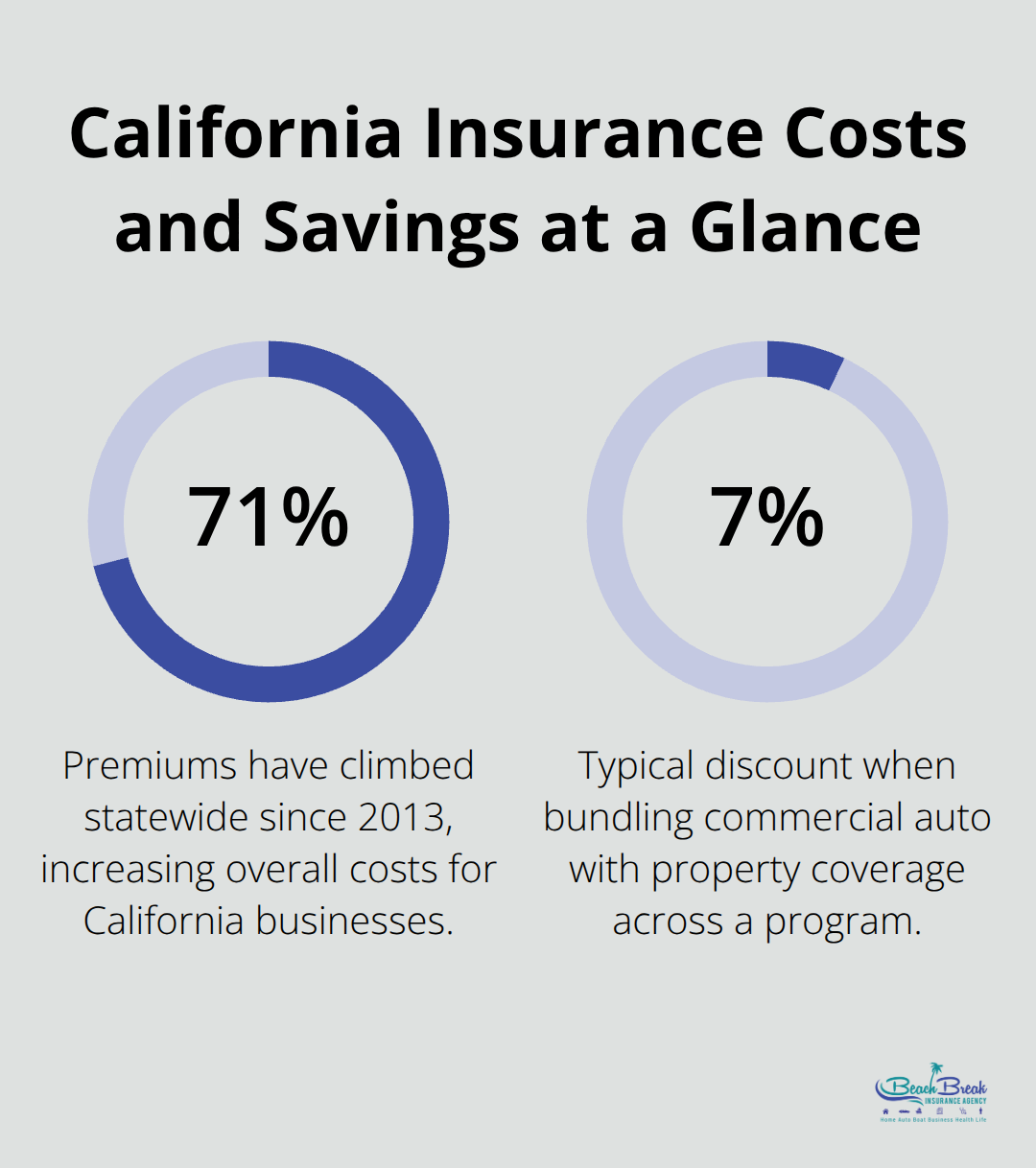
California insurance premiums have climbed 71 percent since 2013, according to direct premium data tracked across the state.

Chart showing 71% premium surge since 2013 and a 7% bundling discount opportunity for California businesses.

That surge means the carrier you pick today directly controls whether your business pays $5,000 or $15,000 annually for the same coverage. General liability alone ranges from $400 to $1,500 per year for small firms, but high-risk industries like construction jump to $2,000 or more. A Business Owner’s Policy bundles property and liability coverage and typically costs 10 to 20 percent less than buying those lines separately, which is why checking multiple carriers matters. One business might qualify for a BOP at $1,200 per year while another receives a quote of $2,000 for identical limits simply because underwriters weigh risk differently. Shopping three to five carriers reveals these gaps fast. Workers’ compensation premiums vary wildly too, calculated per $100 of payroll and ranging from under $1 for clerical work to over $20 for roofing. A small construction firm with five employees could see premiums swing by thousands depending on the carrier’s appetite for that trade. Commercial auto insurance typically runs $1,200 to $3,500 per vehicle annually, but a clean driving record with one insurer might earn you a better rate than a competitor offers. The point is blunt: accepting the first quote you receive leaves money on the table, and in a market where California premiums already outpace most states, that mistake compounds year after year.

Hidden Exclusions Cost More Than High Premiums

Coverage gaps hide in plain sight across quotes. A quote that looks cheap often excludes coverages your lease requires or your industry demands. California contracts routinely mandate specific liability limits and endorsements even when state law does not, so comparing quotes against your actual lease or client agreements reveals which carriers truly fit your obligations. Professional liability for service businesses starts around $500 to $1,000 annually, but endorsements like equipment breakdown or extended business interruption add protection that some quotes include and others skip entirely.

Specialized Coverage Varies Dramatically Between Carriers

Cyber liability premiums range from $500 to $5,000 per year depending on data volume and security practices, yet many small owners skip it because they did not see it listed in a baseline quote. Wildfire coverage in fire-prone regions like Sonoma County affects property insurance costs dramatically, and carriers respond differently to wildfire risk based on their underwriting appetite. One insurer might renew you at the same rate while another non-renews because their portfolio exposure shifted.

Identical Limits Hide Critical Differences

Comparing quotes side by side against your specific exposures prevents you from discovering a coverage gap only after a loss occurs. The most dangerous mistake is thinking all quotes for the same coverage limit are equal. Identical limits can hide different exclusions, different deductible structures, or different claim-handling processes that matter when you actually file a claim. These differences determine whether a carrier pays your claim quickly or fights you in court.

What Actually Matters When You Compare Quotes

Start With Your Actual Coverage Needs, Not the Lowest Price

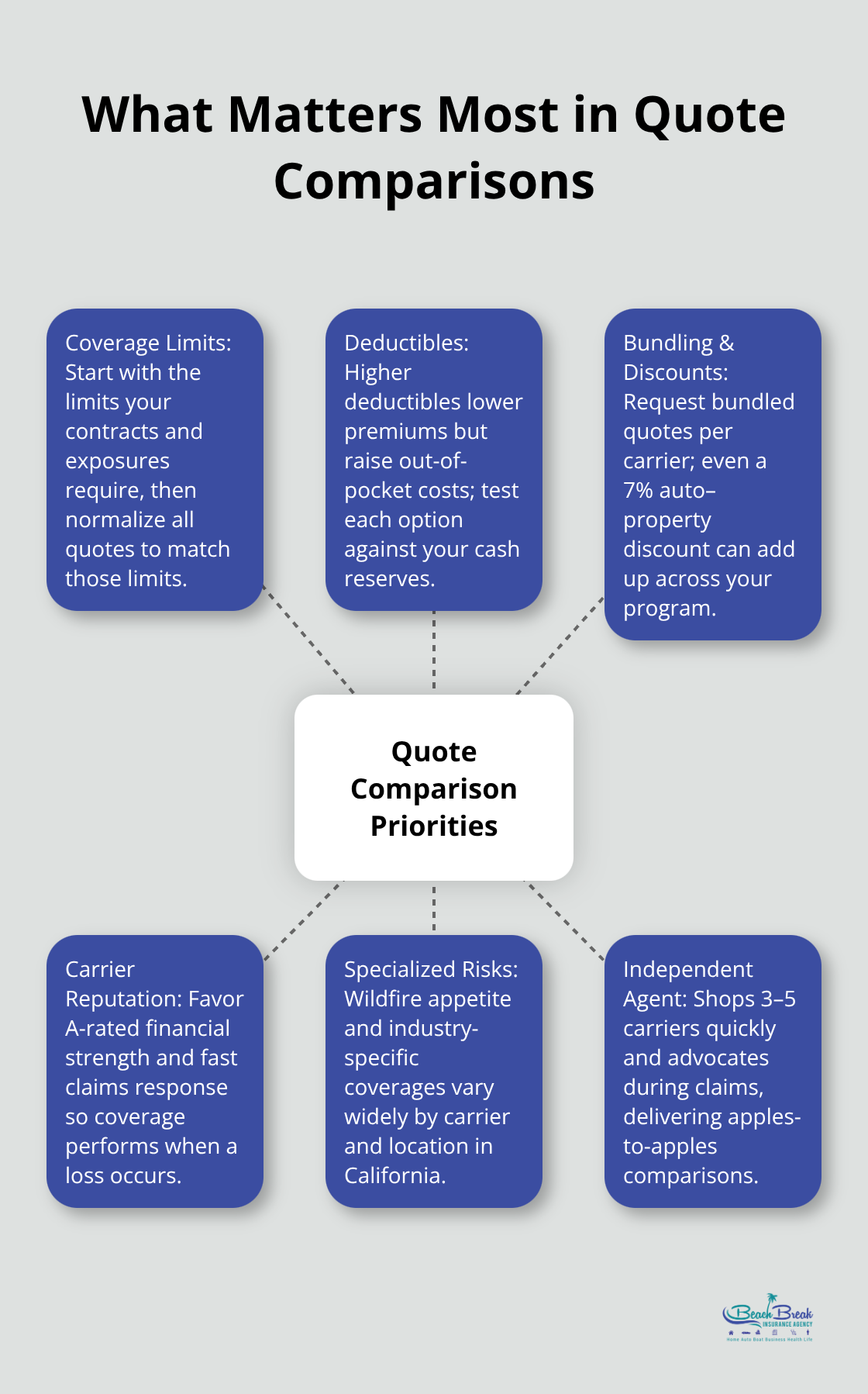
Coverage limits and deductibles form the foundation of every quote comparison, but most small business owners reverse the process. They chase the lowest premium first and then try to understand what they actually bought. Start instead with your actual exposures and work backward to find quotes that match. If your lease requires $2 million in general liability coverage, a quote offering $1 million at a lower price becomes worthless because you cannot accept it. California contracts often demand specific coverage amounts that state law does not require, so pull your lease, client agreements, and any vendor contracts before requesting quotes. Compare quotes only after you normalize all of them to identical coverage limits across every line. An $800 annual premium for a Business Owner’s Policy with $300,000 in property coverage does not cost less than a $950 quote with $500,000 in property coverage if your equipment inventory actually exceeds $400,000.

Deductibles Determine What You Pay When Claims Happen

Deductibles create the second layer of comparison that trips up owners. Higher deductibles lower your premium but raise what you pay out of pocket when a loss hits. A $1,000 deductible versus a $2,500 deductible might save $300 annually on workers compensation, but if your business cannot absorb that extra $1,500 in a single claim, you chose poorly.

Hub-and-spoke diagram highlighting key priorities when comparing California business insurance quotes.

California construction firms and manufacturers face workers comp premiums calculated per $100 of payroll ranging from $5 to $20 depending on the trade, so a deductible choice compounds across dozens of employees. Test each deductible option against your actual cash reserves to confirm you can cover it without disrupting operations.

Bundling Discounts and Premium Context Matter More Than You Think

Premium cost comparisons demand context that online quote tools cannot provide. A 7 percent discount for bundling auto and property coverage sounds small until you calculate it across your entire program, which could mean $400 to $800 in annual savings depending on your size. A Business Owner’s Policy median runs around $1,687 annually for small firms, but your actual quote depends entirely on your industry risk level and location within California. Construction and manufacturing pay substantially more than professional services, and wildfire-prone areas like Sonoma County see property premiums spike compared with inland regions. Request bundling quotes from each carrier and compare the total program cost, not individual line items.

Carrier Reputation and Claims Speed Separate Good Insurance From Real Protection

Carrier reputation and claims processing speed separate adequate insurance from actual protection when you need it most. Check the California Department of Insurance complaint records and financial stability ratings through A.M. Best, trying for carriers rated A or better, because a low premium from a financially weak insurer becomes worthless if they cannot pay your claim. Ask every carrier directly how long they take to assign a claims adjuster after you file, and request the contact information for their local claims office in your area. Independent agents can shop multiple carriers simultaneously and advocate for you during claims, while captive agents sell only one company’s products and cannot reveal better options elsewhere in the market. The speed at which a carrier responds to your claim often matters more than the premium you paid.

Getting Quotes Ready Without Wasting Time

Organize Your Business Information First

Requesting quotes without first organizing your business information wastes everyone’s time and produces incomplete comparisons. Pull together the actual details that underwriters need: your business structure, annual revenue, number of employees, specific job duties for each role, equipment inventory value, annual payroll, any prior claims history, and lease or contract requirements. This takes about 30 minutes but prevents carriers from requesting information three times over email. When you request quotes with complete data upfront, you receive comparable quotes within days rather than weeks.

Incomplete applications force underwriters to make assumptions that inflate premiums or create coverage gaps you did not expect. For workers compensation specifically, have your payroll breakdown by classification ready because California rates vary significantly by job classification. If you operate multiple locations or have seasonal employees, document that structure clearly because it affects how carriers structure your quote.

Document Your Contractual Coverage Requirements

A construction firm with five permanent employees and ten seasonal workers requires different workers comp calculations than a firm with only five permanent staff, and vague descriptions lead to low-ball quotes that do not cover your actual exposure. Pull your commercial lease and any client contracts that specify insurance requirements, then flag the exact coverage limits and endorsements demanded. Most California contracts require general liability minimums of $1 million to $2 million even when state law does not mandate those amounts, so knowing your contractual obligations before requesting quotes prevents you from accepting inadequate coverage at a discount price.

Use an Independent Agent to Shop Multiple Carriers

Independent agents dramatically streamline the quote process because they request quotes from multiple carriers simultaneously rather than you contacting each insurer separately. An independent agent can shop three to five major carriers within 24 to 48 hours and present you with apples-to-apples comparisons, while requesting quotes individually takes two weeks or more. An independent agent can compare multiple top-rated carriers at once to deliver tailored coverage and help you save time and money.

Build a Comparison Spreadsheet With All Key Data Points

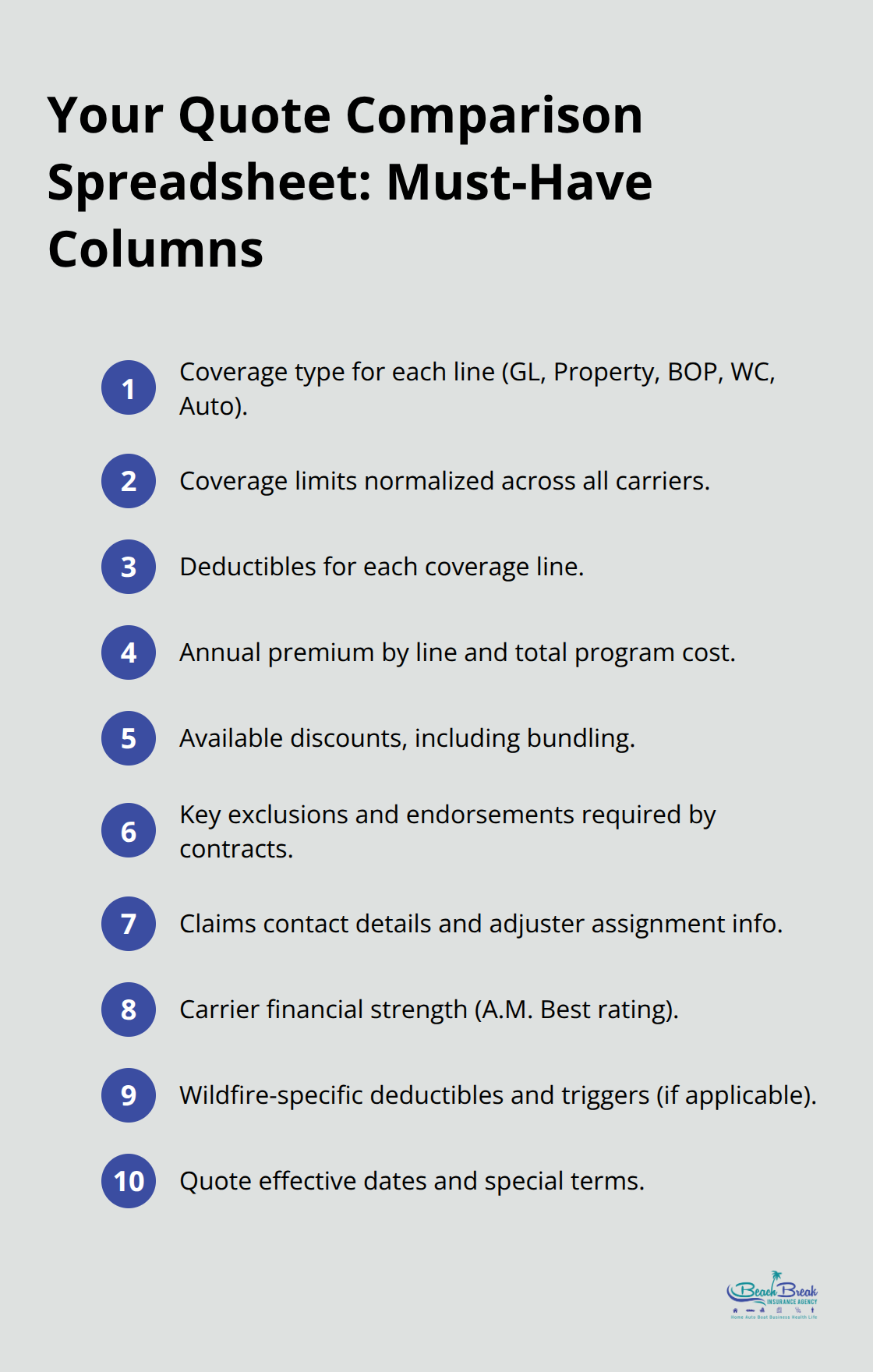
Once you receive quotes, create a spreadsheet with coverage type, limits, deductibles, annual premium, available discounts, and exclusions for each carrier across every line of coverage. This forces you to normalize quotes to identical limits so you see real price differences rather than comparing a $1 million liability limit against a $2 million limit. Add columns for claims contact information and carrier financial ratings from A.M. Best so you have carrier stability data alongside pricing.

Compact checklist of essential columns to include when comparing California business insurance quotes.

For a business with property, liability, workers compensation, and commercial auto coverage, this spreadsheet contains roughly 20 to 30 data points per carrier, but comparing those details side by side reveals which carrier truly offers the best value rather than just the lowest premium. Wildfire-prone regions like Sonoma County need property coverage columns that specifically track fire deductibles and coverage triggers because carriers vary dramatically on wildfire appetite. A spreadsheet also prevents you from overlooking bundling discounts, which typically save 7 percent on auto when bundled with property and can compound to hundreds of dollars annually across your full program.

Final Thoughts

Comparing California business insurance quotes directly controls whether your business pays $5,000 or $15,000 annually for the same protection. Premiums have surged 71 percent since 2013, which means the carrier you select today compounds into thousands of dollars in savings or waste over the years ahead. Start with your actual coverage needs rather than chasing the lowest premium, normalize all quotes to identical limits, and build a spreadsheet that tracks coverage, deductibles, exclusions, and carrier ratings side by side.

An independent agent accelerates this process by shopping multiple top-rated carriers simultaneously and advocating for you during claims in ways that captive agents cannot match. Test each deductible option against your cash reserves to confirm you can absorb it without disrupting operations, and always verify that carriers hold A-rated financial strength from A.M. Best because a low premium from a weak insurer protects nothing. At Beach Break Insurance Agency, we compare quotes from multiple carriers to deliver tailored coverage that aligns with your actual exposures and budget.

Contact an independent agent who understands California’s regulatory environment and can shop the full market on your behalf. The time you invest now in comparing California business insurance quotes compounds into years of savings and genuine protection when claims happen.

The information provided in this blog is for general informational purposes only and does not constitute legal, financial, or insurance advice. Coverage options, terms, and availability may vary. Please consult with a licensed professional for advice specific to your situation.
Artificial intelligence may have been used to generate text and images in some blog articles.
Small Restaurant Insurance in California: Smart Choices for Growth

Running a restaurant in California means juggling dozens of moving parts. One mistake with your insurance coverage can cost you thousands in unexpected expenses.

We at Beach Break Insurance Agency work with restaurant owners who discover gaps in their policies only after something goes wrong. Small restaurant insurance in California requires careful planning, not guesswork.

What Coverage Do California Restaurants Actually Need

General liability, property insurance, and workers’ compensation form the foundation of restaurant protection in California, but the numbers matter more than the names. General liability insurance typically costs around $141 per month and covers third-party bodily injury and property damage claims, such as when a customer slips on a wet floor or suffers a foodborne illness from your menu items. California requires this coverage at roughly $1 million per occurrence and $2 million aggregate for most restaurants.

Checklist of essential restaurant insurance coverages in California with typical monthly costs. - Small restaurant insurance California

Property insurance protects your building, leasehold improvements, kitchen equipment, and inventory from fire, theft, and water damage-a Business Owner’s Policy that bundles property and liability coverage averages about $251 monthly and represents the most cost-effective starting point for growth. However, property policies in California often exclude wildfire damage or impose dangerously low sublimits, so you should verify your actual coverage limits for fire risk in your specific location rather than assuming standard protection applies.

Workers’ Compensation Is Mandatory in California

Workers’ compensation is mandatory for any restaurant with employees and costs between $15,000 and $30,000 annually for a $500,000 payroll, depending on job classifications and claims history. California imposes criminal charges and fines starting at $10,000 for non-compliance, making this the one policy you cannot skip. A clean safety record directly lowers your experience modification factor, reducing premiums over time, so you should implement basic hazard controls in the kitchen and dining areas to see measurable savings. At roughly $113 per month for a small restaurant, workers’ comp remains genuinely affordable compared to the financial devastation of an uninsured employee injury claim.

Equipment Breakdown Protects Your Kitchen Operations

Standard property policies do not cover equipment breakdown or food spoilage, yet a walk-in cooler failure or POS system outage can wipe out your inventory in hours. Equipment breakdown coverage typically costs $30–$50 monthly and protects refrigeration, ovens, and point-of-sale systems when they malfunction. This endorsement covers the repair or replacement costs that property insurance ignores, preventing operational shutdowns during your growth phase.

Food Spoilage Coverage Reimburses Inventory Loss

Food spoilage coverage, often bundled into commercial packages, reimburses you for perishable inventory lost during power outages or equipment failures-a critical addition if your restaurant depends on high-value inventory turnover. Many restaurant owners skip this endorsement and face thousands in losses when equipment fails unexpectedly. Adding spoilage protection upfront prevents painful surprises and keeps your cash flow stable as you expand operations.

Liquor Liability Fills a Critical Gap

If you serve alcohol, general liability does not cover alcohol-related claims, leaving you exposed to dram shop liability and over-service incidents. Liquor liability insurance costs around $41 per month and protects against claims arising from serving alcohol to intoxicated patrons or minors. California’s Responsible Beverage Service certification teaches servers to responsibly serve alcoholic beverages and can qualify you for premium discounts, so staff training directly reduces your insurance costs. This coverage becomes more important as alcohol revenue grows, so you should assess your current mix and adjust limits accordingly as your menu evolves.

What You’re Probably Missing in Your Restaurant Coverage

Most restaurant owners in California think their general liability and property policies cover everything until a specific incident reveals otherwise. The gap between what you believe is covered and what actually is covered tends to cost thousands in out-of-pocket expenses.

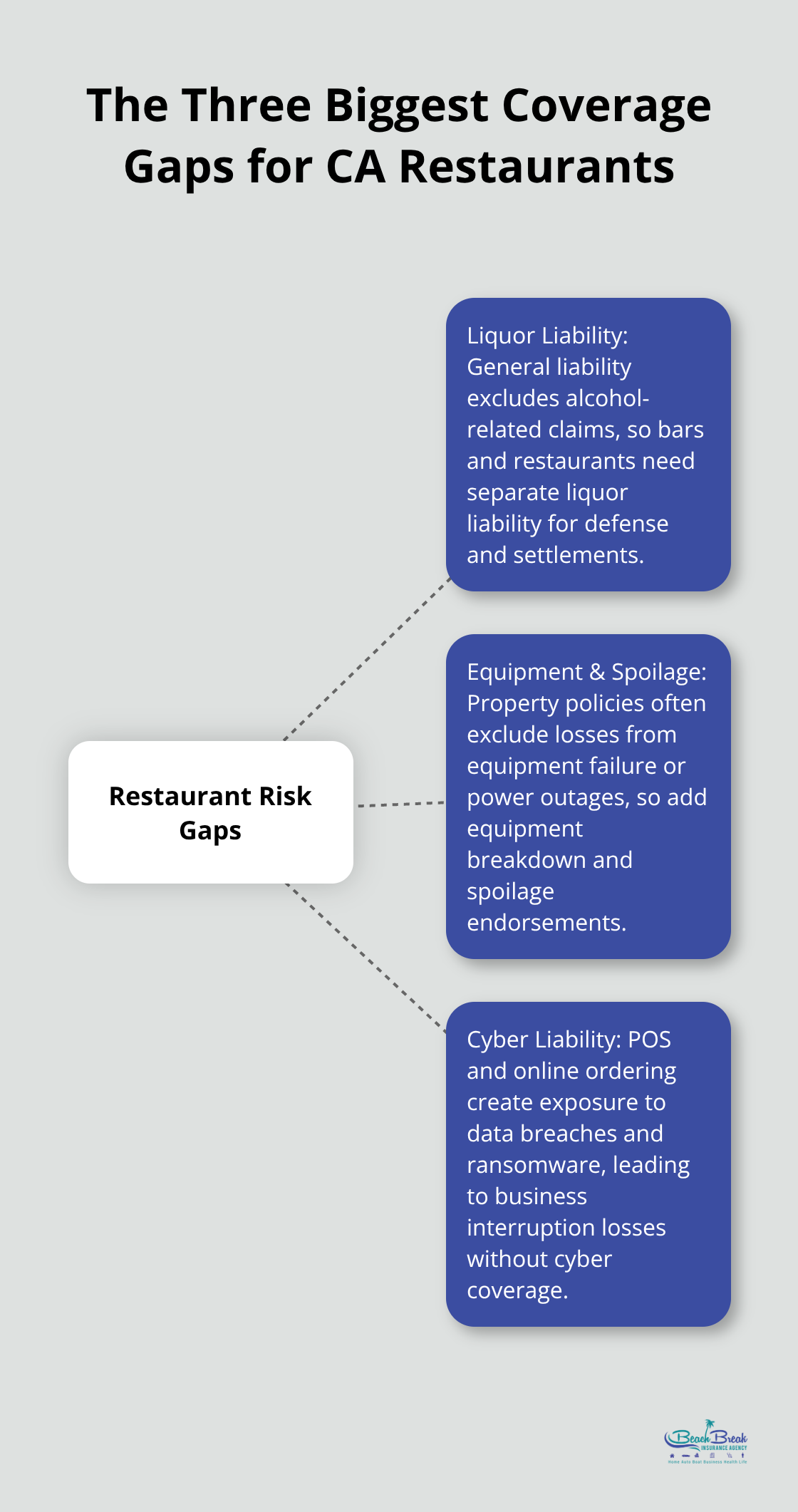
Liquor Liability Exposes You to Dram Shop Claims

Liquor liability stands as the first major blind spot because general liability explicitly excludes alcohol-related claims. If a customer becomes intoxicated at your restaurant and causes harm, your standard policy will not defend you or cover settlements. In California, dram shop liability theories generally do not impose civil liability on bars, restaurants, or social hosts for injuries caused by intoxicated adults, yet liquor liability coverage remains essential for other alcohol-related exposures and legal defense costs.

Many restaurant owners carry liquor liability at the minimum $41 monthly cost without understanding that this coverage becomes more expensive as alcohol revenue grows. Your current premium may not reflect your actual exposure if you have expanded your bar program or added craft cocktails to your menu in the past year. Assess your alcohol revenue mix and adjust your limits accordingly as your menu evolves.

Equipment Failure and Spoilage Wipe Out Your Inventory

Inventory and spoilage represent the second major gap because standard property policies exclude food losses from equipment failure or power outages. A walk-in cooler breakdown during summer destroys $3,000 to $8,000 in perishable inventory within hours. Restaurant owners frequently assume that property insurance covers spoilage, then face the harsh reality that they must absorb the full loss themselves when equipment fails unexpectedly.

Equipment breakdown coverage costs $30 to $50 monthly and protects refrigeration units, ovens, and dishwashers from mechanical failure. Food spoilage endorsements specifically reimburse inventory losses during covered outages. Adding both endorsements to your policy takes twenty minutes to arrange and prevents the cash flow crisis that follows a kitchen equipment failure during peak operating season.

Cyber Attacks Halt Your Point-of-Sale Operations

Cyber liability represents the third and most overlooked gap for restaurants operating point-of-sale systems and accepting online orders or reservations through digital platforms. Cyber insurance costs approximately $129 monthly and covers data breach notification costs, credit monitoring for affected customers, and business interruption losses when your POS system goes offline due to a cyberattack or ransomware incident.

California restaurants processed an estimated 40 percent more digital transactions in 2024 compared to 2022, yet most small restaurant owners have not added cyber coverage to their policies despite this shift. A ransomware attack that locks your POS system halts operations for two to five days, during which you lose revenue while still paying staff and rent. Cyber insurance serves as a practical financial safeguard rather than an optional add-on. Your current policy likely covers neither the system restoration costs nor the business interruption losses from a cyberattack, leaving you completely exposed to a growing threat that affects restaurants of all sizes across California.

Understanding these three gaps positions you to make smarter coverage decisions. The next section walks you through how to compare quotes and select the right limits for your specific operation without overpaying for protection you don’t need.

Hub-and-spoke diagram showing liquor liability, equipment/spoilage, and cyber liability as key gaps.

Pick the Right Coverage for Your Restaurant’s Actual Risks

Gather Quotes That Reflect Your Specific Operation

Comparing insurance quotes requires more than scanning headline premiums. Start by requesting three to five quotes from carriers that specialize in restaurant coverage rather than treating your business as a generic commercial account. Progressive Commercial, Insureon’s network of carriers, and regional insurers familiar with California fire zones all provide tailored quotes within 24 hours. When you request quotes, provide accurate payroll numbers, employee count, annual revenue, and a detailed description of your operation-whether you operate a full kitchen with liquor service, a ghost kitchen for delivery only, or a catering operation. Carriers price policies based on these specifics, so vague applications produce inflated estimates that don’t reflect your actual risk.

Compare Coverage, Not Just Price

Once you receive quotes, ignore the headline premium and instead compare what each policy covers. A $200 monthly policy that excludes equipment breakdown and spoilage costs far more than a $280 policy that includes both endorsements, because the cheaper option leaves you exposed to thousands in uninsured losses. Review each quote’s limits, deductibles, exclusions, and endorsements side by side using a simple spreadsheet.

Compact checklist of what to line up when comparing restaurant insurance quotes. - Small restaurant insurance California

Note which policies exclude wildfire damage, which offer spoilage coverage, and which include cyber liability. This comparison takes 30 minutes and reveals which carrier actually understands California restaurant risks versus which one simply bundled generic coverage into a low price.

Match Coverage Limits to Your Restaurant’s Characteristics

Your restaurant’s specific characteristics should dictate coverage limits, not industry averages. A 40-seat neighborhood restaurant with no alcohol service needs different limits than a 120-seat gastropub with a full bar program and delivery operations. Calculate your property coverage by adding the replacement cost of your building or leasehold improvements, all kitchen equipment, furniture, POS systems, and typical inventory-most California restaurants underestimate this value by 30 to 40 percent, then face coverage shortfalls when equipment fails or fire damage occurs. If you operate delivery or catering, add commercial auto coverage with hired and non-owned auto protection, because personal vehicle policies exclude business use and leave you liable for accidents.

For liquor liability, assess what percentage of your current revenue comes from alcohol sales-if it exceeds 25 percent, your baseline policy is inadequate and you should increase limits to $500,000 or $1,000,000 per occurrence. Workers’ compensation cost depends on your payroll and job classifications, so provide your actual staff breakdown rather than estimates. A kitchen with five cooks, two dishwashers, and eight servers will have different workers’ comp costs than a kitchen with two cooks and twelve servers, because job classification drives the premium. Request that each carrier calculate your experience modification factor based on your claims history, because a clean safety record can reduce your workers’ comp premium by 10 to 15 percent over two years.

Account for Equipment Value and Location Risk

Equipment breakdown coverage should reflect your cooler and oven replacement costs-if your walk-in cooler costs $8,000 to replace and holds $4,000 in daily inventory, equipment breakdown and spoilage coverage is worth the $40 to $50 monthly cost. Location matters significantly in California: restaurants in Los Angeles and San Francisco pay 20 to 30 percent higher premiums than suburban or rural locations due to higher property values and loss frequency. If you operate in a high-fire zone, verify that your property policy doesn’t exclude wildfire damage or impose sublimits below your building’s replacement cost. The California FAIR Plan offers fire insurance as a last resort when standard carriers won’t cover your property, but FAIR Plan policies cost significantly more and include higher deductibles, so careful carrier selection saves money long term.

Final Thoughts

Proper insurance protects your growth by eliminating the financial uncertainty that derails restaurant expansion. When you carry the right coverage at the right limits, you operate with confidence knowing that equipment failures, customer injuries, employee claims, and cyberattacks won’t force you to choose between paying staff and staying open. Small restaurant insurance in California requires deliberate choices about what risks matter most to your operation, not blind acceptance of whatever your landlord or lender demands.

Your next step is straightforward: gather three to five quotes from carriers that specialize in restaurant coverage, compare what each policy actually covers rather than just the monthly premium, and adjust limits based on your specific payroll, property value, and revenue sources. Most carriers deliver quotes within 24 hours, so you can complete this comparison in a single afternoon. Request quotes within the next week so you have time to review them carefully before your renewal date arrives.

We at Beach Break Insurance Agency help restaurant owners navigate these decisions by comparing quotes from multiple top-rated carriers and delivering tailored coverage that matches your actual needs. As an independent San Diego-based agency, we quickly identify gaps in your current policy and show you exactly what additional coverage costs versus what it protects. Contact Beach Break Insurance Agency to discuss your restaurant’s specific risks and get a personalized quote that reflects your growth plans rather than industry averages.

The information provided in this blog is for general informational purposes only and does not constitute legal, financial, or insurance advice. Coverage options, terms, and availability may vary. Please consult with a licensed professional for advice specific to your situation.
Artificial intelligence may have been used to generate text and images in some blog articles.

Restaurant General Liability Insurance: Protecting Your Restaurant and Reputation

Running a restaurant means managing countless moving parts every single day. One slip-a customer’s fall, a food-related illness, or accidental property damage-can turn into a costly lawsuit that threatens your business.

Restaurant general liability insurance protects you from these financial disasters. At Beach Break Insurance Agency, we help restaurant owners understand what coverage they actually need and how to get protected without overpaying.

What General Liability Actually Covers in Your Restaurant

Bodily Injury Claims and Medical Expenses

General liability insurance protects your restaurant against three major categories of claims that can drain your finances fast. First, bodily injury claims cover medical expenses when a customer or visitor gets hurt on your premises. This includes slip-and-fall incidents, which account for nearly 25% of all workplace injuries in the service industry. If a customer slips in your dining area and breaks their arm, general liability pays their medical bills and any legal defense costs if they sue. The coverage also extends to food-related illnesses-if someone gets sick from your food and files a claim, this policy covers investigation costs, settlements, and your legal defense.

Infographic showing the three core protection categories included in restaurant general liability insurance in the U.S.

Property Damage Liability

Second, property damage liability protects you when your restaurant accidentally damages someone else’s property. This might seem less common than bodily injury, but it happens regularly. If your delivery driver hits a parked car, or if water from your building damages a neighbor’s property, general liability covers the damage costs. These incidents can expose you to significant financial liability without proper coverage in place.

Advertising Injury Coverage

Third, advertising injury coverage handles claims arising from your marketing activities, such as accusations of defamation or copyright infringement in your ads or social media. This protection matters more than many restaurant owners realize, especially as you expand your digital presence.

Real Costs and Coverage Limits

The financial stakes are real. Among restaurant customers, general liability averages around $42 per month for small businesses, with typical monthly costs ranging from 54 to 334 dollars depending on coverage specifics and your restaurant’s risk profile. Common per-occurrence limits run from 500,000 to 1,000,000 dollars, with aggregate limits between 500,000 and 2,000,000 dollars. Many policies offer a zero deductible for general liability, which means you won’t pay anything out of pocket when you file a claim.

Compact list summarizing average premiums, typical cost ranges, and common liability limits for U.S. restaurants. - Restaurant general liability insurance

Why You Can’t Afford to Skip This Coverage

The real question isn’t whether you can afford this coverage-it’s whether you can afford not to have it. A single serious injury claim can cost tens of thousands of dollars in medical expenses and legal fees alone. Your lease and lenders almost certainly require this coverage anyway, so getting it protects both your business and your contractual obligations. Understanding what limits work best for your specific restaurant operation becomes the next critical step.

Why Your Restaurant Needs This Coverage Now

Slip-and-Fall Claims Lead Restaurant Losses

Slip-and-fall incidents represent the top claim type across restaurants, driven by wet floors, cluttered aisles, uneven surfaces, and poor lighting. Analysis of restaurant claims data confirms this pattern across the industry. A single slip-and-fall claim costs your restaurant thousands in medical expenses and legal defense, even if you win the case. These incidents happen constantly in food service environments where water, grease, and spills create hazardous conditions. Without general liability coverage, you absorb the full financial impact of these preventable accidents.

Foodborne Illness and Kitchen Injuries Create Significant Exposure

Foodborne illness claims have increased as restaurants expand delivery and takeout operations. When a customer contracts food poisoning from your establishment, general liability covers the investigation, medical expenses, and settlements. Kitchen burns and cuts from knives, slicers, and fryers also generate claims regularly. These incidents happen despite precautions, and one serious injury claim can devastate your finances. The financial reality is stark: a customer hospitalization from food poisoning or a severe burn injury results in settlements ranging from $10,000 to $100,000 or more depending on severity and jurisdiction.

Lease and Lender Requirements Make Coverage Mandatory

Your lease and lender almost certainly require general liability insurance as a contractual condition. Most commercial landlords mandate minimum coverage of $500,000 to $1,000,000 per occurrence before you occupy the space. Banks financing restaurant equipment or build-outs will not approve loans without proof of adequate liability coverage. This requirement protects them from exposure if your restaurant causes injury or property damage. Suppliers and delivery partners often require certificates of insurance before they work with you.

Personal Liability Exposure Without Coverage

Operating without this coverage leaves you personally liable for claims. Creditors can pursue your personal assets, home, and savings if a judgment exceeds your restaurant’s resources. The cost of protection is minimal compared to the exposure. General liability runs roughly $42 to $74 per month for small restaurants with standard risk profiles, making it one of the most affordable risk management tools available. This modest investment shields your restaurant, your personal finances, and your ability to operate legally on leased premises.

Now that you understand why general liability matters, the next step involves selecting the right coverage limits and comparing options from multiple carriers to match your restaurant’s specific risk profile.

How to Choose the Right Coverage for Your Restaurant

Assess Your Specific Business Risks

Your restaurant’s specific risks determine the coverage limits you need. A fine-dining establishment with a full bar faces different exposures than a quick-service pizza shop. If you serve alcohol, your liability exposure increases significantly because dram shop laws in most states hold you responsible for injuries caused by intoxicated patrons. A customer injured in a bar altercation or car accident after overservice can sue for substantial damages.

Restaurants with outdoor seating, delivery operations, or catering services add additional exposure points. Your building size and square footage matter too-a 2,000-square-foot neighborhood cafe has fewer slip-and-fall hazards than a 6,000-square-foot establishment with multiple dining rooms and a busy bar area. The number of employees and their job classifications affect your risk profile as well. A kitchen with six line cooks generates more burn and cut injuries than a counter-service operation.

List every way a customer or visitor could potentially be injured at your restaurant, then map those scenarios to coverage needs. This exercise reveals exposure points you might otherwise overlook.

Determine Appropriate Coverage Limits

Most restaurant owners should carry per-occurrence limits between $500,000 and $1,000,000, with aggregate limits of $1,000,000 to $2,000,000. This range covers typical slip-and-fall claims, foodborne illness cases, and property damage incidents without excessive premium costs. If you serve alcohol, lean toward the higher end of this range because liquor liability claims tend to settle for larger amounts.

The financial stakes justify adequate limits. A customer hospitalization from food poisoning or a severe burn injury results in settlements ranging from $10,000 to $100,000 or more depending on severity and jurisdiction. Underinsuring exposes your personal assets to judgment creditors.

Compare Quotes from Multiple Carriers

Once you’ve identified your target limits, obtain quotes from at least three different carriers to reveal significant price variations for identical coverage. A $500,000 per-occurrence limit might cost $45 per month from one carrier and $85 from another, depending on their underwriting criteria and risk appetite. Shopping multiple carriers takes time but saves substantial money over your policy term.

Evaluate Deductible Options

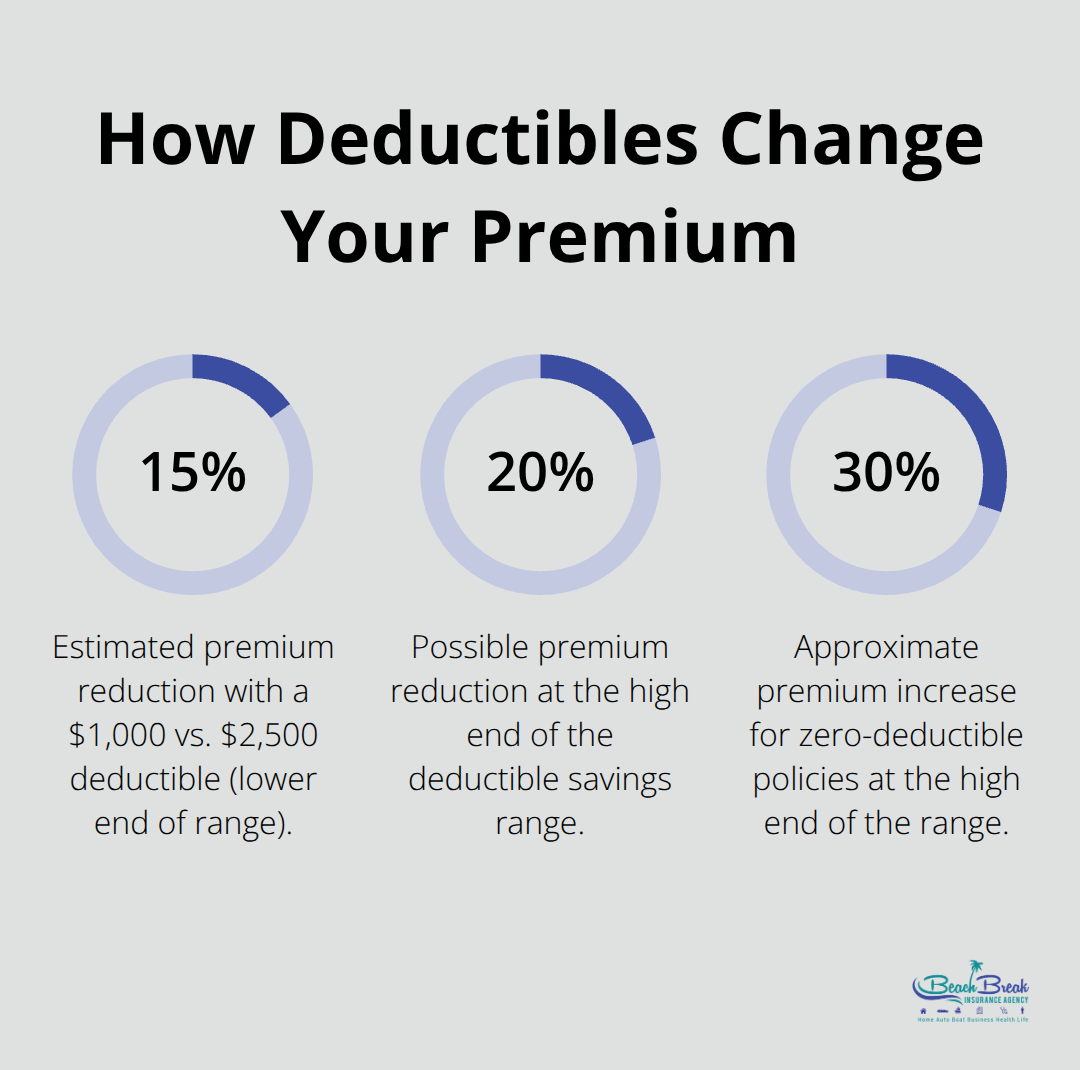
Many restaurant owners overlook deductible choices, but this decision impacts both premiums and out-of-pocket costs. A $1,000 deductible versus a $2,500 deductible can reduce your monthly premium by 15 to 20 percent, though you’ll pay more out of pocket when filing a claim. The zero-deductible policies advertised by some carriers sound appealing but typically cost 20 to 30 percent more in premiums.

Percentage chart showing deductible savings and the higher cost of zero-deductible policies for U.S. restaurants.

Calculate whether saving $10 to $15 monthly justifies paying $1,000 or more if you need to file a claim. Most restaurant owners find that a deductible option strikes the right balance between affordable premiums and manageable out-of-pocket exposure.

Final Thoughts

Restaurant general liability insurance protects your business from the financial devastation that slip-and-fall incidents, foodborne illness claims, and property damage can cause. A single serious injury claim costs tens of thousands of dollars in medical expenses and legal fees, but your monthly premium stays affordable at $42 to $74 for most small restaurants. Your lease and lenders require this coverage anyway, so obtaining protection fulfills contractual obligations while safeguarding your personal assets.

Start by assessing your specific restaurant risks based on your cuisine type, alcohol service, building size, and employee count. Then determine appropriate coverage limits between $500,000 and $1,000,000 per occurrence based on your exposure level. Once you identify your target limits, obtain quotes from multiple carriers to find the best price for identical coverage, since variation between carriers can save you substantial money over your policy term.

Loss prevention measures reduce claims frequency and help you negotiate better renewal terms. Place saturated mats at entrances, keep aisles clear, maintain regular hood and duct inspections per NFPA 96 standards, and enforce strict food safety protocols with no bare-hand contact on ready-to-eat foods. We at Beach Break Insurance Agency specialize in comparing quotes from multiple top-rated carriers to deliver tailored restaurant general liability insurance for your specific needs, so contact us today to get quotes that match your restaurant’s risk profile and budget.

The information provided in this blog is for general informational purposes only and does not constitute legal, financial, or insurance advice. Coverage options, terms, and availability may vary. Please consult with a licensed professional for advice specific to your situation.
Artificial intelligence may have been used to generate text and images in some blog articles.
Wildfire Coverage for Homes: Protecting Your Property

Wildfires are destroying homes at record rates across the country, and standard homeowners insurance often leaves significant gaps in protection. At Beach Break Insurance Agency, we’ve helped countless homeowners understand what wildfire coverage for homes actually covers and where their policies fall short.

The right preparation and insurance strategy can mean the difference between financial recovery and devastating loss. This guide walks you through your coverage options and the concrete steps to protect your property today.

How Wildfires Threaten Your Home and What It Means for Your Coverage

Wind-Blown Embers Travel Farther Than You Think

Wildfires move faster and burn hotter than most homeowners realize, and understanding how they threaten your specific property is the first step toward protecting it. Wind-blown embers can be carried by winds and deposited several miles downwind, meaning your house faces risk even if the fire itself hasn’t reached your neighborhood. The Congressional Research Service reports that roughly 61,410 wildfires occur annually across the United States, burning about 7.2 million acres per year between 2013 and 2022. Climate change is intensifying this problem, making fires more frequent and destructive.

Your roof and attic represent your home’s most vulnerable zones. A wood shingle roof ignites far more easily than composite, asphalt, metal, clay, or tile roofing. Unsealed gaps under roof tiles and shingles allow wind-blown embers to enter your attic, where they can smolder and ignite hours after the fire has passed. Gutters filled with leaves and pine needles act as fuel sources that accelerate this process.

Three Factors That Determine Your Home’s Vulnerability

Your home’s vulnerability depends on three concrete factors: building materials, nearby vegetation, and defensible space around your property. Vegetation within 10 feet of your house creates a direct path for flames to reach your walls and windows. Trees with low-hanging branches and dense shrubs trap heat and embers against your structure. The materials you use to construct and maintain your home either slow fire spread or accelerate it-there is no middle ground.

Regional Variations Shape Your Coverage Options and Costs

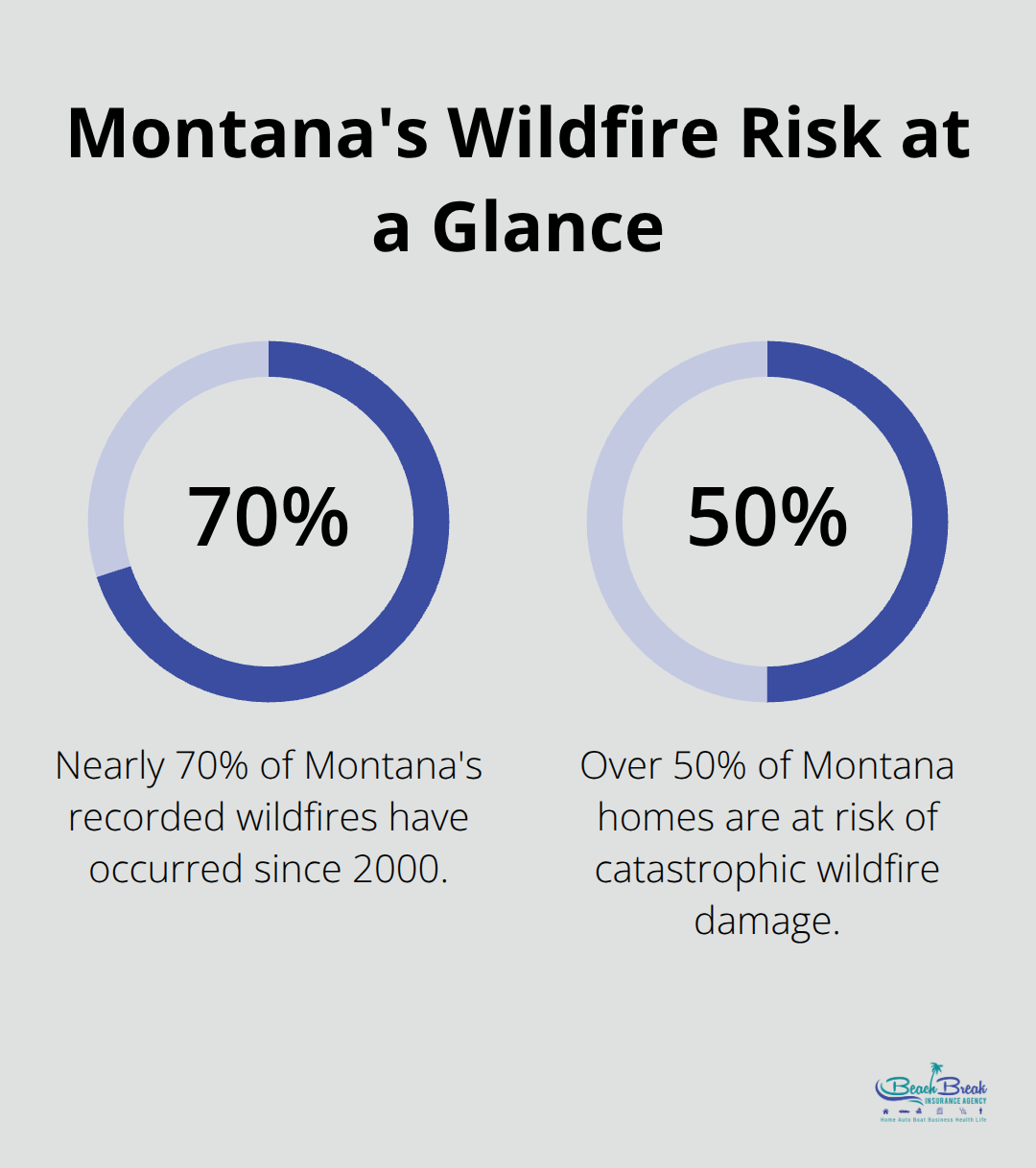
Regional variations matter enormously for your coverage options and costs. Montana has experienced the fifth-highest state increase in homeowners insurance rates this year according to the National Association of Realtors, driven by higher replacement costs and property values combined with wildfire risk. Nearly 70 percent of all wildfires on record in Montana have occurred since 2000, and the state now ranks second nationally for the percentage of homes at risk of catastrophic wildfire damage, with over 50 percent of properties vulnerable. Homeowners near wildland-urban interfaces face steep premium hikes or non-renewal notices because insurers are pricing risk more aggressively.

Key Montana wildfire statistics impacting insurance costs

Washington experiences hundreds of thousands of acres burned each year, with most fires started by people and risk remaining dangerously high during dry summer months. If standard insurers won’t cover you in high-risk areas, the California FAIR Plan provides coverage when the private market cannot, though policies typically cost more with lower limits. Washington requires all standard homeowners and renters policies to include fire damage protection, with insurers using terms aligned with Washington’s official model fire policy.

The Gap Between Coverage and Actual Rebuilding Costs

Having fire coverage and having enough fire coverage are different things. Your dwelling coverage must reflect actual rebuilding costs in your area, which have surged after large-scale wildfires due to labor and material shortages. Extended replacement cost or guaranteed replacement cost coverage closes the gap between your policy limit and what rebuilding actually costs. Personal property coverage has sublimits for high-value items like jewelry and firearms, meaning standard limits may not fully protect these belongings unless you schedule them separately on your policy. Understanding these gaps in your current policy is essential before a fire threatens your property.

What Your Standard Policy Actually Covers in a Wildfire

Fire Coverage Exists, But Gaps Are Widespread

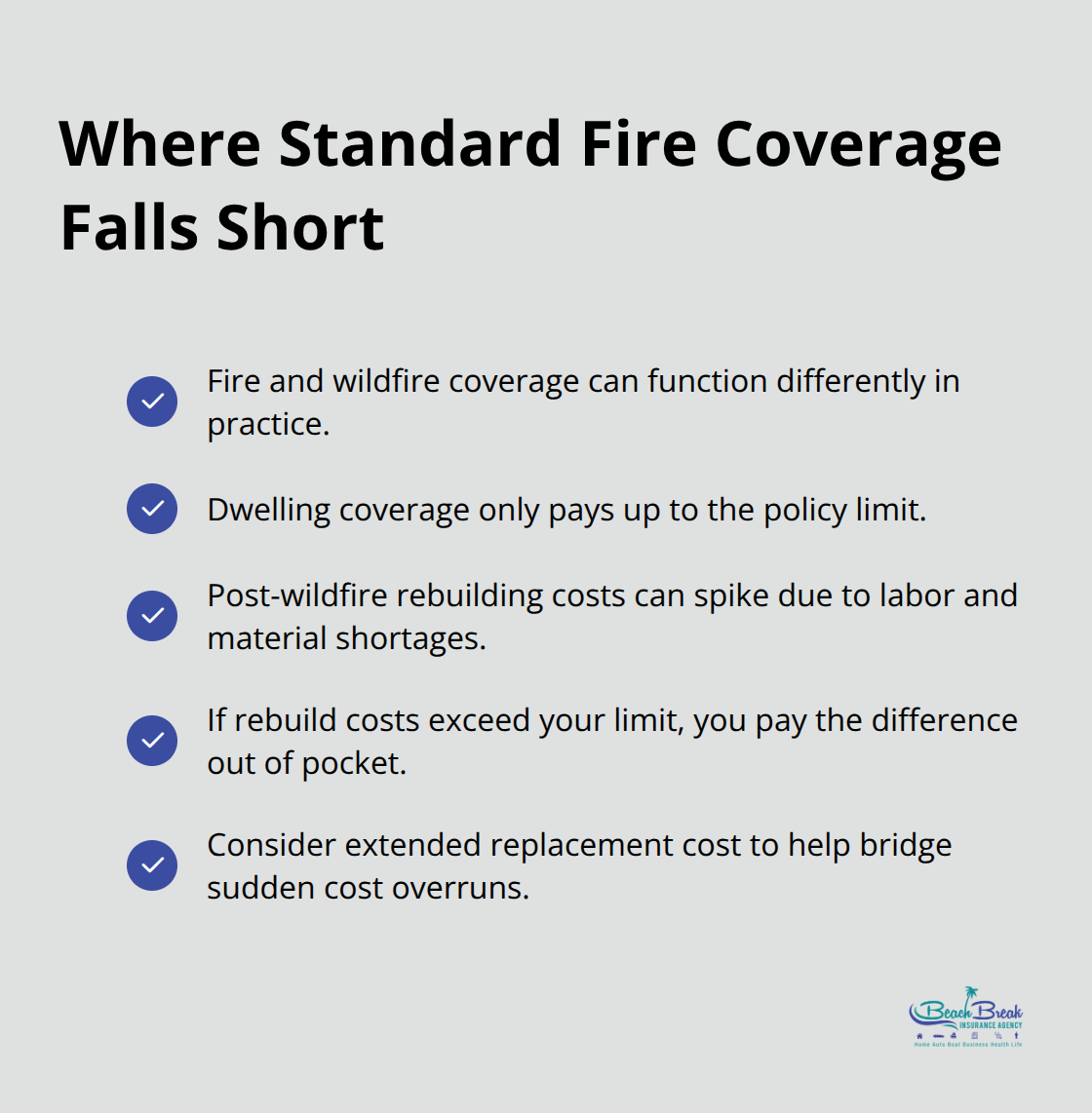
Standard homeowners insurance covers fire damage, but the coverage has hard limits that catch most homeowners off guard. Standard homeowners and renters policies in Washington include fire damage protection by law, and similar protections exist across most states. However, fire coverage and wildfire coverage operate differently in practice. Your dwelling coverage pays to repair or rebuild your home up to your policy limit, but after large-scale wildfires, reconstruction costs spike dramatically due to labor shortages and material scarcity. If your dwelling limit sits at $400,000 and rebuilding actually costs $550,000, you absorb the $150,000 gap yourself.

Common wildfire-related gaps in standard homeowners policies - Wildfire coverage for homes

Personal Property and Loss of Use Have Hard Caps

Your personal property coverage has sublimits for high-value items like jewelry and firearms, meaning you recover only a fraction of their actual value unless you schedule them separately on your policy. Loss of use coverage reimburses hotel stays and meal expenses if your home becomes uninhabitable, but this protection has a cap. Many homeowners discover too late that their coverage reflects property values from five years ago, not current replacement costs in their market. Scheduling high-value items ensures full recovery of their replacement cost rather than depreciated actual cash value.

The FAIR Plan Offers Protection at a Higher Price

When private insurers decline to cover you in high-risk fire zones, the California FAIR Plan serves as your safety net, though it comes with trade-offs. Policies through the FAIR Plan cost significantly more than standard coverage and carry lower limits, making them expensive protection for what amounts to basic coverage. The Montana Legislative Council is currently studying root causes of rising property insurance rates statewide, reflecting how aggressive insurers have become about pricing wildfire risk.

Extended Replacement Cost Closes the Gap

Extended replacement cost or guaranteed replacement cost coverage eliminates the gap between your limit and actual rebuilding expenses (where available). These options protect you when reconstruction costs exceed your policy limit, a scenario that occurs frequently after major wildfires. An independent agent can compare quotes from multiple carriers to identify gaps before you face a non-renewal notice and help you determine whether extended replacement cost makes sense for your property and budget.

Your Next Step: Assessing Your Specific Vulnerabilities

Understanding what your policy covers is only half the battle. The real protection comes from knowing your home’s specific vulnerabilities and taking action to reduce them before a fire threatens your neighborhood.

Prepare Your Property and Insurance Before Fire Season Arrives

Harden Your Roof and Attic Against Ember Intrusion

The roof represents your home’s most vulnerable component, and according to the State Fire Marshal’s wildfire guidance, wood shingle roofs ignite far more easily than composite, asphalt, metal, clay, or tile alternatives. If you live in a fire-prone area and still have a wood shingle roof, replacing it should rank above almost every other property improvement because embers can ignite it from a mile away. Seal gaps under roof tiles and shingles with caulk to block embers from reaching your attic. Clean gutters and roof surfaces monthly during fire season to remove pine needles and leaves that act as fuel. Install chimney screens with metal mesh openings of 3/8 to 1/2 inch and keep your fireplace flue closed during wildfire season.

Install Ember-Resistant Vents and Windows

Vent screens need 1/16 to 1/8 inch noncombustible material, and the State Fire Marshal maintains a list of flame- and ember-resistant vents you can reference. For windows, install dual-pane glass with at least one tempered layer, and add screens to all operable windows facing large vegetation. These upgrades slow fire spread and prevent embers from entering your home through small openings.

Create and Maintain Defensible Space

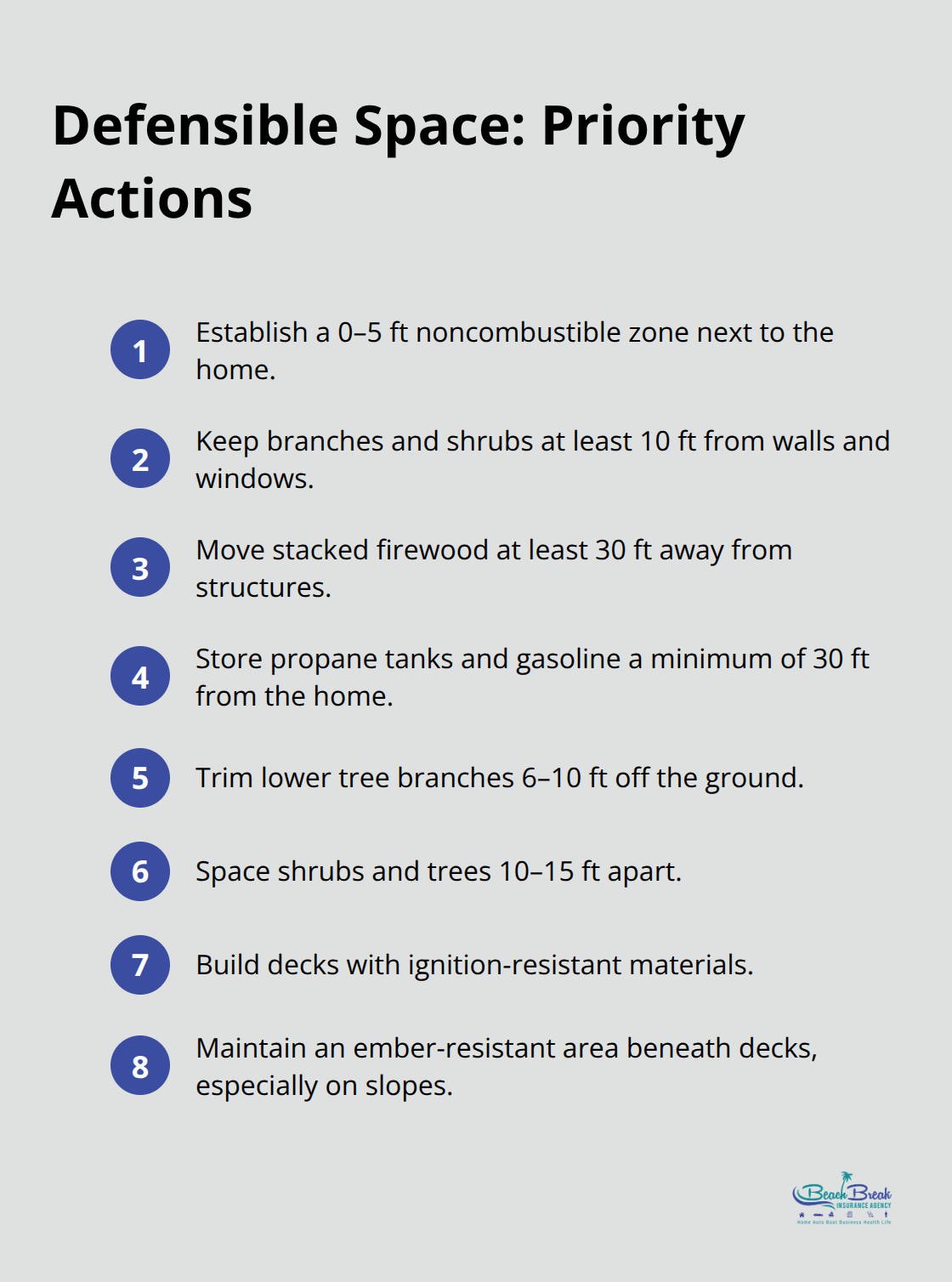
Your defensible space starts with the first five feet from your home, the most critical zone for ember resistance. Clear dead leaves and flammable materials, keep tree branches and shrubs at least 10 feet from your house, and establish a 5-foot noncombustible area with gravel or concrete rather than wood mulch. Move firewood 30 feet away, store propane tanks and gasoline at least that distance out, and trim lower tree branches 6 to 10 feet off the ground while spacing shrubs and trees 10 to 15 feet apart.

Steps to create defensible space around your home - Wildfire coverage for homes

Build decks with ignition-resistant materials and maintain an ember-resistant zone beneath them to prevent fire spread on slopes.

Document Your Property and Schedule High-Value Items

Your insurance documentation must match your property’s actual replacement cost because underinsurance leaves you financially vulnerable after a total loss. Create a detailed home inventory with photos and receipts for every room, and store copies offsite or in cloud storage so wildfire damage cannot destroy your proof of ownership. High-value items like jewelry, firearms, and art require separate scheduling on your policy because standard personal property coverage applies sublimits that recover only a fraction of replacement cost.

Review Coverage Limits and Loss of Use Protection

Review your dwelling coverage annually because construction costs in fire-prone markets rise faster than standard policy increases, and confirm that your limit reflects current rebuilding expenses in your zip code rather than values from five years ago. Loss of use coverage caps reimbursement for hotel stays and meals if your home becomes uninhabitable, so verify this limit covers at least 12 months of living expenses in your area. If you receive a non-renewal notice due to wildfire risk, contact an independent agent immediately because waiting weeks into fire season eliminates your options. The FAIR Plan provides coverage when private insurers won’t, but policies cost significantly more with lower limits, making it a last resort rather than a primary solution. An independent agent can compare quotes from multiple carriers to identify gaps before you face coverage denials and help you determine whether extended replacement cost makes sense for your property and budget. Schedule a policy review with an independent agent at least annually to confirm your coverage reflects recent home improvements, updated property values, and changes in your neighborhood’s wildfire risk profile.

Final Thoughts

Wildfire coverage for homes protects your financial future, but only when your policy matches your actual property value and your home resists ember intrusion. The gap between standard coverage and real rebuilding costs after a major wildfire is substantial, and waiting until fire season arrives leaves you vulnerable to non-renewal notices and coverage denials. Your dwelling limit must reflect current construction costs in your market, your personal property coverage must account for high-value items through separate scheduling, and your loss of use protection must cover months of temporary housing if evacuation becomes necessary.

The concrete steps matter as much as the insurance itself. Replacing a wood shingle roof, sealing gaps under roof tiles, installing ember-resistant vents, and maintaining defensible space around your property reduce your home’s ignition risk dramatically. These upgrades also qualify you for premium discounts with many carriers, offsetting the cost of improvements while lowering your insurance expense.

An independent agent compares quotes from multiple carriers simultaneously, identifying coverage gaps and premium savings you cannot find alone. Contact Beach Break Insurance Agency to compare quotes and confirm your wildfire coverage reflects your home’s true replacement cost before fire season arrives.

The information provided in this blog is for general informational purposes only and does not constitute legal, financial, or insurance advice. Coverage options, terms, and availability may vary. Please consult with a licensed professional for advice specific to your situation.
Artificial intelligence may have been used to generate text and images in some blog articles.

San Diego Business Insurance: A Local Guide to Coverage

Running a business in San Diego means facing risks that other cities don’t. From coastal weather threats to California’s strict employment laws, your operation needs protection tailored to local conditions.

At Beach Break Insurance Agency, we’ve helped hundreds of San Diego business owners find the right coverage. This guide walks you through the insurance types you actually need and how to pick a provider that understands your market.

Why San Diego Businesses Face Insurance Gaps

San Diego’s business landscape creates specific exposures that generic insurance templates miss. The city’s tech sector, construction industry, and hospitality operations each face distinct liability patterns. A software developer’s cyber risks differ completely from a contractor’s site safety exposures or a restaurant’s food-handling liabilities. California’s workers’ compensation requirements apply to any business with employees, and the state’s data breach notification laws require tech and service firms handling customer information to carry cyber liability coverage. According to the California Department of Insurance, workers’ compensation is mandatory if you have staff, but most San Diego business owners underestimate how quickly claims can exceed standard policy limits. The City of San Diego adds another layer: vendors working on city contracts must carry $1,000,000 in commercial general liability, workers’ compensation, and automobile liability, with the city named as additional insured. This requirement applies regardless of project size, and proof of insurance must arrive within 10 days of contract award. Missing this deadline jeopardizes contract renewal.

Key insurance requirements and deadlines for vendors working on City of San Diego contracts - San Diego business insurance

Operating without proper coverage exposes you to catastrophic financial risk. A single customer injury claim, property damage incident, or employee workplace injury can bankrupt a small operation if you lack adequate limits. California’s strict employment laws also mean that claims related to wrongful termination, harassment, or discrimination can trigger six-figure legal defense costs even if your business ultimately prevails. Insurance costs in San Diego vary significantly by industry and location. General liability averages around $42 per month for small businesses, workers’ compensation runs approximately $63 monthly, and professional liability sits near $94 monthly according to industry data, but these figures shift based on your specific operations and claims history.

Typical monthly premiums for common small-business policies in San Diego

The real cost of going uninsured isn’t the monthly premium you avoid; it’s the business closure that follows a single major incident.

Coastal and Climate-Related Exposures

San Diego’s proximity to the Pacific Ocean and wildfire zones creates property and business interruption risks that inland businesses don’t face. Fire insurance through traditional carriers can become difficult or expensive in high-risk areas, making the California FAIR Plan a critical backup option for businesses in brush zones or near coastal bluffs. Seasonal flooding, though less common than fires, can still damage inventory, equipment, and facilities, making commercial property coverage essential for any operation with physical assets.

Contractor and Service Industry Specifics

If your business involves construction, landscaping, plumbing, electrical work, or similar trades, city verification and licensing requirements trigger mandatory insurance. The City of San Diego requires contractors to carry coverage before performing any municipal work, and private clients increasingly demand the same. This isn’t optional negotiation; it’s a market requirement in San Diego. Landscapers with specialized equipment or techniques face higher exposure, and some operations like goat herds for brush management may require $1,000,000 liability limits just to operate legally.

Why Coverage Gaps Happen

Most San Diego business owners purchase insurance reactively-after a lease requires it or a client demands proof. This approach leaves gaps in protection. You might carry general liability but skip professional liability, or maintain workers’ compensation while overlooking cyber coverage. Each gap represents a specific risk that one incident can exploit. The solution isn’t to purchase every available policy; it’s to match your coverage to your actual operations and local market demands. Understanding what your industry requires and what your clients expect puts you in position to select the right combination of policies.

The Core Insurance Policies Every San Diego Business Needs

Business Owners Policies and General Liability Coverage

A Business Owners Policy bundles general liability and commercial property coverage into a single plan, making it the most cost-effective starting point for San Diego small businesses with physical locations or inventory. General liability protects against third-party claims for bodily injury, property damage, and advertising injury, covering both legal defense costs and settlements. For a typical San Diego small business, general liability costs about $42 monthly according to industry benchmarks, though your actual cost depends on your industry, location, and claims history. If you operate a storefront, carry inventory, or maintain equipment on-site, adding commercial property coverage through a BOP protects your building contents, computers, tools, and supplies from fire, theft, and weather damage. The bundling discount typically saves 10 to 15 percent compared to purchasing policies separately, which matters when you’re managing tight margins.

When a BOP Falls Short

A BOP alone won’t cover your business if you provide professional services, handle customer data, or operate vehicles for work purposes. Those exposures require additional specialized coverage that a standard bundled policy doesn’t address. Professional liability insurance protects service-based businesses from negligence claims and covers legal costs-a critical gap for consultants, software developers, and other service providers. Cyber liability insurance covers data breaches and cyber attacks, with first-party costs like data recovery and investigations plus third-party costs like legal fees and settlements. These specialized policies work alongside your BOP to create comprehensive protection tailored to your actual operations.

Commercial Auto Insurance Requirements

California mandates commercial auto insurance if you use any vehicle for business operations, whether that’s a company truck, a delivery van, or even your personal car when transporting supplies or traveling between job sites. California’s minimum requirements are $30,000 in bodily injury per person, $60,000 total bodily injury per accident, and $15,000 in property damage, but these minimums leave you dangerously exposed. A single serious accident can easily exceed these limits, making higher coverage essential. If your employees or contractors drive personal vehicles for business purposes, hired and non-owned auto coverage extends protection to those situations without requiring employees to add your business to their personal policies.

Workers’ Compensation and Employment Liability

Workers’ compensation is non-negotiable if you have employees in California-the state requires it regardless of business size, and penalties for non-compliance include fines up to $10,000 plus potential criminal liability. The average cost runs approximately $63 monthly for small operations, though construction, hospitality, and manufacturing businesses typically pay significantly more due to higher injury risk. Coverage includes medical expenses, rehabilitation costs, and wage replacement for injured workers, protecting both your employees and your business from catastrophic liability. Employment practices liability insurance addresses a different threat: wrongful termination, harassment, or discrimination claims. California’s employment laws are among the strictest in the nation, and legal defense costs for these claims can reach six figures even when your business ultimately prevails. This coverage isn’t required by law, but it’s increasingly demanded by business owners who understand that a single terminated employee can trigger litigation costs that dwarf annual insurance premiums.

Selecting the Right Coverage Combination

The specific policies you need depend on your industry, operations, and local market demands. A contractor faces different exposures than a tech startup, and a restaurant operation requires different protection than a consulting firm. The solution isn’t to purchase every available policy; it’s to match your coverage to your actual operations and what your clients expect. Understanding what your industry requires and what your clients demand puts you in position to select the right combination of policies-and that’s where comparing quotes from multiple carriers becomes essential.

Selecting the Right San Diego Insurance Provider

Compare Quotes from Multiple Carriers

You must contact multiple carriers to secure competitive rates. A single application to an independent agency produces quotes from several top-rated insurers within days, letting you compare pricing and coverage options without contacting each carrier individually. San Diego business owners typically see premium variations of 20 to 40 percent across carriers for identical coverage, meaning the difference between a $100 monthly policy and a $140 monthly policy often reflects which three or four companies you actually contacted. Bundling commercial auto with property coverage can reduce your overall costs, but you only capture that discount if you request quotes that include bundled options.

Range of premium variation San Diego businesses see when comparing identical coverage across multiple carriers - San Diego business insurance

When you request quotes, provide consistent information across all carriers: your exact business location in San Diego, number of employees, annual revenue, industry classification, and any prior claims. Inconsistencies between applications create quote variations that reflect underwriting confusion rather than actual pricing differences. Request quotes that include your baseline coverage needs plus optional add-ons relevant to your industry, so you can see the actual cost of professional liability, cyber coverage, or higher liability limits rather than estimating based on industry averages.

Match Coverage to Your Specific Industry

Industry-specific coverage demands make generic quote comparisons useless. A contractor bidding on City of San Diego municipal work needs quotes that reflect the $1,000,000 liability limits, additional insured endorsements naming the city, and waiver of subrogation language required by the city’s purchasing department. A tech startup handling customer data needs cyber liability quotes that specifically cover breach notification costs and forensic investigation expenses, not just generic data breach language. A restaurant needs quotes that address food-handling liability and liquor coverage if applicable, not standard commercial property bundling.

Rather than comparing quotes based on lowest premium alone, evaluate whether each carrier actually covers your specific operations and whether their policy language addresses your clients’ insurance requirements. An independent agency specializes in matching San Diego businesses with carriers that understand local market demands and can write policies with the endorsements and coverage limits your contracts actually require. These agencies access multiple carriers simultaneously, saving you weeks of calling individual companies while ensuring quotes reflect apples-to-apples coverage.

Ask Carriers the Right Questions

When you evaluate proposals, ask each carrier or agent three specific questions: What endorsements are included in the base policy? What additional insured requirements can they accommodate? What is their timeline for adding new coverage if your business operations change? Carriers that answer these questions clearly and quickly typically provide better service when you actually file a claim.

Final Thoughts

San Diego business insurance requires regular attention as your operation evolves. Your coverage needs shift when you hire staff, expand locations, add equipment, or change operations significantly-gaps that pose no risk today can become catastrophic exposures tomorrow. Start by identifying your baseline requirements: workers’ compensation if you have employees, commercial auto insurance if you operate vehicles for business, and the $1,000,000 liability limits plus additional insured endorsements if you work on City of San Diego contracts. These aren’t optional expenses; they determine whether you can legally operate in your market.

Next, layer in coverage that matches your specific industry and client demands. A contractor needs different protection than a tech startup, and a restaurant faces different exposures than a consulting firm. Request quotes that reflect your actual operations and the endorsements your contracts require, then compare proposals from multiple carriers-you’ll typically find 20 to 40 percent premium variations for identical coverage, making the effort of contacting three or four insurers directly impact your bottom line.

We at Beach Break Insurance Agency help San Diego business owners compare quotes from multiple top-rated carriers and match coverage to their actual operations. Our independent approach means we’re not tied to any single insurer, so we can find the right combination of policies at competitive rates. Contact us to review your current coverage or get quotes for protection you’re missing.

The information provided in this blog is for general informational purposes only and does not constitute legal, financial, or insurance advice. Coverage options, terms, and availability may vary. Please consult with a licensed professional for advice specific to your situation.
Artificial intelligence may have been used to generate text and images in some blog articles.
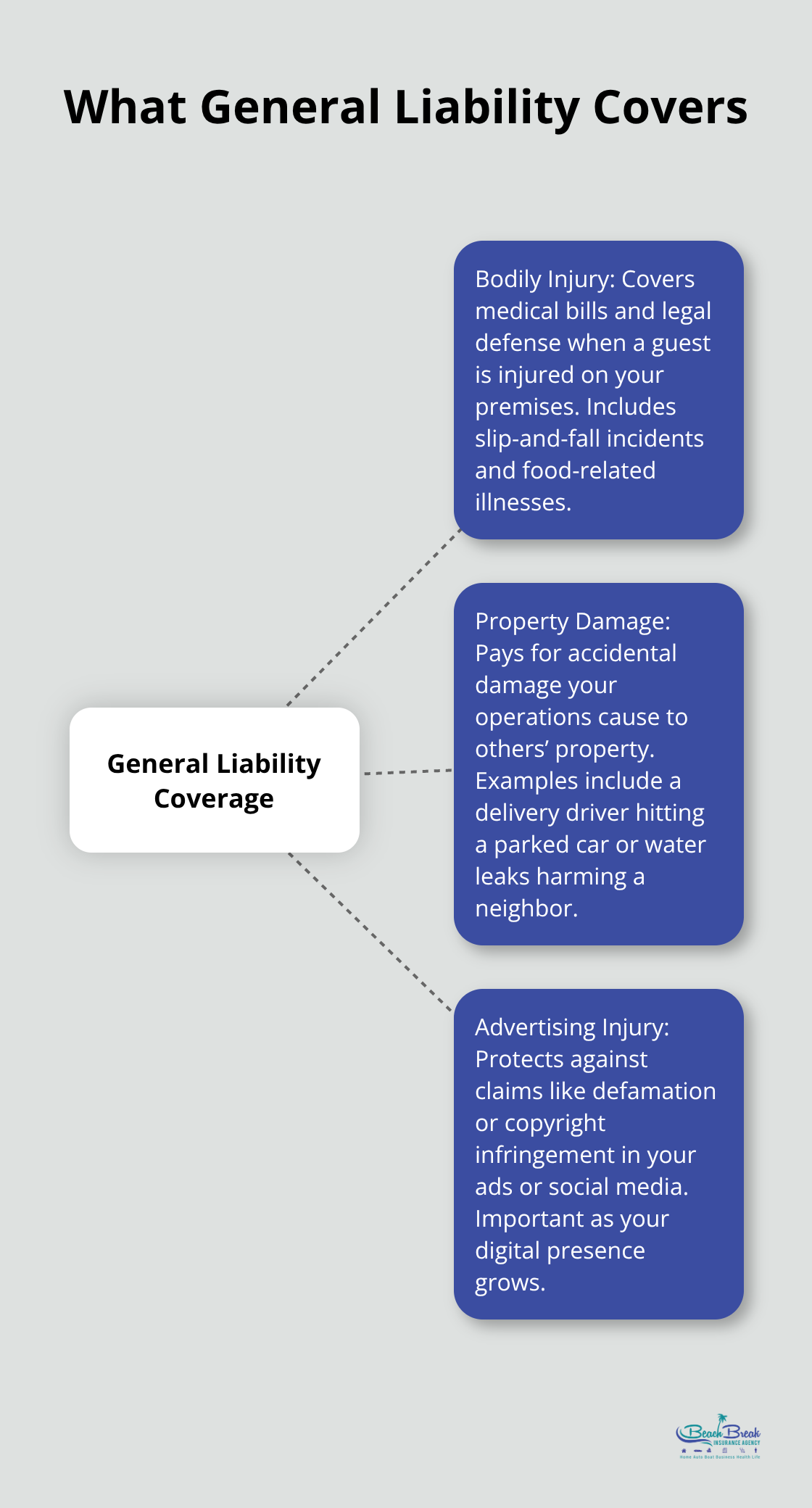
California Workers Comp Rates: What Small Businesses Pay

California workers comp rates can take a significant bite out of your small business budget. The good news is that your premiums aren’t set in stone-they’re based on specific factors you can actually control.

At Beach Break Insurance Agency, we’ve helped countless small business owners understand what drives their costs and find real ways to reduce them. This guide walks you through exactly how California calculates your rates and what you can do about it.

What Actually Drives Your California Workers Comp Premium

Your California workers comp premium starts with three concrete numbers: your industry classification code, your total payroll, and your experience modification rate. These aren’t theoretical-the California Department of Insurance files them and they directly determine what you pay. As of September 2025, the advisory base rate across California stands at $1.52 per $100 of payroll, but your actual rate depends entirely on your classification. A construction company pays $8 or more per $100 of payroll, while an office-based business pays $0.50. The formula is straightforward: multiply your classification rate by your total payroll divided by 100, and you get your base premium before adjustments.

Core components that determine a California workers comp premium for small businesses - California workers comp rates

Your Classification Code Sets the Foundation

The WCIRB assigns a four-digit classification code to your business based on job duties, not your industry name. Two landscaping companies with different equipment or service types fall into different codes with dramatically different rates. Misclassification ranks as one of the fastest ways to overpay-or underpay and face audit penalties. Pull your classification code from your current policy and verify it against the WCIRB’s Standard Classification System. If your employees perform multiple tasks, each task receives its own code and rate. A roofing company with office staff needs separate codes for roofers and administrative workers. Contact your insurer directly if you’re unsure about your classification; they won’t change it without cause, but they will explain how they arrived at it.

Experience Modification Rate Rewards or Penalizes Your Safety Record

Your experience modification rate, or X-Mod, adjusts your base premium up or down based on your claims history compared to similar businesses. An X-Mod of 0.85 means you pay 15% less than the base rate because your claims outperform the average. An X-Mod of 1.20 means you pay 20% more because your claims exceed what’s typical for your classification.

Percentage impact of common X-Mod values on your workers comp premium

The WCIRB calculates your X-Mod by comparing your actual losses to the expected losses for your classification and size. For small businesses with under $50,000 in payroll, you might not have an X-Mod yet-the WCIRB requires sufficient exposure to calculate it reliably. Once you have one, it updates annually and can shift 15% to 30% of your premium depending on your claims history. Lower losses directly reduce your X-Mod over time, making workplace safety programs a financial investment, not just a compliance requirement.

Payroll Reporting Accuracy Prevents Surprise Audits

Your payroll amount multiplied by your classification rate equals your premium-but insurers verify this with audits during and after your policy term. Underreporting payroll creates serious problems; if an insurer discovers misreporting, they adjust your premium upward, sometimes to triple your estimated amount. Keep detailed payroll records, separate employees by classification, and report accurately at renewal. Small businesses often make mistakes (classifying all employees under one code or forgetting seasonal workers in payroll projections). The insurer will audit your actual payroll records, tax filings, and job descriptions to confirm accuracy. If your business grows mid-year, your payroll estimate may fall short, triggering a significant adjustment at audit. A licensed broker or agent helps catch these issues before they become expensive problems.

What Happens Next With Your Premium

Once your classification, X-Mod, and payroll align, your insurer applies rating plans and adjustments that can further modify your final cost. These adjustments-whether credits for safety group memberships or debits for new business status-vary significantly between carriers, which is why shopping around matters. The next section walks you through the specific factors that increase or decrease your premiums and shows you where you actually have control.

What Pushes Your Premiums Up or Down

Your classification code and Experience modification rate (X-Mod) form your rate foundation, but several real-world factors either reward you with lower premiums or penalize you with higher ones. The most direct lever is your claims history. When you file a workers comp claim, that claim stays on your record for three years and directly influences your X-Mod calculation. A serious injury claim can raise your X-Mod, translating to hundreds of dollars in additional annual premium. Conversely, three years without claims moves your X-Mod downward, sometimes dramatically. A small plumbing business with zero claims over three years might see their X-Mod drop from 1.15 to 0.90, saving roughly $2,000 to $3,000 annually depending on payroll size. This is why workplace safety programs aren’t optional-they’re direct investments in your bottom line. Track near-misses, enforce equipment maintenance schedules, and document safety training. When you prevent injuries, you prevent premium increases that compound year after year.

Industry Classification Determines Your Baseline Risk

Industry classification determines your baseline risk, and certain sectors face dramatically higher rates than others. According to the WCIRB, construction and roofing classifications carry rates of $8 to $12 per $100 of payroll, while office-based classifications run $0.50 to $1.00. Food delivery and warehouse work fall in the $3 to $5 range. If your business straddles multiple classifications, your premium becomes a weighted average across all your employees’ job duties. A landscaping company with office staff, equipment operators, and ground workers pays three different rates. Review your payroll breakdown by classification annually-if you misclassify even a few employees, your premium swells unnecessarily.

Turnover and Training Shape Your Insurability

Employee turnover and training directly affect your insurability and cost. High turnover signals instability to insurers and often results in higher experience modification rates because new, less-trained workers file more claims. Businesses with stable, well-trained workforces show lower injury rates and qualify for better rates. Some insurers offer premium credits for formal safety training programs or membership in industry safety groups. A construction company that invests in OSHA 10-hour training for all field staff may receive a 5 to 10 percent premium credit, offsetting the training cost within months. Document your training investments and share them with your insurer at renewal-these programs create measurable value.

How to Identify Your Specific Cost Drivers

Your premium reflects the intersection of your classification, claims history, and operational practices. Pull your current policy and identify which classification codes apply to your workforce. Cross-reference those codes against the WCIRB’s Standard Classification System to confirm accuracy. Check your most recent X-Mod statement to see whether your modification sits above or below 1.00. If your X-Mod exceeds 1.10, your claims history costs you real money-safety improvements become urgent. If your X-Mod sits below 0.95, you’ve built a strong safety record worth protecting. Many small business owners discover they’re paying for classifications that no longer match their actual operations. A contractor who shifted from field work to project management might still carry a high-risk code. An office manager who added occasional warehouse duties might be underclassified. These mismatches create either overpayment or audit risk. Correcting them often yields immediate savings or prevents future penalties.

What Comes Next in Your Rate Strategy

Understanding what drives your premium is the first step. The next section shows you concrete strategies to lower your costs-from safety programs that reduce claims to shopping tactics that expose rate differences between carriers.

How to Actually Lower Your Workers Comp Costs

Safety programs work because they reduce the exact thing that raises your X-Mod: workplace injuries. A roofing contractor who implements daily toolbox talks, enforces fall protection protocols, and documents near-misses sees measurable results within 12 to 24 months. When claims drop, your X-Mod falls, and your premium follows. WCIRB’s data shows that businesses with formal safety programs experience measurable improvements in claims reduction compared to comparable businesses without them.

Identify Your Highest-Risk Tasks and Address Them

Start with your highest-risk tasks. If your workforce spends 60 percent of time on ladders, invest in ladder safety training and inspection schedules. If repetitive motion injuries plague your team, implement ergonomic assessments and job rotation. Some insurers offer premium credits directly for participation in industry safety groups or completion of recognized training programs like OSHA certification. Contact your insurer before launching a program and ask specifically which activities generate credits. A manufacturing business that joins a safety council and completes quarterly audits might receive a meaningful premium reduction.

Use Return-to-Work Programs to Reduce Claim Costs

Return-to-work programs create another direct savings path by getting injured employees back into productive roles faster, which reduces claim duration and severity. When an employee sustains a minor injury, offering modified duties keeps them earning wages, maintains morale, and shortens the time they draw temporary disability benefits. Document these efforts with your insurer because claim management directly influences your next X-Mod calculation. A small landscaping company that returns an injured worker to office tasks within two weeks rather than keeping them off work for six weeks demonstrates better claims management to underwriters, which can translate to rate stability or improvement at renewal.

Compare Quotes Across Multiple Carriers

Shopping for quotes exposes rate differences that often exceed 30 to 40 percent between carriers for identical businesses. California’s open rating system means each insurer sets their own rates within regulatory guidelines, creating genuine competition. Pull your four-digit classification code from your current policy and gather your most recent payroll figures and X-Mod statement. Contact at least three carriers directly or work with a broker who accesses multiple markets.

Compare the base rates they quote per $100 of payroll, but don’t stop there. Ask each carrier about available credits: safety group memberships, loss control services, preferred provider discounts, or schedule rating adjustments for businesses with strong records.

Hub-and-spoke showing practical strategies to cut workers comp premiums - California workers comp rates

A contractor with a 0.90 X-Mod and documented safety practices might qualify for an additional 5 to 15 percent credit that another carrier won’t offer. Some insurers charge higher base rates but provide better service or more flexible claims handling. Others compete aggressively on price but have limited loss control support. For small businesses, the difference between a carrier offering proactive safety guidance and one that simply processes claims can prevent future losses.

Time Your Switch to Maximize Savings

Request quotes 60 to 90 days before your renewal date so you have time to make changes if switching saves money. Be aware that mid-term switches trigger short-rate cancellation penalties on your current policy, sometimes 10 to 15 percent of remaining premium. Compare your total out-of-pocket cost including penalties against the savings from the new carrier. A small business saving $3,000 annually but facing a $1,500 cancellation penalty still nets $1,500 in year-one savings, making the switch worthwhile. If your renewal is approaching, switching at renewal eliminates cancellation penalties entirely and gives you a clean start with a new carrier’s underwriting perspective.

Final Thoughts

Your California workers comp rates reflect three controllable factors: your classification accuracy, your claims history, and your operational practices. Classification codes determine your baseline rate, your experience modification rate rewards or penalizes your safety record, and your payroll reporting accuracy prevents expensive audits. The businesses that pay the least aren’t necessarily in low-risk industries-they’re the ones that maintain accurate classifications, invest in workplace safety, and shop aggressively across multiple carriers.

Start with your current policy and verify your classification codes match your actual job duties. Check your experience modification rate to understand whether your claims history costs you money. If your X-Mod exceeds 1.10, prioritize safety improvements because every claim reduction directly lowers your future premiums. Request quotes from at least three carriers 60 to 90 days before your renewal date, since California’s open rating system creates rate differences of 30 to 40 percent for identical businesses. Ask each carrier about available credits beyond their base rate-safety group discounts, loss control services, and schedule rating adjustments add up quickly.

Beach Break Insurance Agency helps you compare quotes from multiple top-rated carriers to find the best coverage for your workers comp needs. We identify rate differences and available credits that individual carriers won’t highlight, so you focus on running your business instead of shopping for insurance. Contact us to see how much you might save on your California workers comp rates.

The information provided in this blog is for general informational purposes only and does not constitute legal, financial, or insurance advice. Coverage options, terms, and availability may vary. Please consult with a licensed professional for advice specific to your situation.
Artificial intelligence may have been used to generate text and images in some blog articles.
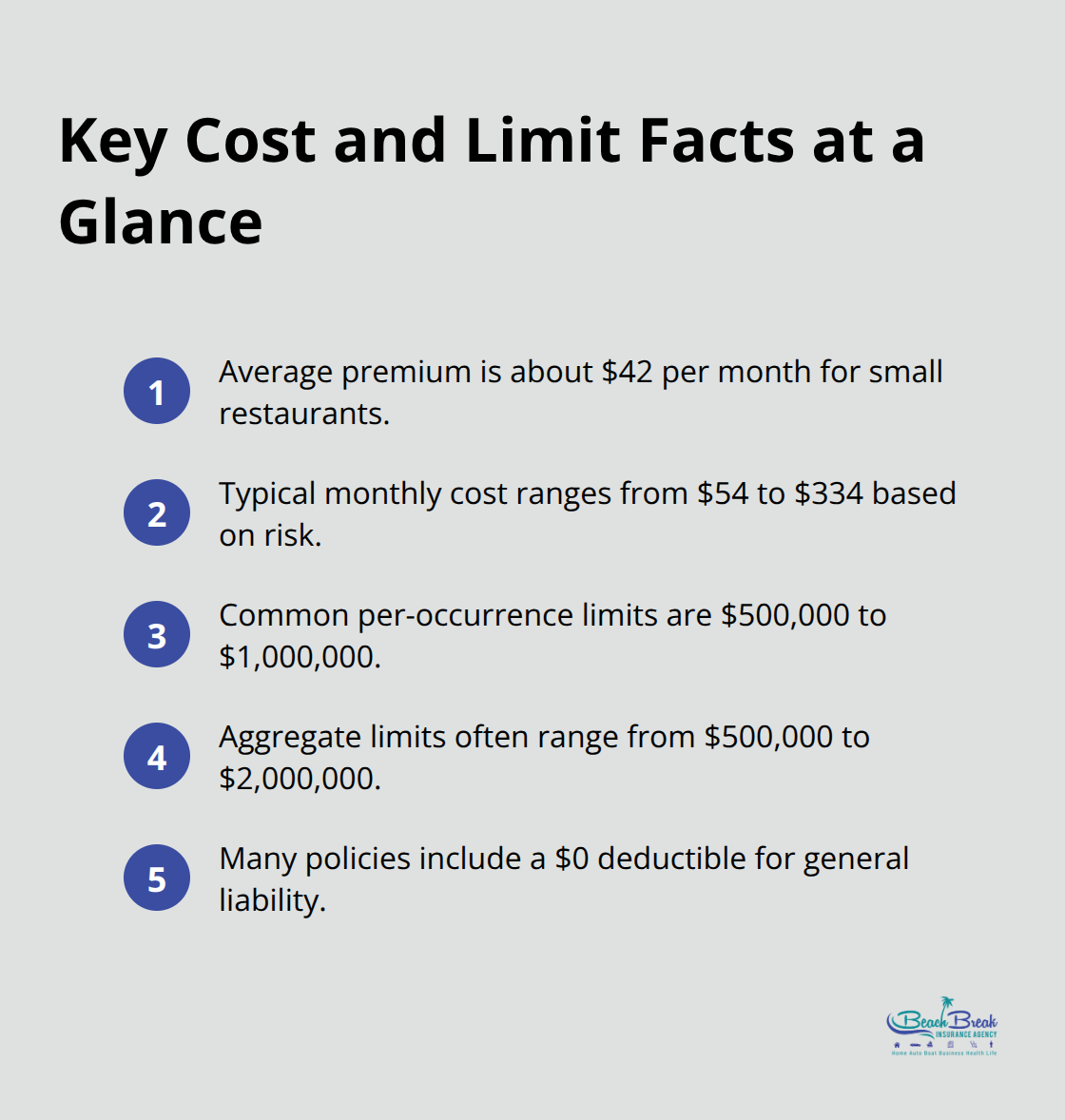
Avoiding Workplace Injuries in Restaurants

The restaurant industry is known for being fast-paced and dynamic, with workers handling various tasks such as cooking, serving, cleaning, and more. However, with this fast-paced environment comes an increased risk of workplace injuries. According to the U.S. Bureau of Labor Statistics, the restaurant industry has one of the highest rates of occupational injuries and illnesses. As such, it is crucial for employers and employees alike to take steps to prevent workplace injuries in restaurants. Here are some ways to achieve this:

      1. Regular training and education: All restaurant employees should receive regular training and education on workplace safety. This should include information on proper lifting techniques, how to handle sharp objects, how to use kitchen equipment, and more. Employers should also conduct regular safety meetings to remind employees of the importance of workplace safety and to address any concerns or questions they may have.
      2. Implement safety protocols: Restaurants should have specific safety protocols in place to prevent injuries. This can include procedures for handling hot oil, wearing protective gear, using knives and other sharp objects, and more. Employers should also provide employees with the necessary safety equipment such as non-slip shoes, gloves, and aprons.
      3. Keep the workplace clean and organized: A cluttered and messy workplace can lead to accidents and injuries. Employers should encourage employees to keep their work areas clean and organized, with all equipment properly stored and labeled. Regular cleaning and maintenance should also be conducted to prevent slips, trips, and falls.
      4. Use ergonomic equipment: Repetitive motions and poor posture can lead to musculoskeletal injuries such as back pain and carpal tunnel syndrome. Employers should provide ergonomic equipment such as standing mats, adjustable chairs, and keyboards to help prevent these types of injuries.
      5. Encourage breaks and rest periods: Working in a fast-paced environment can be physically and mentally demanding. Employers should encourage employees to take breaks and rest periods to prevent fatigue and reduce the risk of injuries.
      6. Properly train new employees: New employees should receive comprehensive training on workplace safety before starting their job. This should include information on safety protocols, handling equipment, and more. Employers should also provide ongoing training to keep employees up-to-date on the latest safety procedures and practices.

In conclusion, preventing workplace injuries in restaurants requires a collective effort from both employers and employees. By implementing safety protocols, providing regular training and education, keeping the workplace clean and organized, using ergonomic equipment, encouraging breaks, and properly training new employees, restaurants can create a safer work environment for everyone.

Things You Should Know About a Commercial Auto Insurance Policy

When many people think of a commercial auto insurance policy, they may think of big vehicles such as semi-trucks, box trucks, garbage trucks, etc. However, there are many variations of vehicles that would qualify for a commercial auto insurance policy.

How to Determine If You Need a Commercial Auto Insurance Policy

If you are using your vehicle or your employer’s vehicle for business purposes, you need a commercial auto insurance policy or endorsement. For instance, many people are working in the gig economy in jobs such as delivering food with your own vehicle or doing rideshare. It is important you have the right insurance coverage. If you do get into an accident where you are making a food delivery and damage your vehicle or someone else’s property, your standard personal car insurance policy will likely not cover you. Contact our agents with any questions you may have.

Here is a quick reference to help you determine if you need a commercial auto insurance policy:

  1. Using your vehicle to carry business equipment
  2. Freight transportation
  3. Towing vehicles
  4. Delivering food or goods (Amazon drivers, food delivery drivers, newspaper delivery)
  5. Using your vehicle to chauffeur people (Uber or Lyft Drivers, taxi service)
  6. Transporting material

How Is A Commercial Auto Insurance Policy Different Than My Personal Auto Insurance?

Since your vehicle is being used for business purposes, there are different risks that need to be insured. Additionally, the rating system used by companies is entirely different than a personal auto policy.  Each commercial policy needs vary, so have a discussion with your agent to discuss your specific policy limits. For business owners with many vehicles to insure, business auto fleet policies are available. Additionally, consider adding a commercial umbrella policy above and beyond your standard commercial auto policy to protect your business from a catastrophic vehicle accident claim.

How Much Does Commercial Auto Insurance Cost?

Just like your personal auto insurance policy, a commercial auto insurance policy is rated on many factors. Here are a few common examples of what could determine your insurance rate.

  • Driving records
  • Driver age
  • Credit history
  • The size & type of your vehicle
  • The number of vehicles you are insuring
  • What you plan to transport

Not Sure What Kind of Coverage You Need for Your Business?

That is where we can help. Our agents can help determine what type of coverage will be the best fit for your specific needs. If you plan to use your vehicle for business and personal purposes, we can help you determine an appropriate type of policy. If you are only looking to cover your vehicle for business use, we can help find you the best rate. We will explain all of your options so you understand your policy. Get a free commercial auto insurance quote by calling or emailing us.

Do I Need To Maintain Insurance On My Boat, Motorcycle Or RV During Winter?

boat insurance san diegoIt is a sad time of year when we have to say goodbye to long warm summer nights and hello to more moderate weather and shorter days. But, the good news is pumpkin lattes are out again.

With fewer boat, motorcycle or road trips in the RV happening in the fall and winter months, many wonder if they need to maintain insurance on these vehicles when they aren’t being driven. There are many different scenarios that warrant keeping these vehicles insured year-round so let’s take a closer look at these.

Weather Related Damages: Weather is especially nasty in the winter months so keeping your boat protected from covered weather-related damages is important. Even when stored, lightning, wind and hail can occur.

Physical Damages: It seems strange that you may be subjected to a property claim when your vehicle is not being used. However, take this simple example: You have a house party and someone wants to sit on your bike. During which, they accidentally knock it over denting your custom painted tank and scratching the paint. Your home insurance will not cover this.

Theft & Vandalism: If someone decides to steal your boat, motorcycle or RV in the winter months, you need coverage to cover the loss. Thefts occur everywhere, so even if in a secured area, vandalism can occur. Unfortunately, thieves don’t mind bad weather.

Fire: If your boat, motorcycle or RV is stored in your home or garage and there is a fire, your home insurance will not pay for damages to your vehicle. Instead, you will need a comprehensive insurance policy to cover these damages.

Financing: If you finance your boat, motorcycle or RV, your lienholder will require you to maintain insurance to protect the investment.

Multi-policy discounts: If you insure your boat, motorcycle or RV with your home or auto insurance company, you may be eligible for multi-policy discounts. By removing your insurance on your vehicle, you will raise the cost of your other policies.

Owning a boat, motorcycle or RV is a great experience for most. Don’t turn the joy of boat, motorcycle or RV ownership into a nightmare by trying to cut your insurance costs in the off-season. Protect your vehicle year-round and enjoy greater discounts on your other insurance products by bundling them together. For a quote on your insurance, give us a call. We represent the best insurance companies and can quote you different coverages, rates and apply for special discounts.