
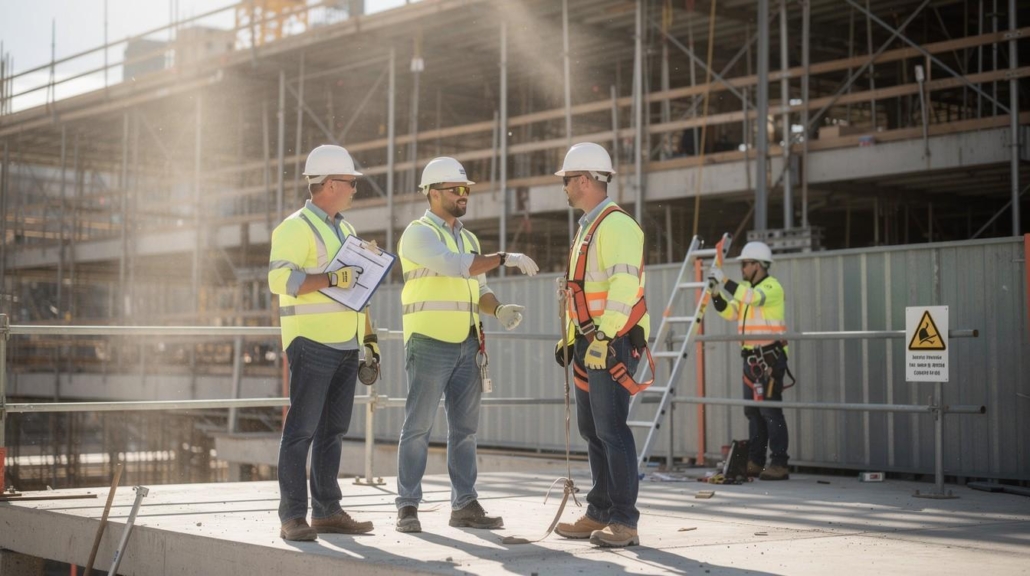
Construction Workers Compensation California: Building Safer Worksites
Construction workers compensation in California isn’t optional-it’s the law. If you employ construction workers, you need coverage, and you need it right.
At Beach Break Insurance Agency, we’ve helped countless construction business owners navigate California’s complex requirements while actually reducing their injury rates and insurance costs. This guide walks you through what you’re legally required to carry, how to build a safer worksite, and where to find real savings on your premiums.
What California Actually Requires From Construction Employers
California law doesn’t give you wiggle room on workers’ compensation insurance. If you have even one employee, you must carry coverage-no exceptions, no delays. Business and Professions Code section 7125 makes this crystal clear, and the penalties for ignoring it are severe. Operating without coverage is a criminal offense with fines up to $10,000 and potential jail time up to one year. The state takes this seriously because injured workers need immediate access to medical care and wage replacement.
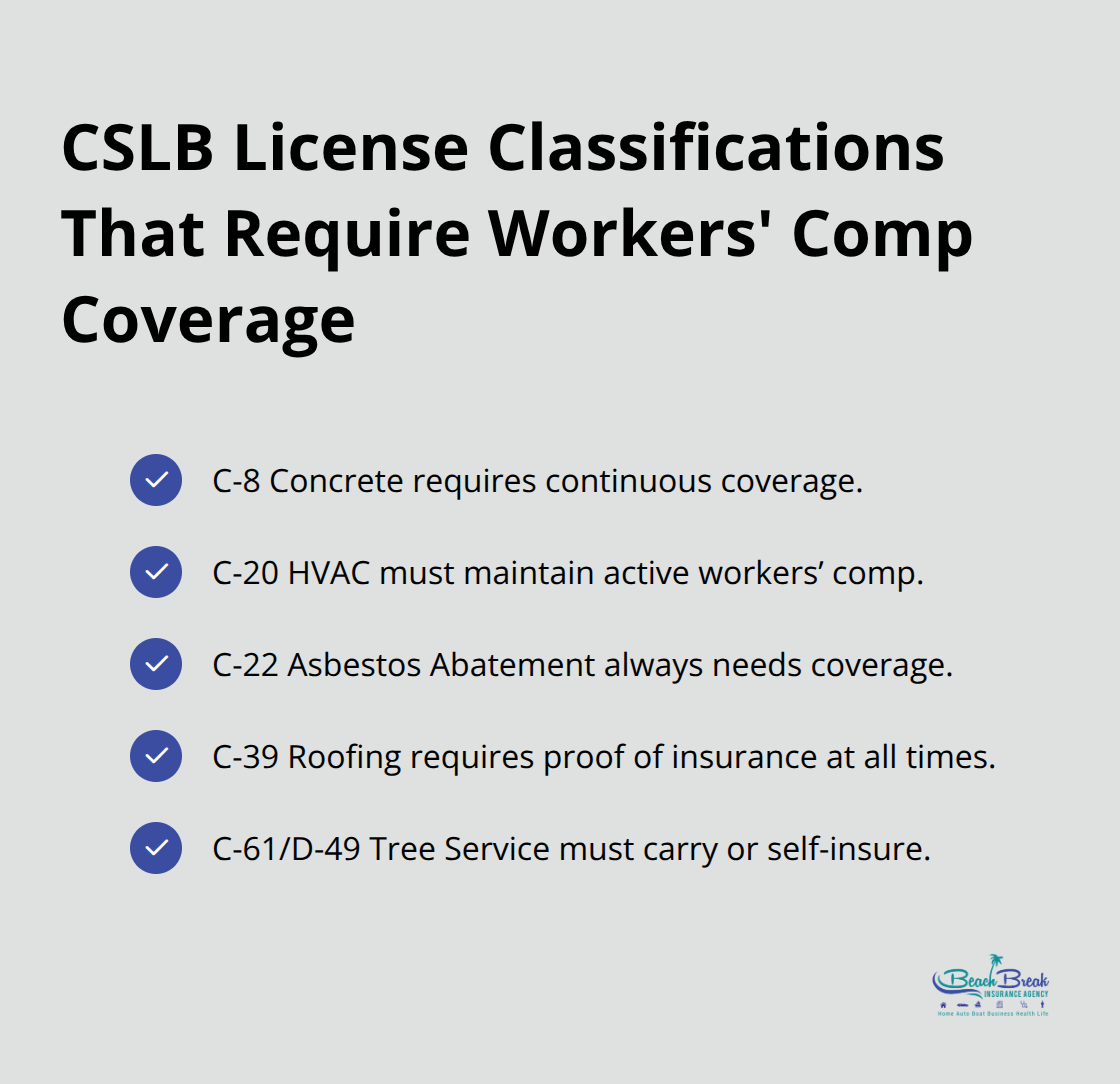
When you hire your first employee, coverage must be active before they start work. If you’re a sole proprietor with no employees, you can opt out, but the moment you bring on even a part-time worker, the requirement kicks in. Some license classifications demand coverage regardless of whether you have employees-C-8 Concrete, C-20 HVAC, C-22 Asbestos Abatement, C-39 Roofing, and C-61/D-49 Tree Service all fall into this category. If your CSLB license holds one of these codes, you must maintain proof of coverage or self-insurance certification at all times.
How Classification Codes Determine What You Pay
Your premium isn’t random-it’s tied directly to your work classification and payroll. You report up to three classification codes with the highest estimated payroll to the CSLB, and these codes determine your rate class. The catch is that rates vary significantly by carrier, and the state doesn’t set them. Instead, insurers file rates with the California Department of Insurance, meaning you can shop around and find real savings.
Your experience modification factor also matters-if your company has had fewer injuries than industry average, your rates drop. If you’ve had more claims, they rise. This is why safety investments directly impact your bottom line. When you file your Certificate of Workers’ Compensation Insurance with the CSLB, make sure the classification codes actually reflect your real payroll. Misreporting codes is a common mistake that can trigger audits later.
The CSLB doesn’t verify accuracy, so that responsibility falls on you. If you perform work outside your primary classification, you may need additional codes. Some contractors incorrectly report low-payroll codes to reduce premiums-this creates audit exposure and potential penalties.
Employee Versus Contractor Status Matters More Than You Think
Misclassifying workers as independent contractors when they should be employees is one of the fastest ways to face serious liability in California. The state uses a strict ABC test to determine employment status, and it’s stacked against contractors. A worker is presumed an employee unless your company proves all three conditions: the worker operates free from your control and direction, they perform work outside your usual business scope, and they’re independently established in that trade.
Most construction workers fail this test. A framing subcontractor working on your projects under your specifications and schedule is likely an employee in California’s eyes, not a contractor, even if they have their own business license. If you misclassify and that worker gets injured, you’re liable for their medical care and lost wages, plus the state can assess penalties and back payroll taxes.
The Uninsured Employers’ Benefit Trust Fund will pay their claim and then pursue you for reimbursement with interest. Your best move is to work with an insurance professional who understands California construction to confirm your worker classifications are defensible. Proper classification protects your workers, keeps you compliant, and actually simplifies your payroll and tax reporting.
Once you lock in the right coverage and classification structure, the next critical step is building a safety culture that actually prevents injuries and reduces your claims-which directly lowers your premiums and keeps your team healthy.
Building Safety Systems That Actually Prevent Injuries
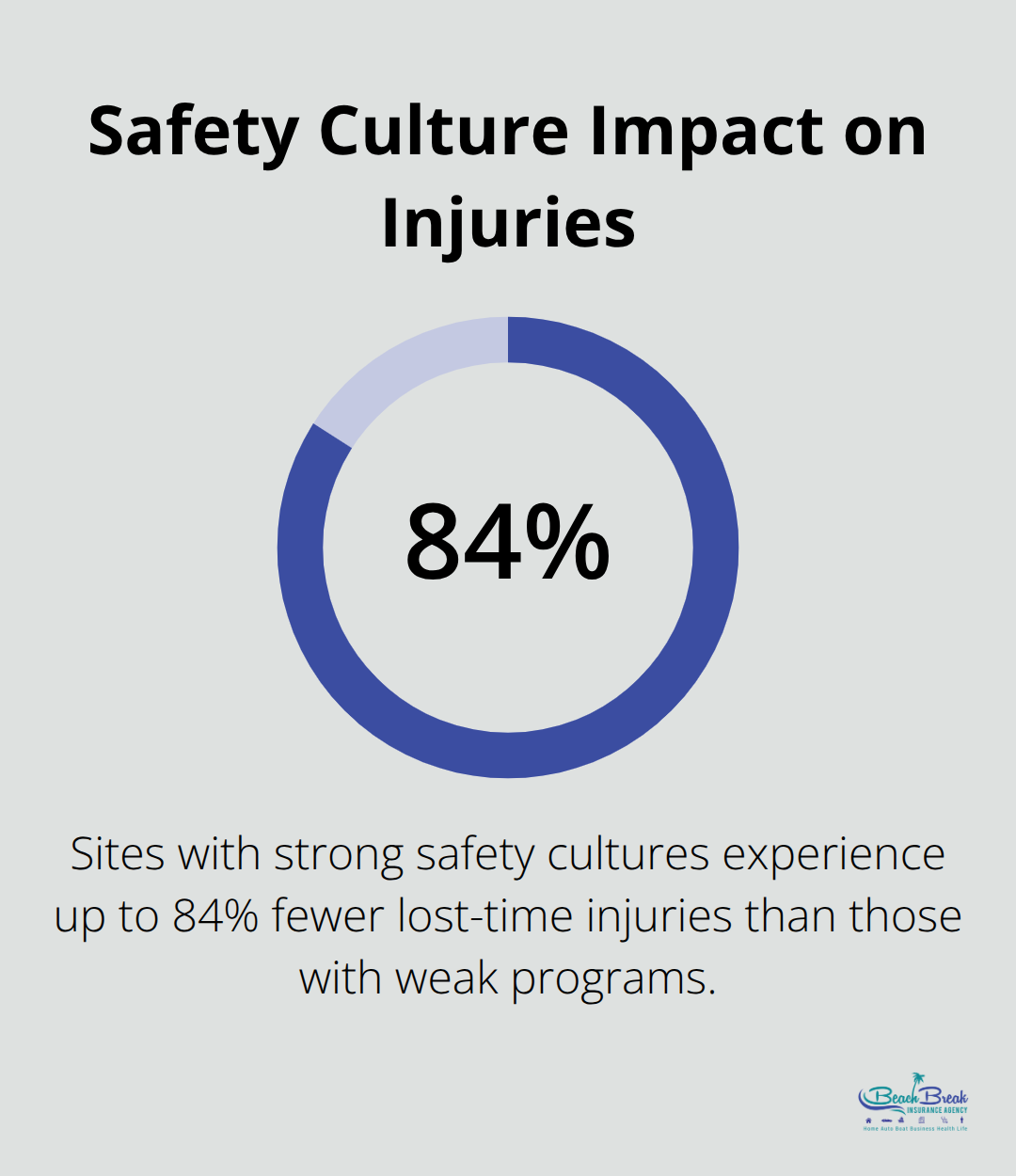
Safety on construction sites isn’t about compliance theater or posting posters nobody reads. It’s about designing systems that stop injuries before they happen, and the data proves this works. According to CPWR and NIOSH research, construction sites with strong safety cultures experience up to 84% fewer lost-time injuries compared to those with weak programs. That’s not theoretical-it directly translates to fewer claims, lower premiums, and workers who show up ready to work instead of calling out injured.
The Four Hazards That Kill Construction Workers
The four leading causes of construction deaths are falls, struck-by incidents, caught-in/between hazards, and electrocutions, accounting for over 60% of all construction fatalities. Every one of these is preventable with proper planning and execution. Start with a Job Hazard Analysis before work begins. Review your project scope, site conditions, seasonal concerns, and emergency response procedures. This pre-job planning is among the strongest predictors of safety performance because it forces you to identify problems while you can still change your approach.
Create a hierarchy of controls: engineering solutions first (guardrails, electrical GFCI protection, trench shoring), administrative controls second (exclusion zones, flaggers, work schedules), and personal protective equipment last. PPE is your final line of defense, not your primary one.
Fall Protection and Elevated Work
Falls demand your most aggressive controls because they’re the leading killer. Install guardrails with a 42-inch top rail, midrails, and toe boards on elevated work. Use safety nets on larger projects and personal fall arrest systems where guardrails won’t work. Document your fall protection plan in writing and review it with your crew before they’re at height.
Underground Work and Electrical Hazards
For trenching and underground work, call 811 for utility locates 48-72 hours ahead-this single step prevents electrocutions and struck-by hazards that can be fatal. Use protective systems for trenches over five feet: shoring, shielding, or proper sloping. Have a competent person inspect trenches daily and require safe access within 25 feet of workers. On struck-by and caught-in hazards, establish exclusion zones around heavy equipment and suspended loads. Use flaggers and spotters trained to direct traffic safely. Require high-visibility vests and hard hats in all work areas. For electrical work, GFCI protection is mandatory on 120-volt circuits, and maintain at least 10 feet clearance from overhead power lines.
Training, Fatigue, and Heat Management
Training matters more than most contractors realize. Implement layered training: orientation for all new hires, task-specific training before workers perform specialized work, and refresher training annually. Conduct toolbox talks at the start of each shift-these 5-10 minute conversations about daily hazards keep safety top-of-mind.
Track fatigue and heat exposure closely. Fatigue accounts for a significant portion of construction accidents, so manage schedules to prevent exhaustion. Implement acclimatization for new workers (7-14 days), enforce hydration breaks, schedule work during cooler hours in extreme heat, and have an emergency response plan ready.
Documentation and Continuous Learning
Equip your sites with baseline personal protective equipment: hard hats, safety glasses, high-visibility vests, gloves, protective footwear, and hearing protection. Maintain these items, replace them when damaged, and keep on-site PPE stations stocked. Document everything. When injuries or near-misses occur, conduct root-cause analysis focused on systems and processes, not blame. Share lessons learned across your projects and protect workers from retaliation for reporting hazards. This continuous learning closes gaps and prevents repeat incidents, which directly reduces your workers’ compensation claims and creates the foundation for lower premiums and better insurance outcomes.
How Lower Injury Rates Actually Cut Your Insurance Costs
The connection between workplace safety and your workers’ compensation premiums is direct and measurable. Your experience modification factor calculates whether you pay more or less than the standard rate for your classification. If your actual losses fall below the industry average, your EMR drops below 1.0 and you receive a rate discount. If losses exceed the industry average, your EMR climbs above 1.0 and you pay a premium. A contractor with an EMR of 0.85 pays 15% less than standard rates, while one at 1.25 pays 25% more.
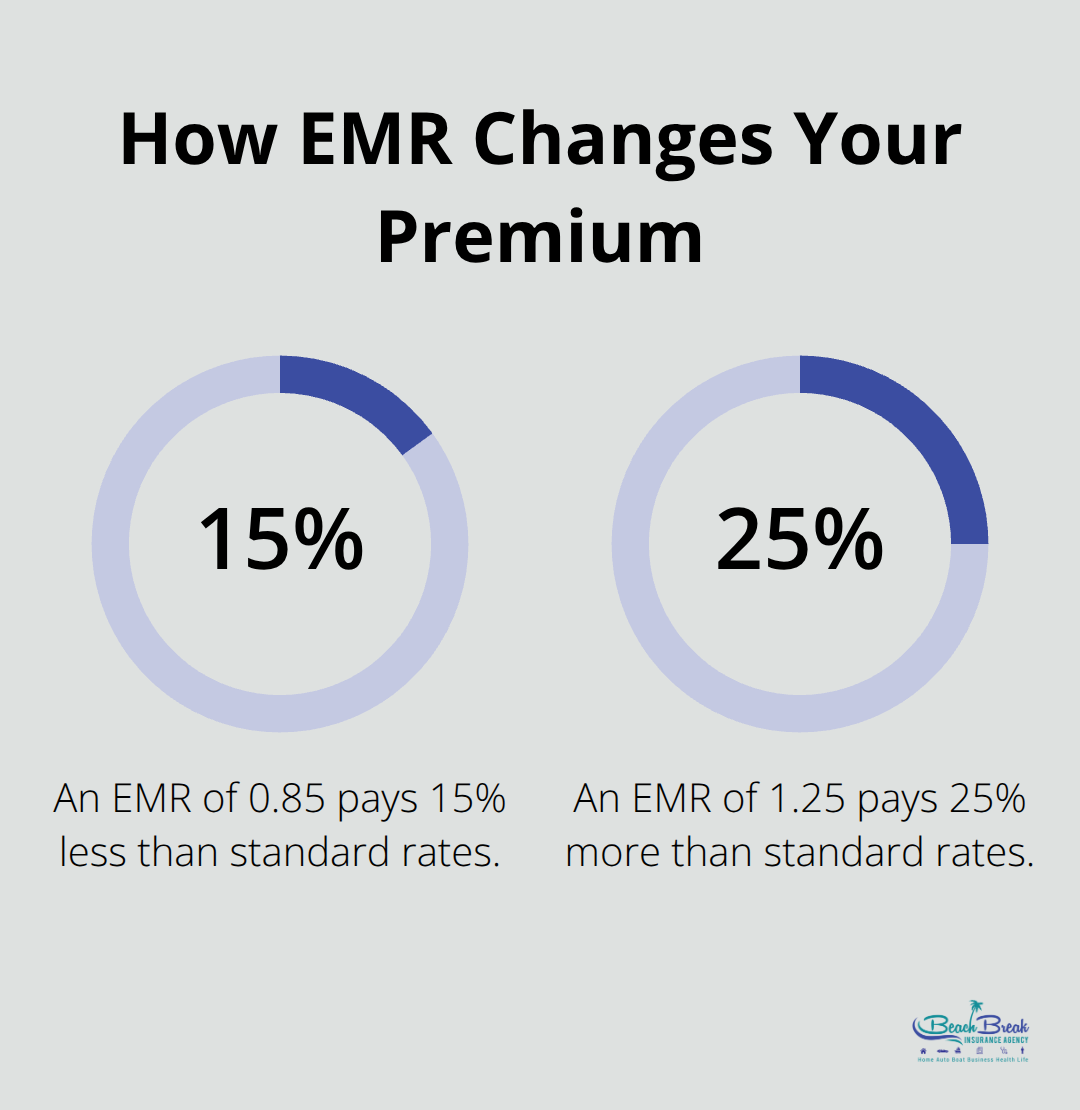
Over a year, that difference on a $500,000 payroll could mean $12,500 in savings or additional costs. The math is simple: fewer injuries mean lower premiums, period.
Safety Investments Pay Back Directly
Safety investments aren’t expenses-they’re direct reductions to your insurance costs. Focus on the hazards that actually cause claims in construction: falls, struck-by incidents, caught-in hazards, and electrocutions. These four categories generate the majority of claims payouts. Implement specific controls for each and you’ll see your loss history improve within 12 to 24 months.
Many contractors assume their claims history is locked in, but it’s not. The California Department of Insurance calculates EMR based on your prior three years of losses, meaning aggressive injury prevention now directly lowers what you pay next year. Safety programs work because they reduce the exact thing that raises your experience modification factor: workplace injuries. A single serious injury can spike your EMR for years, while consistent safety performance steadily reduces it.
How to Manage Claims When Injuries Occur
When an injury does occur, how you document and manage the claim determines whether it becomes a minor expense or a major cost driver. California law requires you to provide a claim form within one working day of injury report, return a copy to the worker within one working day of receipt, and forward it to your claims administrator within one working day. Speed matters because delays trigger penalties and worker frustration.
Authorize up to $10,000 in appropriate medical treatment within one working day of receiving the claim-don’t fight this decision. Early, quality medical care gets workers back to work faster and reduces long-term disability costs. If treatment is delivered through a Medical Provider Network, confirm your injured worker understands whether they can choose their own provider or must use network physicians. Some workers pre-designate a personal physician before injury, which is allowed if they have non-occupational health coverage and provide written notice.
Documentation That Protects You
Document the incident thoroughly: what happened, environmental conditions, equipment involved, witness statements, and photos if safe to take them. This documentation protects you if the claim is ever disputed and helps your claims administrator process it efficiently.
Conduct a root-cause investigation focused on what system failed, not who made a mistake. Did the guardrail have a gap? Was the worker fatigued from scheduling? Was communication unclear about the hazard? Fix the system, not just the individual, and you prevent the same injury from happening to another worker.
Share Lessons Across Your Projects
Share these lessons across your projects-if one site identifies a hazard pattern, all your sites benefit. This continuous improvement approach naturally reduces future claims because you systematically eliminate the conditions that cause injuries. Your loss history improves, your experience modification factor drops, and your premiums reflect the safer operation you’ve built.
Final Thoughts
Construction workers compensation California protects your workers, keeps your business compliant, and directly impacts your bottom line through lower premiums and fewer disruptions. Your experience modification factor responds to what you do today-every month without a serious injury, every near-miss you investigate and fix, every worker you train properly moves your EMR downward and reduces what you pay next year. The contractors winning work and building strong reputations understand that safety and compliance are competitive advantages, not obstacles.
Start this week with a concrete action: review your current workers’ compensation certificate to confirm your classification codes match your actual work and payroll, conduct a quick site assessment to identify which of the four major hazards pose the biggest risk on your projects, and assign one person responsibility for implementing a Job Hazard Analysis before your next project starts. These steps take hours, not weeks, and they establish the foundation for measurable improvements in safety and cost. Beach Break Insurance Agency can help you compare coverage options from multiple carriers to deliver tailored workers’ compensation coverage for your construction business.
California’s construction industry moves fast, and compliance requirements keep changing. Stay connected with Cal/OSHA resources, review your safety program quarterly, and adjust your approach as your business grows. The investment in proper coverage and safety systems pays back consistently through lower premiums, healthier workers, and projects that stay on schedule.
The information provided in this blog is for general informational purposes only and does not constitute legal, financial, or insurance advice. Coverage options, terms, and availability may vary. Please consult with a licensed professional for advice specific to your situation.
Artificial intelligence may have been used to generate text and images in some blog articles.


