
SoCal Coastal Home Insurance: Understanding Wildfire Risk and Coverage
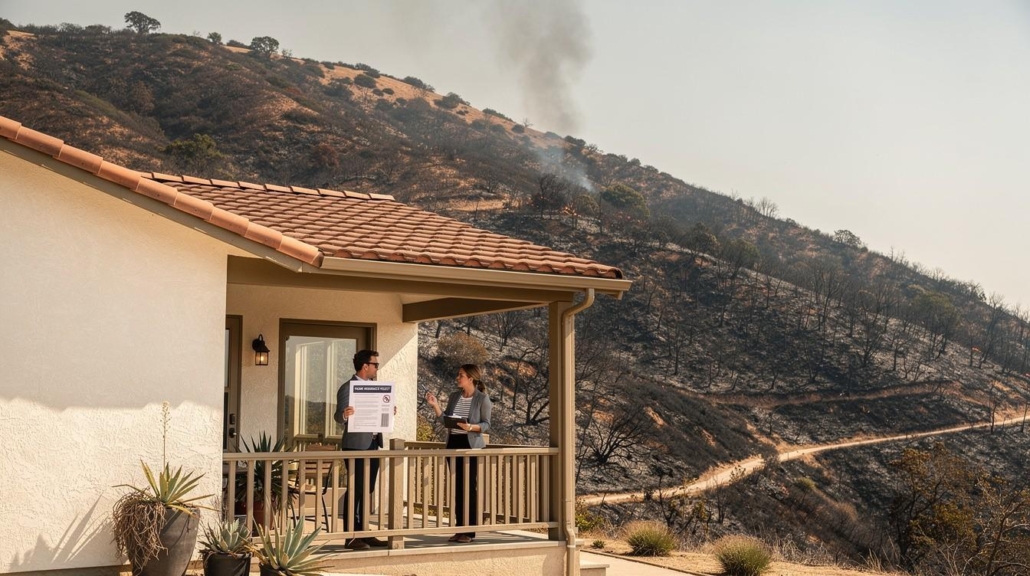
Wildfire season in Southern California is getting more intense, and it’s reshaping how homeowners think about insurance. If you own a coastal home here, your standard policy might not cover what you actually need.
We at Beach Break Insurance Agency help homeowners navigate SoCal coastal home insurance options when fire risk is high. The right coverage can make the difference between financial security and devastating loss.
How Wildfire Risk Reshapes SoCal Home Insurance
Wildfire frequency in Southern California has accelerated dramatically over the past two decades. The state experienced 7,603 fires in 2023 alone, according to Cal Fire data, burning over 632,000 acres. What’s more alarming is the geographic shift-fires no longer stay confined to remote areas. The 2023 Lilac Fire burned 4,300 acres in San Diego County, and the 2021 Dixie Fire became California’s largest wildfire on record at 963,000 acres. These aren’t outliers anymore. Insurance companies now treat coastal Southern California properties as moderate to high-risk zones based on proximity to known fire corridors, vegetation density, and historical burn patterns. This reality directly impacts your premium costs and what insurers will actually cover.
Insurance Rates Reflect Fire Proximity and Home Characteristics
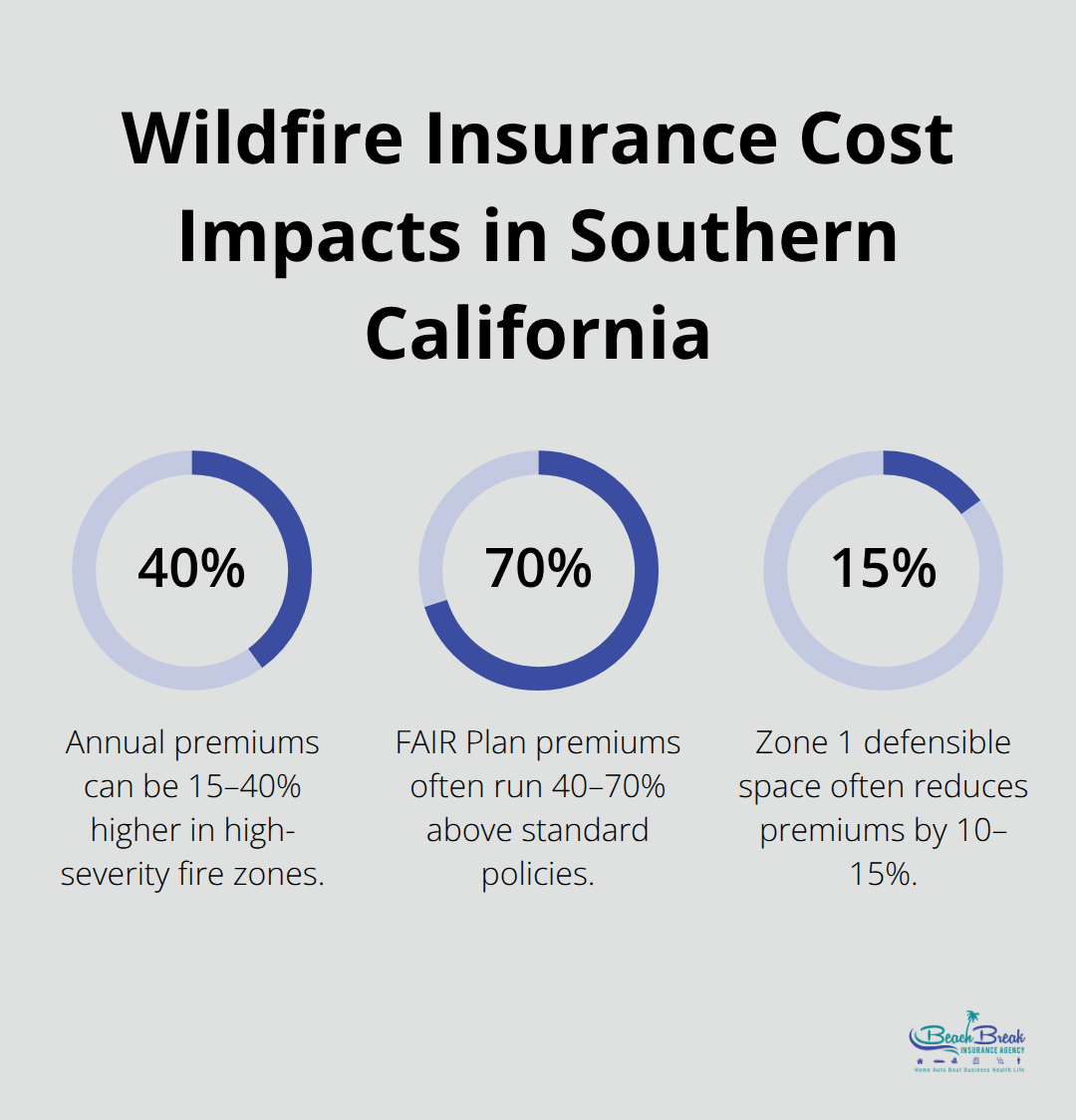
Insurers calculate wildfire premiums using multiple risk factors beyond just location. Cal Fire’s Fire and Resource Assessment Program maps identify fire threat zones, and insurance companies cross-reference these maps with individual property data. A home in a high-severity zone typically costs 15 to 40 percent more in annual premiums than an identical home just outside that zone, depending on your carrier. The specific risk assessment also considers your roof material (composition shingles versus metal or tile), distance to the nearest fire station, and whether defensible space exists around your home. Some carriers have completely withdrawn from high-risk California markets, creating gaps in availability.
Others have implemented stricter underwriting standards, meaning they’ll deny coverage or demand specific home improvements before offering a policy. An independent agent who accesses multiple carriers can match your specific property to insurers still actively writing in your area rather than accepting a denial from one company.
High-Risk Zones Extend Beyond Simple Location Checks
Identifying whether your coastal home sits in a high-risk fire zone requires more than checking a map. Cal Fire’s Fire Hazard Severity Zones classify land into areas of varying fire risk, but insurance companies also layer on additional data. They examine vegetation type, slope, elevation, and proximity to previous fire perimeters. A property on a hillside with dense chaparral faces higher risk than a similar home on level ground in the same neighborhood. Elevation matters too-homes above 3,000 feet in San Diego County often trigger stricter underwriting. Additionally, your home’s age and construction materials significantly influence risk assessment. A 1970s home with wooden eaves and a composition roof will face higher premiums and stricter requirements than a 2015 home with metal gutters and a fire-resistant roof. The coastal areas of San Diego County, particularly inland regions near Ramona, Julian, and the foothills, carry elevated fire risk classifications that directly translate to coverage availability and cost.
Your Property’s Specific Characteristics Drive Coverage Decisions
Your address alone doesn’t tell the full story-the specific characteristics of your property and its surroundings determine whether you’ll find affordable coverage or face limited options. Insurance underwriters examine how your home sits on the land, what materials surround it, and how quickly fire could reach it. A property with mature trees close to the structure presents different risk than one with cleared space. The type of vegetation matters significantly (chaparral burns faster than coastal sage scrub). Your home’s defensible space-or lack of it-becomes a major factor in whether carriers will write a policy at all. Properties that lack adequate clearance around structures often face denial or substantial rate increases. Understanding these specific factors helps you take targeted action before shopping for coverage, which we’ll address in the next section.
What Coverage Actually Works for Fire-Prone Coastal Homes
Standard Policies Fall Short in High-Risk Areas
Standard homeowners insurance policies sold in California contain a critical limitation that most homeowners discover only after a loss: they exclude or severely restrict coverage for wildfire damage in high-risk zones. Insurance carriers writing standard HO-3 policies in Southern California increasingly use exclusions or non-renewal to manage wildfire exposure. If your home sits in a Cal Fire Fire Hazard Severity Zone, many insurers will either decline to renew your policy or impose such high premiums that coverage becomes economically unrealistic. This leaves coastal property owners in a difficult position.
The FAIR Plan: Protection When Traditional Carriers Won’t Cover You
California created the FAIR Plan (Fair Access to Insurance Requirements) in 1968 specifically to address this gap. The FAIR Plan enrollment and growth statistics show a 212% increase since September 2022, with the FAIR Plan operating as an insurer of last resort, accepting policies that traditional carriers reject. Premiums run substantially higher than standard policies, typically 40 to 70 percent above what you’d pay through a traditional carrier. Coverage limits are capped, and the policy excludes certain protections like loss of use coverage that standard policies include. For many coastal Southern California homeowners, the FAIR Plan represents temporary protection while you work to improve your property’s fire-resistance characteristics or find an agent with access to specialty carriers still active in high-risk zones.
Specialty Carriers and Riders Fill Coverage Gaps
Specialty insurers and regional carriers continue writing policies in California’s fire-prone areas, though they maintain stricter underwriting standards than historical norms. An independent agent can access multiple carriers simultaneously, identifying which ones still write in your specific zip code and fire zone. Some carriers offer fire-specific riders or endorsements that add wildfire coverage to base policies at reasonable costs.
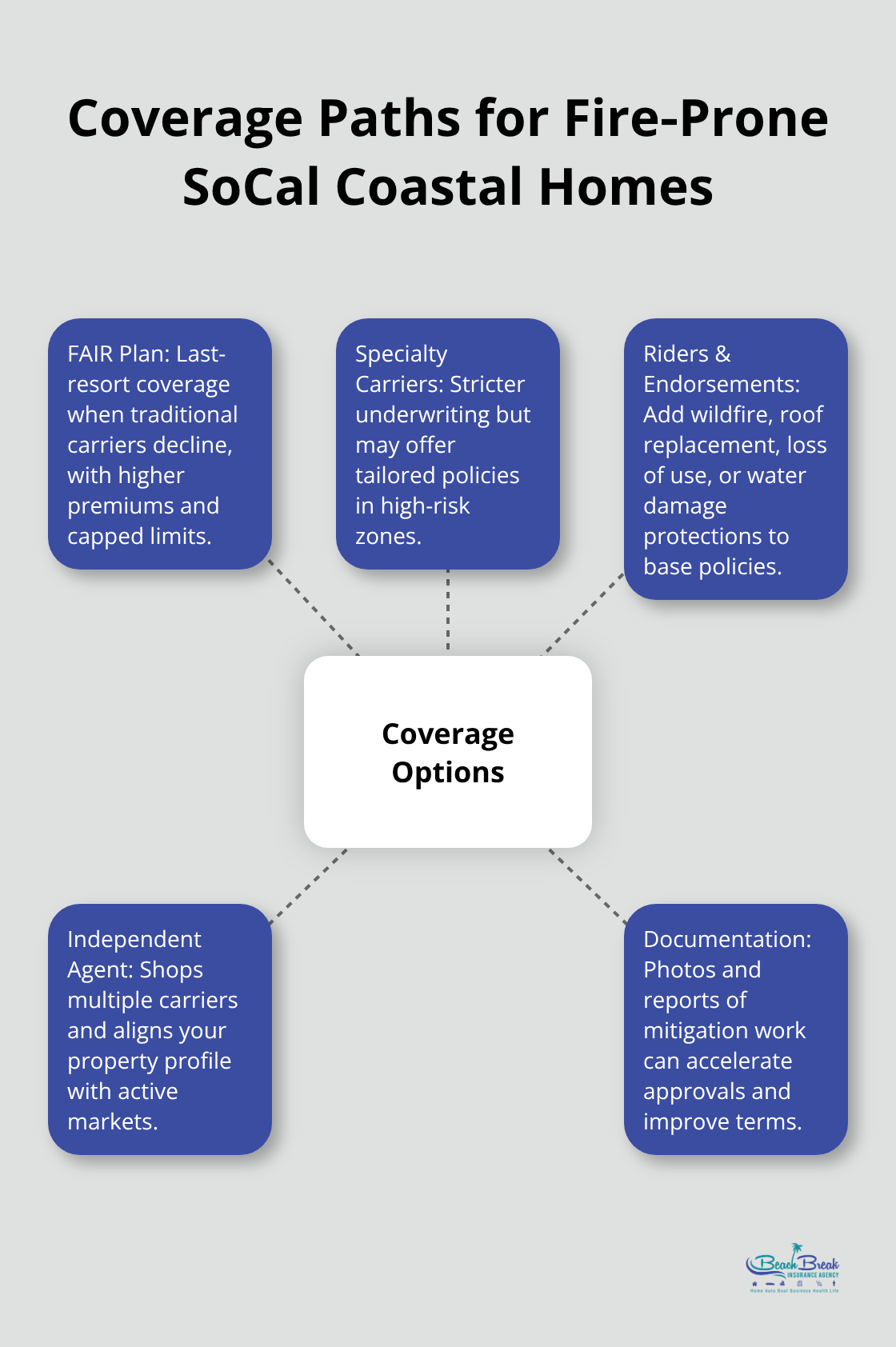
Roof coverage riders cover roof replacement after fire damage at replacement cost rather than depreciated value, costing between $15 and $50 annually and saving thousands after a loss. Loss of use coverage, sometimes called additional living expenses, reimburses temporary housing and meals if your home becomes uninhabitable following a fire, typically costing $200 to $400 per year for adequate limits. Water damage coverage riders become essential in coastal fire zones because wildfires increase flooding risk when burn scars prevent soil absorption during heavy rains. The 2023 fires in San Diego County were followed by debris flow events that caused significant water damage to homes miles from the burn perimeter.
Multiple Carriers Offer Dramatically Different Terms
Comparing quotes across multiple carriers reveals dramatic differences in what they’ll cover, at what price, and under what conditions. A property that one carrier rejects might qualify for standard coverage through another, or qualify for the FAIR Plan at a lower rate through a different agent accessing additional specialty carriers. The specific characteristics of your home-roof material, defensible space, construction age, and proximity to previous fire perimeters-determine which carriers will write policies and at what cost. Taking action to improve these characteristics before shopping for coverage can shift you from the FAIR Plan into standard market options with better rates and broader protection. Your next step involves identifying which specific improvements your property needs and how those changes affect your insurance options.
How to Lower Your Rates and Get Coverage Approved
Defensible Space Creates Immediate Insurance Impact
Improving your property’s fire resistance directly determines whether insurers will cover you and what they’ll charge. Insurance underwriters evaluate specific physical improvements and adjust terms accordingly. The most effective approach combines defensible space work with structural hardening, then shops with an agent who documents these changes to multiple carriers. Carriers like State Farm and Allstate have published specific requirements for high-risk zones, and meeting those standards shifts your property from rejection to approval.
Cal Fire’s defensible space guidelines recommend 100 feet of defensible space in high-severity zones, though practical results appear in three distinct zones. Zone 1 (0 to 5 feet from your home) requires removal of all dead vegetation, leaves, and branches touching the structure-this zone alone prevents embers from igniting your home during a fire’s approach. Zone 2 (5 to 30 feet) demands spacing between trees and removal of lower branches so flames can’t climb into canopies.
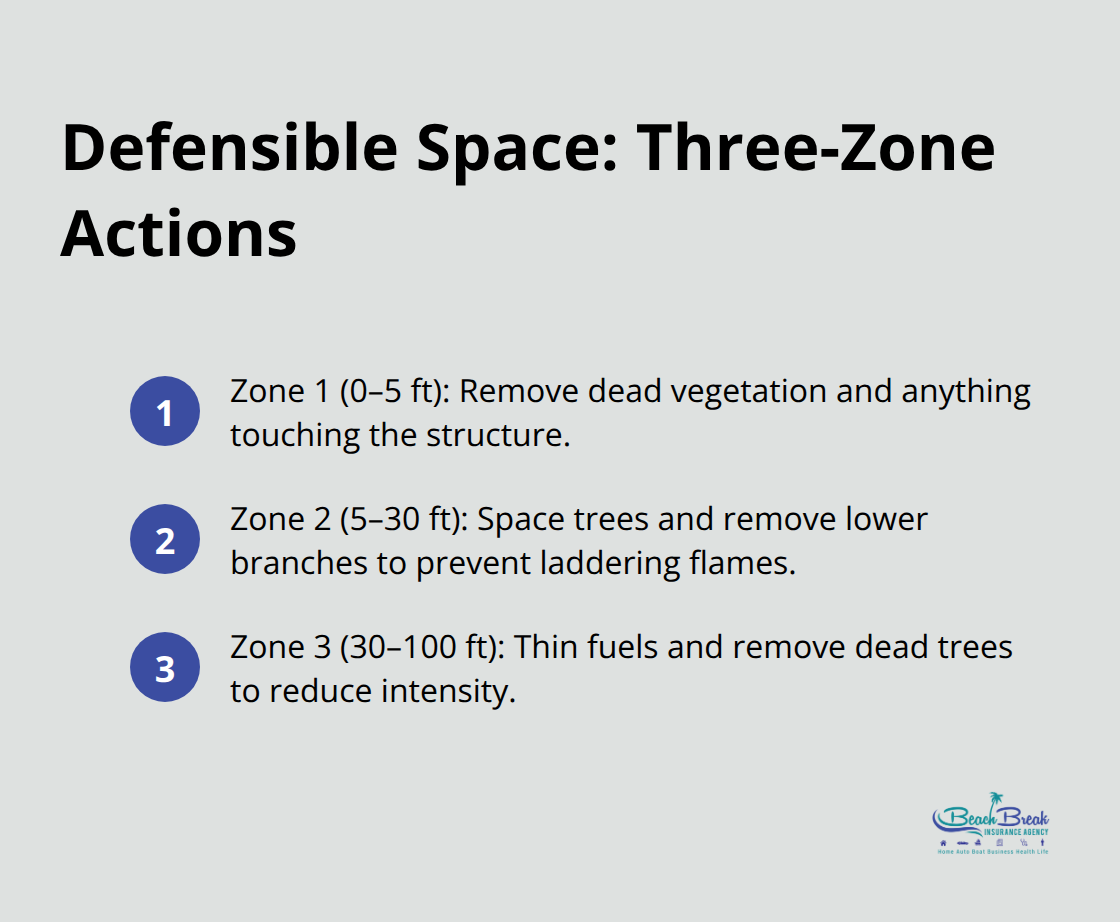
Zone 3 (30 to 100 feet) focuses on reducing fuel density and removing dead trees entirely.
Completing Zone 1 work costs between $500 and $2,000 for most coastal properties and typically reduces premiums by 10 to 15 percent. Adding Zone 2 work costs another $1,500 to $4,000 but can shift approval from specialty carriers who previously declined coverage. Professional fire mitigation companies in San Diego County charge $75 to $150 per hour and will photograph completed work, providing documentation that insurers require during underwriting.
Structural Improvements Deliver Long-Term Value
Structural improvements matter equally and sometimes more than landscaping. Metal gutters, Class A fire-rated roofing materials, and enclosed eaves prevent ember penetration during wildfires. Insurance companies offer substantial incentives for these upgrades-a metal roof installation costing $8,000 to $12,000 can lower annual premiums by $400 to $800, paying for itself in 12 to 18 years while simultaneously making your home more insurable.
Tempered glass windows and metal screening on vents cost $2,000 to $5,000 but address specific vulnerabilities underwriters flag in high-risk zones. These improvements reduce your property’s exposure to the ember storms that precede active flames, a factor that carriers weight heavily in their underwriting decisions.
Documentation Accelerates Carrier Approval
After completing either defensible space work or structural improvements, contact an independent agent immediately to re-shop your coverage before the next renewal. An independent agent can access multiple carriers simultaneously and present specific documentation of your improvements to underwriters who previously rejected your property. Timing matters significantly-many carriers process underwriting decisions within 48 hours when an agent submits complete documentation, meaning you could shift from FAIR Plan coverage to standard market rates within days rather than waiting for your policy renewal date.
Final Thoughts
Wildfire risk in Southern California is real, and it reshapes what coverage looks like for coastal homeowners. The statistics are clear: fires occur more frequently, burn larger areas, and reach closer to populated neighborhoods than ever before. Your standard homeowners policy will not protect you in high-risk zones, and waiting until renewal time to address coverage gaps leaves you vulnerable.
You must act on two fronts to secure affordable SoCal coastal home insurance. First, improve your property’s fire resistance through defensible space work and structural upgrades-these changes determine whether carriers will write policies at reasonable rates. Zone 1 defensible space work costs $500 to $2,000 and typically reduces premiums by 10 to 15 percent, while a metal roof pays for itself through premium savings over 12 to 18 years. Second, work with an independent agent who accesses multiple carriers simultaneously, since one carrier’s rejection does not mean you must accept the FAIR Plan (different insurers maintain different underwriting standards, and specialty carriers still write in high-risk zones).
Beach Break Insurance Agency specializes in comparing quotes from multiple carriers to find tailored coverage for coastal San Diego properties. They understand fire risk in your specific area and can access solutions like the California FAIR Plan while simultaneously shopping specialty carriers for better rates and broader protection. Contact them to review your current coverage and identify which improvements will shift your property toward standard market options with lower costs.
The information provided in this blog is for general informational purposes only and does not constitute legal, financial, or insurance advice. Coverage options, terms, and availability may vary. Please consult with a licensed professional for advice specific to your situation.
Artificial intelligence may have been used to generate text and images in some blog articles.


