

A Quick Guide to Work Comp Insurance California for SMBs
Work comp insurance California isn’t optional-it’s a legal requirement for most employers. If you’re running a small business in California, understanding your obligations and options can save you thousands in penalties and unexpected costs.
We at Beach Break Insurance Agency help business owners navigate these requirements every day. This guide walks you through what you need to know to protect your team and your bottom line.
What California Work Comp Actually Covers
California’s workers’ compensation system exists because workplace injuries happen, and they’re expensive. The state mandates that employers carry this insurance to protect workers who get hurt on the job, which means you don’t have a choice about whether to carry it. According to the California Department of Industrial Relations, employers with even one employee must have coverage, with very few exceptions for sole proprietors. The system replaces the right to sue your employer in exchange for guaranteed medical coverage and wage replacement.
This trade-off is non-negotiable in California, and the penalties for ignoring it are severe enough that many small business owners skip other expenses to afford it.
Understanding Your Legal Obligation
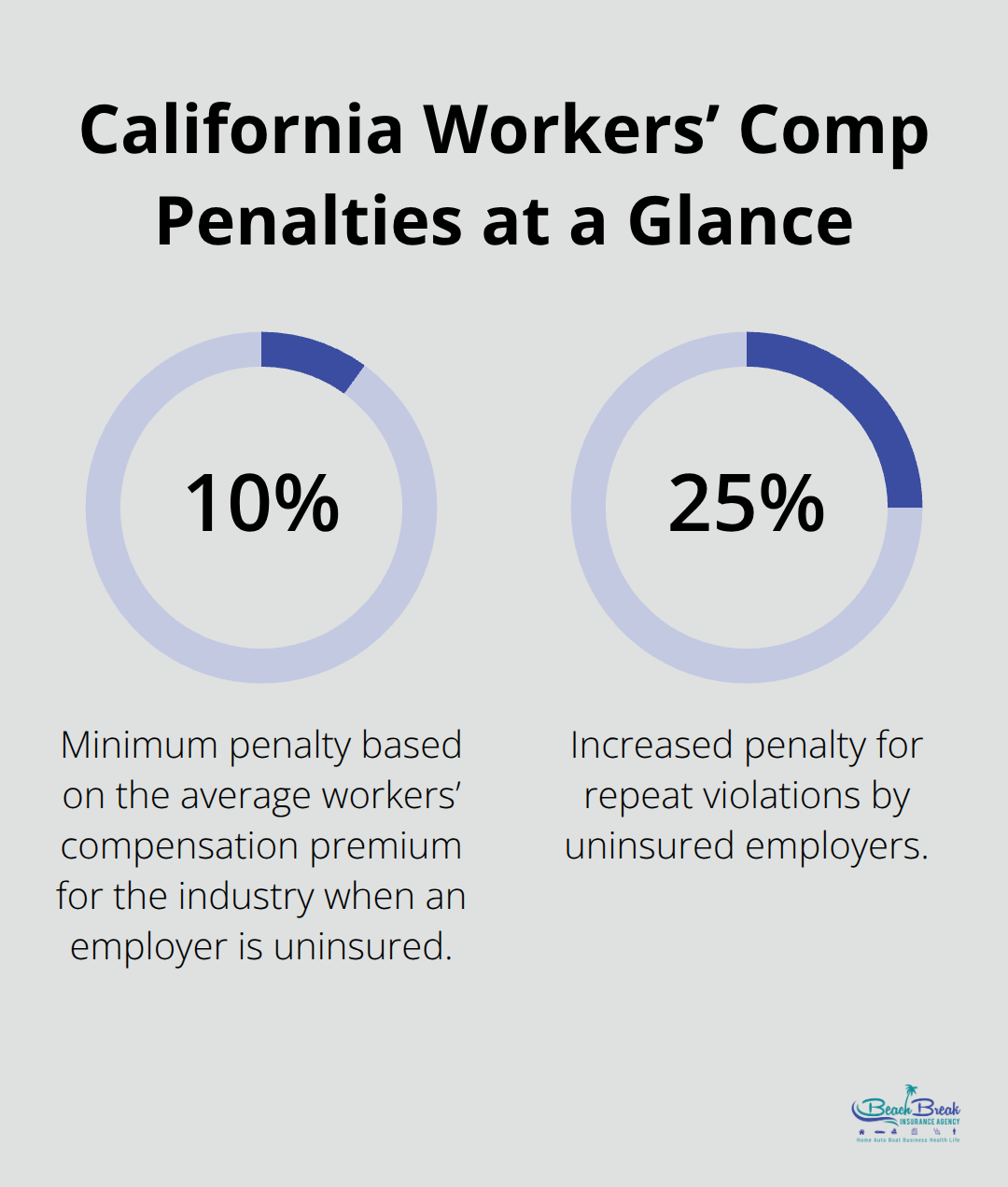
California law requires you to carry workers’ compensation insurance if you have employees on your payroll. The only employers exempt from this requirement are sole proprietors who work entirely alone, partners in partnerships, and corporate officers who elect to exclude themselves. If you misclassify an employee as an independent contractor to avoid coverage, you expose yourself to massive liability. The state takes this seriously, and audits happen regularly. Your insurance carrier reports your payroll quarterly, so underreporting wages to lower premiums gets caught. The California Department of Industrial Relations enforces compliance, and uninsured employers face penalties starting at 10 percent of the average workers’ compensation premium for that industry, with increases up to 25 percent for repeat violations. Beyond fines, you become personally liable for all medical bills and lost wages if an uninsured employee gets hurt on your watch.
What Your Policy Actually Pays For
Workers’ compensation in California covers medical treatment for work-related injuries and illnesses, including doctor visits, hospital stays, surgery, and prescription medications with no time limits. Temporary disability benefits replace lost wages while an employee recovers and cannot work, paying between 60 and 66.67 percent of their average weekly wage. Permanent disability benefits apply when an employee has lasting impairment from a work injury, calculated based on the type of injury and the employee’s age and occupation. Death benefits go to an employee’s family if a workplace injury proves fatal. Vocational rehabilitation helps injured workers retrain for different work if they cannot return to their original job. The coverage is mandatory statewide, and employers cannot require employees to pay for any portion of it or deduct it from wages.
Coverage Limits and What They Mean for Your Business
California does not set a maximum limit on medical benefits, which means your policy covers all necessary treatment related to a work injury indefinitely. Wage replacement benefits, however, have limits tied to the state’s average weekly wage (currently around $1,500 per week). Permanent disability awards cap at two-thirds of the employee’s average weekly wage, with maximum and minimum amounts that the state adjusts annually. These limits protect your premium costs while still providing substantial protection to injured workers. Understanding these thresholds helps you anticipate your actual exposure and plan your business finances accordingly.
Picking the Right Policy for Your California Business
Calculate Your Payroll and Identify Risk Categories
Start by calculating your actual payroll and identifying which job categories pose the highest injury risk. Workers’ comp premiums in California are based entirely on your payroll and industry classification, so accuracy matters more than you might think. If you run a construction company, your rates will be significantly higher than a consulting firm with the same payroll because construction carries inherent physical risks. The California Department of Insurance publishes rate manuals that show the premium per $100 of payroll for each classification code, and these rates vary dramatically. Office clerical workers cost approximately $0.15 per $100 of payroll while roofing classifications sit at roughly $14.22 per $100.
Misclassifying your employees to lower premiums backfires fast when audits happen, which they do regularly. Know your actual payroll breakdown by job function, because that’s what carriers will ask for when they quote you. If your payroll fluctuates seasonally, provide annual figures rather than monthly snapshots, since carriers calculate annual premiums regardless of how you distribute the work throughout the year.
Request Quotes from Multiple Carriers
Getting quotes from multiple carriers reveals massive price differences for identical coverage. Three different insurers might quote you $5,000, $7,200, and $4,100 for the same business, making comparison shopping non-negotiable. When you request quotes, provide each carrier with identical information about your business, payroll, loss history, and safety programs.
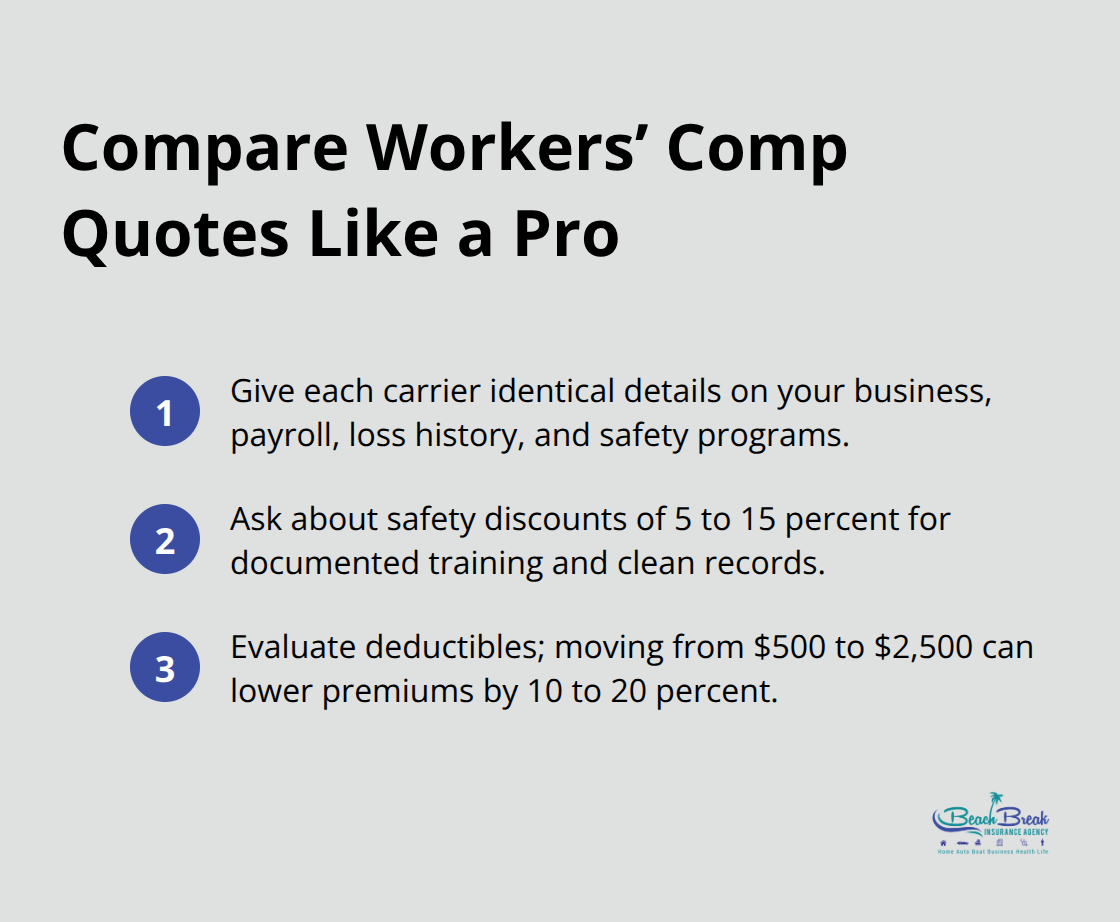
Some carriers offer discounts of 5 to 15 percent if you implement formal safety training and maintain incident-free records, so mentioning your safety practices matters. Review not just the premium but also the deductible options available. A higher deductible like $2,500 instead of $500 typically lowers your annual premium by 10 to 20 percent, which makes sense if your business can absorb that out-of-pocket cost.
Evaluate Deductibles and Loss Control Requirements
Check whether carriers require specific loss control measures or safety certifications in your industry, since some impose mandatory equipment or training at additional cost. The deductible you select directly impacts both your immediate costs and your long-term financial planning. Higher deductibles work well for stable businesses with strong safety records, while lower deductibles protect companies facing unpredictable injury patterns.
Don’t settle for the first quote you receive, and don’t choose based on price alone if a carrier has a reputation for poor claims handling or slow payment to injured workers. An independent agent can quickly compare quotes from multiple top-rated carriers to help you find the best rate without spending weeks on phone calls. The right policy balances affordability with reliable claims support when your team actually needs it.
How to Actually Lower Your Workers’ Comp Premiums
Safety Programs That Carriers Reward
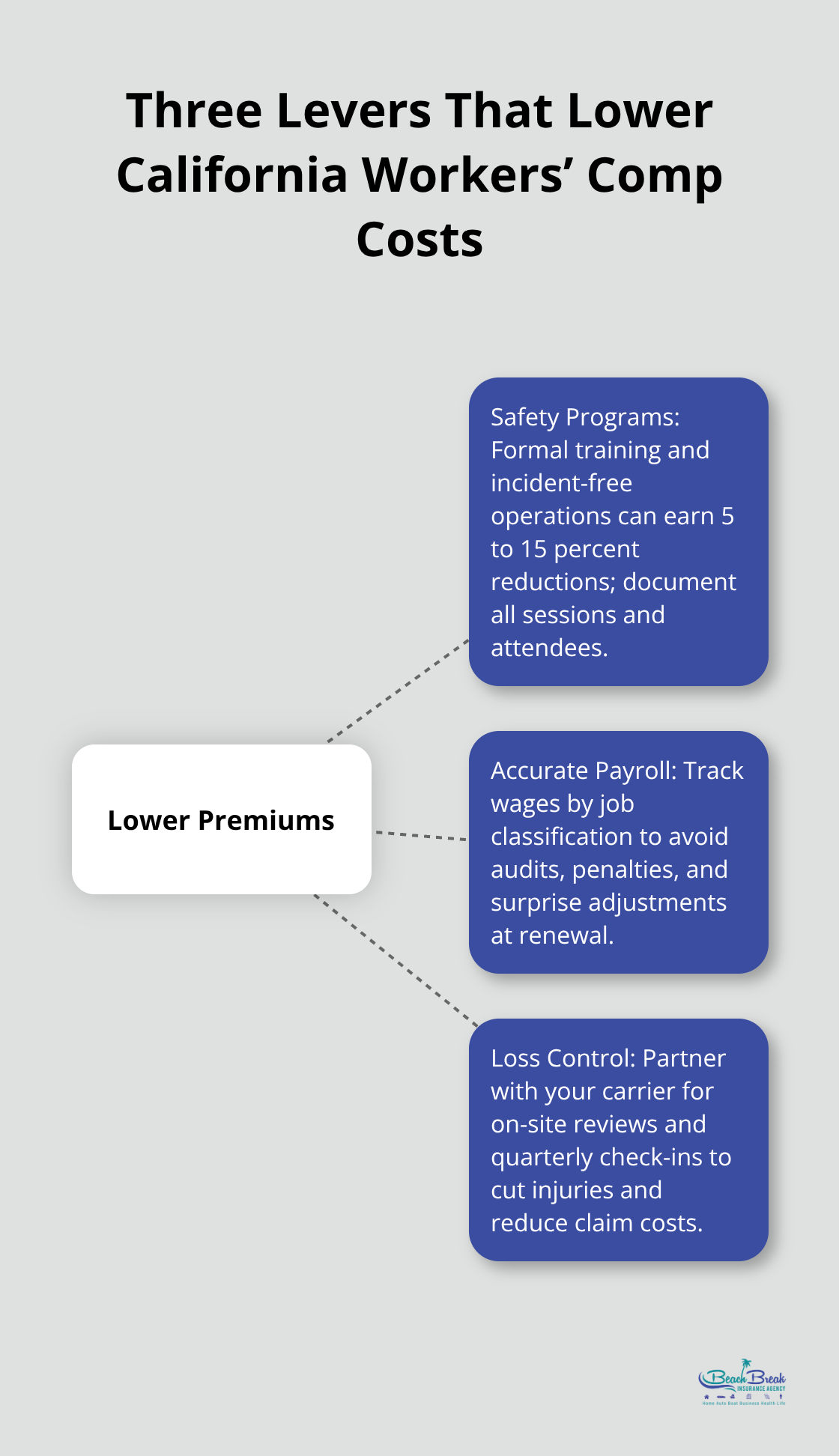
Safety programs work because carriers track your claims history and adjust your rates accordingly. California employers who implement formal safety training see premium reductions of 5 to 15 percent, according to the California Department of Industrial Relations, and these discounts compound over multiple years of incident-free operations. The key is documenting everything. When you train employees on hazard recognition, proper lifting techniques, or equipment operation, keep records showing dates, attendees, and topics covered. Carriers want evidence that you take safety seriously, not just a vague promise that you do.
If your industry requires specific certifications like OSHA training for construction or food safety for restaurants, complete those programs and provide proof to your insurer. One roofing company in San Francisco reduced its premium by $3,200 annually after implementing a documented fall protection program and maintaining zero claims for two consecutive years. Your insurer’s loss control department often provides free safety audits and recommendations tailored to your specific operation, so contact them and ask what they recommend for your industry classification.
Accurate Payroll Records Prevent Audit Surprises
Accurate payroll records directly determine your premium because California uses actual wages to calculate the final cost. Many small business owners underestimate their payroll when getting initial quotes, then face substantial premium increases at audit time when the insurer discovers the discrepancy. Track hours and wages by job classification exactly as your carrier requests, because misreporting your payroll breakdown triggers audits and penalties.
The difference between estimated and actual payroll can cost thousands in unexpected charges. Provide your carrier with complete wage information broken down by job classification, since this accuracy prevents nasty surprises at renewal. If your payroll fluctuates seasonally, report annual totals rather than monthly averages to give carriers the full picture of your actual exposure.
Loss Control Partnerships Lower Injury Rates
When you work with your insurer on loss control, you gain access to resources most business owners never use. Carriers employ safety specialists who visit your location, identify risks specific to your operation, and suggest improvements that reduce injury likelihood. These consultations are free and often reveal simple changes that lower both injuries and premiums. A landscaping company that worked with its carrier’s loss control team to implement proper equipment maintenance procedures and employee stretch routines dropped its injury rate by 40 percent over eighteen months.
Request quarterly reviews of your safety performance with your carrier rather than waiting for annual renewals, since demonstrating continuous improvement positions you for better rates when renewal time arrives. Loss control specialists can identify hazards you might miss because they work across multiple businesses in your industry and spot patterns that matter. This partnership approach (where your carrier actively helps you prevent injuries) costs them less in claims and saves you money on premiums.
Final Thoughts
Work comp insurance California protects your employees and your business from financial devastation when injuries happen. The state’s requirements aren’t negotiable, but your approach to coverage absolutely is. Getting this right means understanding what you’re legally required to carry, comparing quotes from multiple carriers to find real savings, and implementing safety practices that lower your premiums over time.
Calculate your actual payroll and industry classification accurately so you get quotes that reflect your real exposure. Request quotes from at least three carriers and compare their rates, deductibles, and claims handling reputation rather than picking based on price alone. Invest in documented safety programs and maintain clean payroll records, since these directly reduce your premiums and protect your team.
Your workers’ comp policy isn’t just a compliance checkbox-it’s the financial foundation that keeps your business running when someone gets hurt. Beach Break Insurance Agency compares quotes from multiple top-rated carriers to deliver tailored workers’ comp solutions for California businesses. Contact them to get started with a quote that reflects your actual business needs.
The information provided in this blog is for general informational purposes only and does not constitute legal, financial, or insurance advice. Coverage options, terms, and availability may vary. Please consult with a licensed professional for advice specific to your situation.
Artificial intelligence may have been used to generate text and images in some blog articles.


