
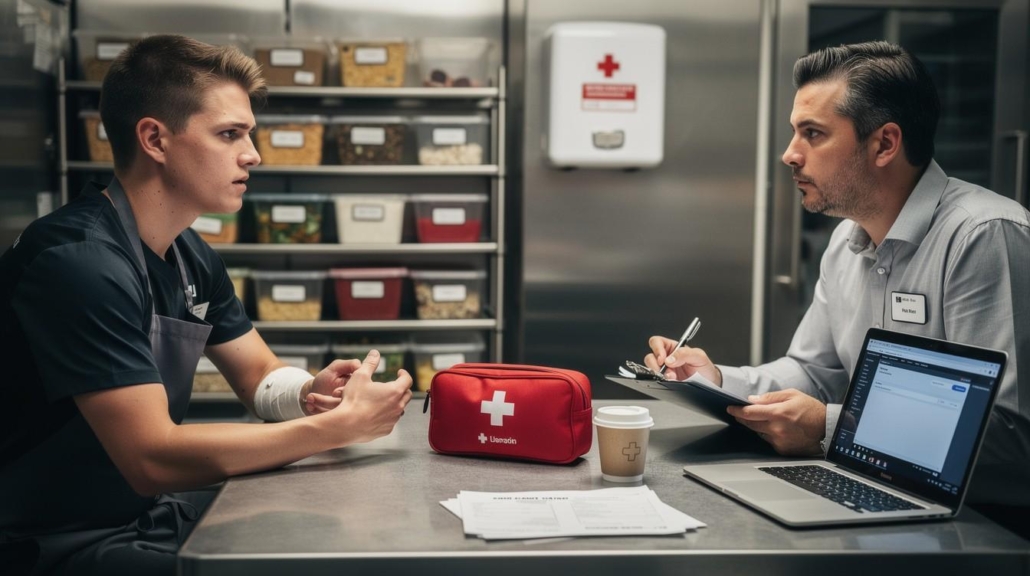
Restaurant Workers Compensation in California: What It Covers
Restaurant workers compensation in California isn’t optional-it’s the law. If you run a restaurant, you need to understand what this coverage actually protects and how it works when accidents happen.
We at Beach Break Insurance Agency know that burns, slips, and injuries are part of the restaurant industry. The right coverage makes all the difference when your team gets hurt on the job.
California’s Workers Compensation Requirements for Restaurants
Legal Mandate for Restaurant Operators
California law mandates that restaurants with one or more employees carry workers compensation insurance. This isn’t optional-it’s a legal requirement enforced by the state. If you operate a restaurant and fail to carry this coverage, you face serious penalties including fines up to $10,000 per uninsured employee, plus potential criminal charges. The California Division of Workers’ Compensation explains basic requirements and procedures to comply with the state’s workplace safety and health standards. Your coverage must meet minimum requirements set by the state, and you cannot opt out or self-insure unless you meet extremely specific criteria that virtually no restaurant owner qualifies for.
Medical and Disability Benefits Explained
Workers compensation in California covers medical treatment, temporary disability benefits, permanent disability benefits, and death benefits if an employee dies from a work-related injury or illness. Medical coverage includes all necessary treatment-doctor visits, surgery, physical therapy, medications-with no deductible or copay for the employee. When a cook burns their arm on a griddle, your policy pays for emergency care, follow-up appointments, and any rehabilitation needed. Temporary disability benefits replace about two-thirds of the employee’s lost wages if they cannot work while recovering, capped at a state maximum that adjusts annually. For 2024, the maximum weekly benefit is $1,554.29 according to the California Department of Industrial Relations. Permanent disability payments apply when an injury causes lasting impairment-a line cook who suffers a severe hand injury that limits their ability to work permanently receives ongoing compensation based on the degree of disability.
Employee Coverage Requirements
Nearly every person working in your restaurant must be covered, including full-time staff, part-time workers, seasonal employees, and even family members you employ. Independent contractors are typically exempt, but California applies strict tests to determine whether someone is truly an independent contractor or misclassified as one. The state presumes workers are employees unless you prove they meet all three criteria: they work free from your control, they perform services outside your usual business operations, and they are customarily engaged in an independently established trade. Many restaurants have faced costly penalties for misclassifying dishwashers, delivery drivers, or prep cooks as contractors when they should have been covered employees. Managers and owners are also covered under workers compensation, though the rules differ slightly for sole proprietors and partners.
What Happens When Injuries Occur
The moment an employee sustains a work-related injury, your workers compensation policy activates to protect both your worker and your business. Understanding what happens next-from the initial report through claim resolution-helps you navigate the process smoothly and ensures your injured employee receives the benefits they’re entitled to.
Common Workplace Injuries in Restaurants
Restaurant injuries follow predictable patterns, and understanding which ones strike hardest helps you prevent them and manage claims effectively. Thermal injuries affect commercial kitchens at rates significantly higher than other industries. A line cook reaching across a hot stove, a server spilling boiling water, or a prep worker touching a griddle without protection-these incidents happen constantly. The severity varies dramatically.
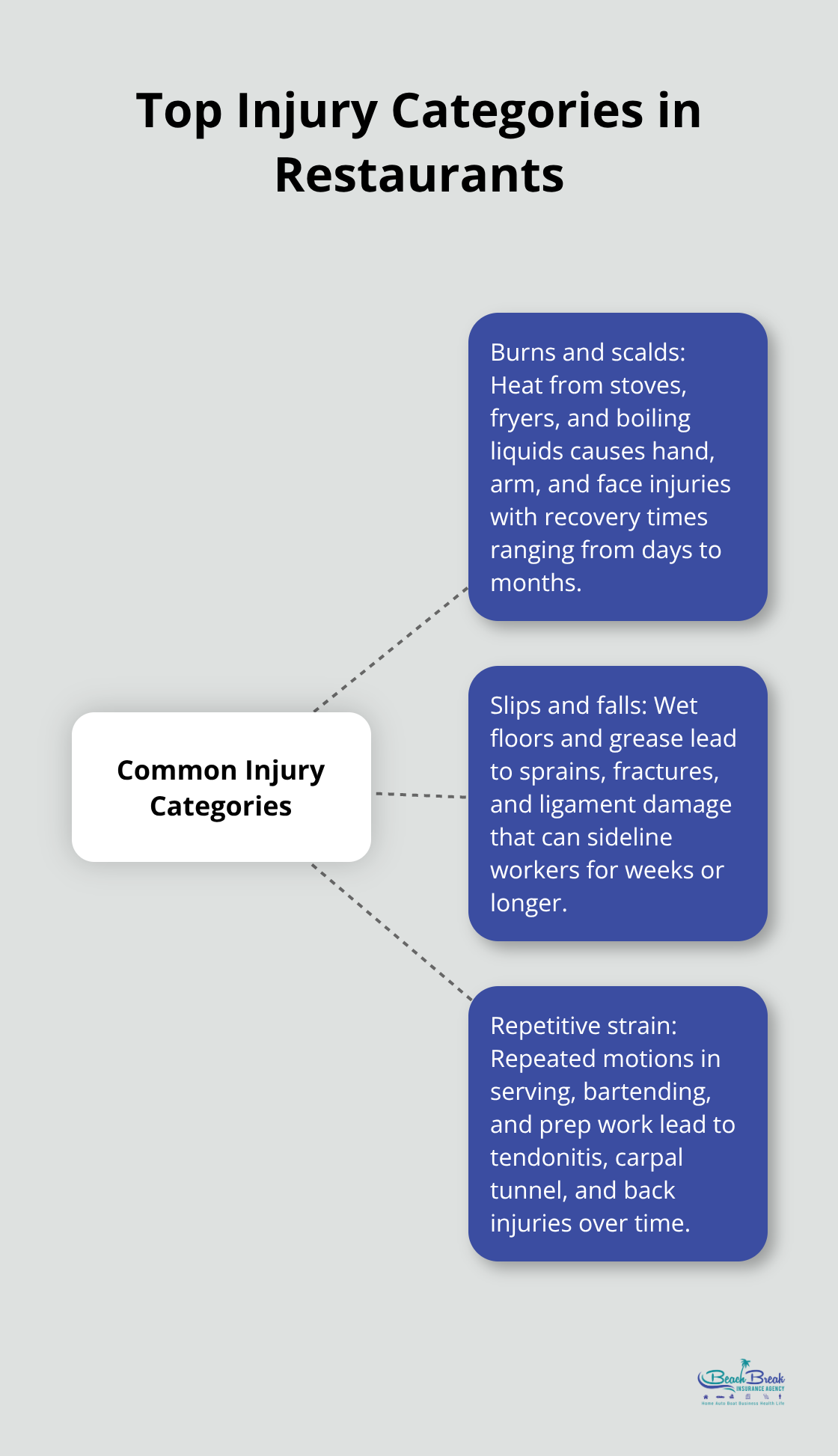
Minor burns heal in days, but deep thermal injuries require weeks of medical care, physical therapy, and lost work time.
Burns and Scalding Incidents
Heat poses the most immediate threat in any kitchen. Thermal injuries affect hands, arms, and faces when workers interact with stoves, fryers, grills, and boiling water. The depth of the burn determines recovery time and workers compensation costs. First-degree burns cause redness and mild pain, healing within a week. Second-degree burns blister and scar, requiring medical treatment and two to three weeks away from work. Third-degree burns destroy skin layers completely, necessitating emergency care, skin grafts, and months of rehabilitation. Your workers compensation policy covers all treatment stages, from initial emergency room visits through physical therapy and scar management. Prevention stops most thermal injuries before they happen. Enforce strict protocols: require oven mitts and long sleeves in hot zones, maintain clear communication when passing hot items, and ensure every employee knows where the first aid station sits. Most restaurants ignore these preventive steps and pay for it through higher insurance costs and injured workers.
Slip and Fall Accidents
Wet kitchen floors and dining areas create hazards that injure thousands of restaurant workers annually. These incidents often seem minor until an employee lands hard on their wrist or knee, resulting in sprains, fractures, or torn ligaments that sideline them for months. Slip and fall accidents rank as the second major injury category in food service. A server rushing between tables on a wet floor, a dishwasher losing footing near the sink, or a line cook slipping on grease behind the stove-each scenario produces different injury patterns and recovery timelines. Implement a non-negotiable floor maintenance schedule to reduce these risks. Wipe spills immediately, use slip-resistant mats behind the bar and in front of sinks, and invest in quality non-slip footwear for your team. These investments cost far less than workers compensation claims for broken bones or ligament damage.
Repetitive Strain and Musculoskeletal Injuries
The third major injury category affects servers, bartenders, and kitchen staff who perform the same motions thousands of times weekly. Carpal tunnel syndrome, tendonitis, and lower back injuries develop gradually but can become career-threatening conditions that force workers into permanent disability claims. A bartender mixing drinks for eight hours daily, a server carrying heavy trays shift after shift, or a prep cook chopping vegetables repetitively-each develops strain injuries that workers compensation must cover for months or years. Rotate tasks so no single person spends eight hours on the same motion. Provide ergonomic training during onboarding, and watch for early warning signs like complaints of wrist pain or stiffness. Workers who catch these issues early and adjust their technique avoid months of lost productivity.
Documentation and Prevention Strategy
Document all injuries, no matter how minor they seem, because unreported incidents often resurface as expensive claims later. When an injury does occur, immediate medical evaluation protects both the worker’s health and your claim timeline. Your workers compensation coverage activates the moment you report the incident, triggering the benefits process and protecting your business from liability. Understanding the filing process and your obligations as an employer ensures smooth claim resolution and keeps your injured employee informed throughout recovery.
How to File a Workers Compensation Claim
Report the Injury Immediately
The moment an injury happens, your employee must report it to you immediately, and you must act fast. California law gives workers 30 days to report an injury to their employer, but waiting that long creates serious problems. If your employee delays reporting, the claims process stalls, medical treatment gets pushed back, and you lose documentation of exactly when and how the injury occurred. Establish a clear reporting protocol where injured workers tell a manager or supervisor within hours of the incident, not days later.
When the report comes in, document everything in writing, including the date, time, location, what the employee was doing, and how the injury happened. This written record becomes critical evidence if disputes arise later about whether the injury was truly work-related. Many restaurant owners skip this step and regret it when the workers compensation carrier questions the claim because no contemporaneous documentation exists.
Provide Required Forms and File the Claim
California requires employers to provide injured workers with a form called the Employee’s Claim Form (also known as Form DWC-1) within one working day of learning about the injury. This form must reach the employee so they can file their claim with the workers compensation carrier. Failure to provide this form promptly violates state law and triggers penalties.
The employee then submits the completed form to your insurance carrier, which has 14 days to either accept or deny the claim. Most accepted claims move quickly into the benefits phase, with medical treatment beginning within days. The entire process from injury report to claim acceptance typically takes two to four weeks, though straightforward cases move faster.
Medical Treatment and Temporary Disability Benefits
Medical treatment starts immediately after a claim is filed, and California law mandates that all reasonable and necessary treatment related to the work injury receives coverage with zero out-of-pocket costs to the employee. Your worker chooses their treating physician, though some insurance policies have networks that offer better coordination. The employee’s doctor documents the injury severity, treatment plan, and expected recovery timeline, which determines how long temporary disability benefits continue.
Temporary disability payments in California replace about two-thirds of the worker’s average weekly wage up to the state maximum of $1,554.29 for 2024. If your line cook earns $800 weekly and cannot work for four weeks, they receive approximately $533 per week in temporary disability benefits while you maintain your workers compensation coverage.
Permanent Disability and Extended Claims
Permanent disability claims take longer because they require comprehensive medical evaluation and rating by a workers compensation judge or agreed medical evaluator, often stretching to three to six months. These claims apply when an injury causes lasting impairment that affects the worker’s ability to earn income long-term.
During this entire process, you must not retaliate against the employee for filing a claim, and California law treats retaliation as a serious violation with significant penalties. The employee has the right to an attorney throughout the process, though most straightforward claims resolve without legal representation. Your responsibility as an employer ends with reporting the injury to your insurance carrier and maintaining accurate records, but staying informed about your worker’s progress demonstrates good faith and often improves workplace morale.
Final Thoughts
Restaurant workers compensation in California protects your team and your business when you understand what it covers and act fast when injuries happen. The three injury patterns we covered-burns, slips, and repetitive strain-account for most claims in food service, and proper protocols prevent most of them. Your legal obligation goes beyond avoiding fines; it creates a workplace where injured employees receive care without financial hardship.
The filing process moves faster when you document injuries immediately and provide required forms within one working day. Your workers compensation carrier handles most of the complexity, but you matter throughout recovery as an employer. Staying engaged with your injured worker, maintaining accurate records, and refusing to retaliate against someone for filing a claim keeps your business protected legally and builds loyalty with your team.
Prevention remains your strongest tool-enforce floor maintenance schedules, require proper protective equipment in hot zones, and rotate tasks to prevent repetitive strain injuries (these investments cost far less than serious injury claims). When accidents happen, your coverage activates immediately to cover medical treatment, temporary disability benefits, and permanent disability payments. Contact our team at Beach Break Insurance Agency to compare quotes from multiple carriers and find restaurant workers compensation California coverage that fits your specific needs and budget.
The information provided in this blog is for general informational purposes only and does not constitute legal, financial, or insurance advice. Coverage options, terms, and availability may vary. Please consult with a licensed professional for advice specific to your situation.
Artificial intelligence may have been used to generate text and images in some blog articles.


