

California Workers Compensation Insurance Demystified
California workers compensation insurance is mandatory for most employers, yet many small business owners remain confused about what it covers and how to choose the right policy.
At Beach Break Insurance Agency, we’ve seen firsthand how this confusion leads to costly mistakes-from misclassifying employees to underestimating coverage needs. This guide breaks down the essentials so you can protect your workforce and your business.
What California Workers Compensation Actually Covers
Medical Treatment Starts Immediately
California’s workers compensation system covers far more than most small business owners realize, and this matters because gaps in understanding lead to inadequate protection. When an employee gets injured on the job, the state requires your policy to pay for medical treatment from day one, including hospital stays, surgery, physical therapy, and medications related to the injury. Medical benefits are unlimited in duration and amount, meaning you won’t face surprise bills for long-term care or specialized treatment.
Wage Replacement While Workers Recover
If an employee misses work due to injury, temporary disability benefits kick in at two-thirds of their average weekly wage, up to a maximum of $1,656 per week as of 2024, according to state guidelines. This continues until they return to work or reach maximum medical improvement. For injuries causing permanent damage, permanent disability benefits provide additional compensation based on the severity and the worker’s age and occupation.
Death Benefits Protect Families
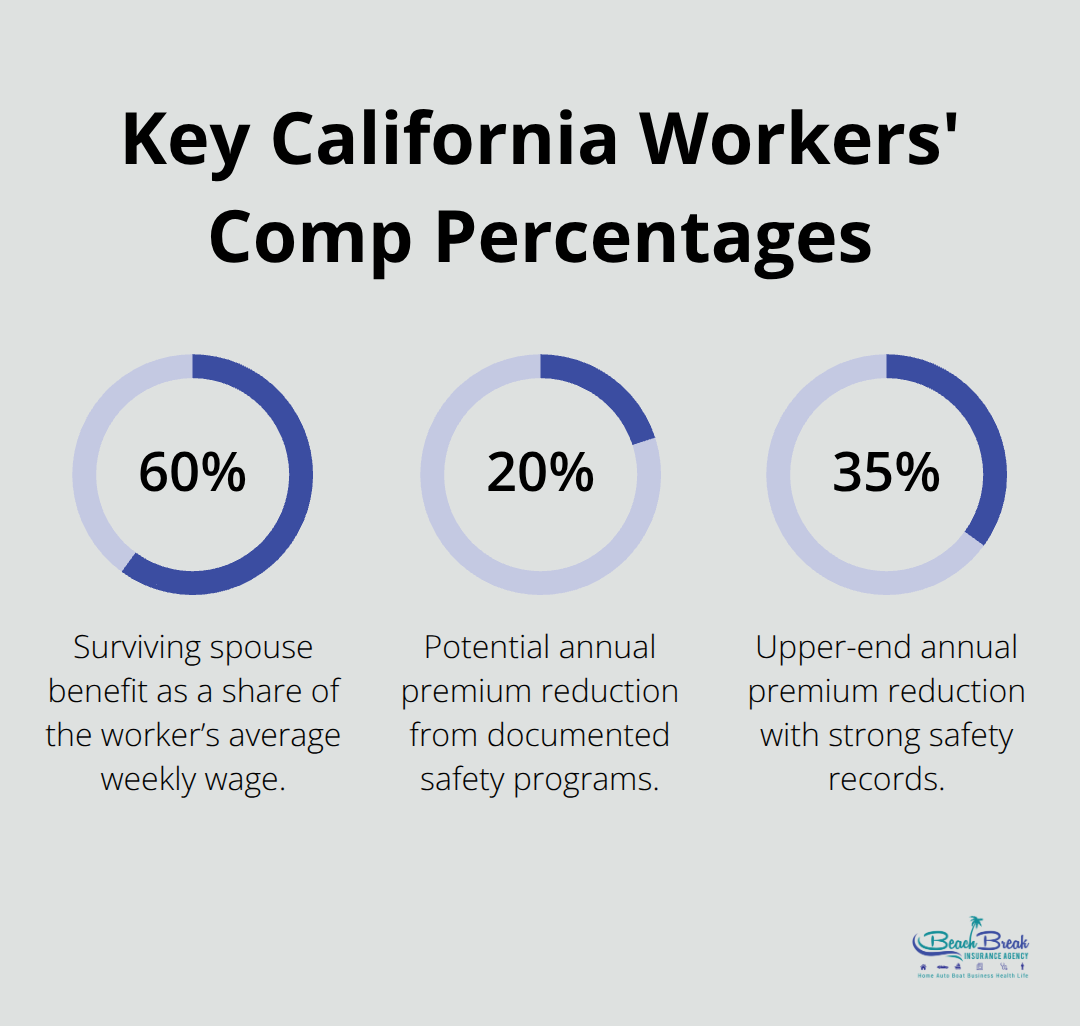
If a workplace fatality occurs, California law requires benefits for surviving spouses and dependents. The surviving spouse receives 60% of the worker’s average weekly wage for life or until remarriage, plus additional payments for each dependent child.
Rehabilitation and Retraining Services
Workers compensation covers rehabilitation services, vocational training to help injured workers transition to different work if needed, and supplemental job displacement vouchers worth up to $6,000 for workers who cannot return to their original position. Your policy also covers diagnostic testing, mental health treatment if the injury has psychological components, and in some cases, home healthcare services.
Why Coverage Gaps Cost More Than Premiums
Many small business owners underestimate these costs because they assume minor injuries won’t trigger significant claims. The key mistake we see repeatedly is thinking workers compensation is just a safety net for catastrophic injuries-it’s actually a comprehensive system that protects employees from financial hardship while protecting your business from lawsuits. Understanding these coverage details helps you choose appropriate limits and avoid the false economy of cutting corners on a policy that exists specifically to handle situations where cutting corners costs far more. With this foundation in place, the next step involves selecting a policy that matches your specific business needs.
Selecting a Policy That Matches Your Business Reality
Identify Your Industry Classification
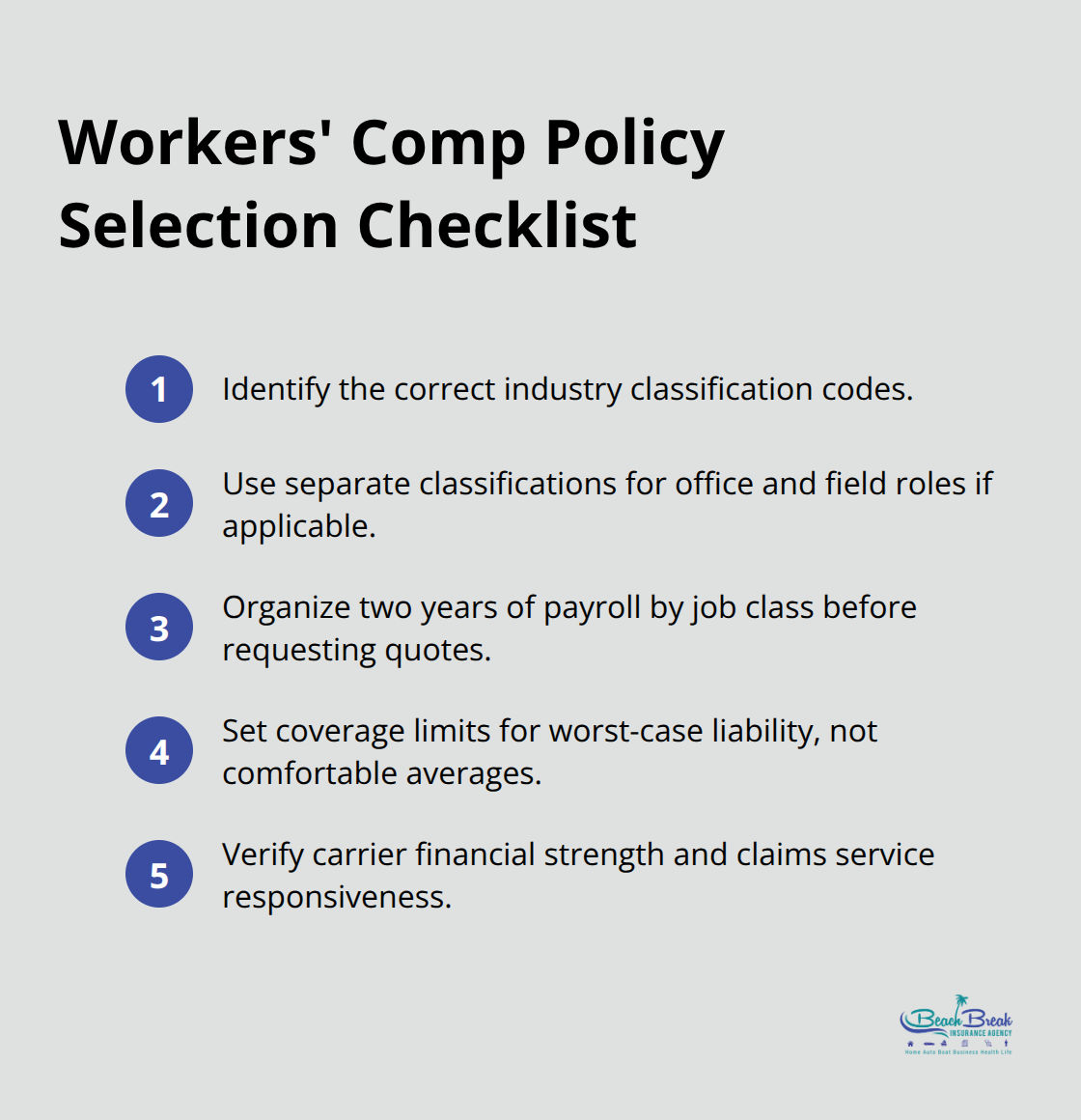
Your industry and payroll size determine everything about your workers compensation costs and coverage needs, yet many small business owners treat this selection process like it’s one-size-fits-all. Construction companies face fundamentally different risk profiles than accounting firms, and a roofing contractor with 50 employees needs a completely different approach than a freelance graphic designer. California assigns an industry classification code based on your primary business activity, and this code directly affects your premium rate. Getting it right matters enormously. If you operate in multiple areas-say you have both office staff and field workers-you’ll need separate classifications for each group.
Organize Your Payroll Records Before Contacting Carriers
Carriers will request your last two years of payroll records organized by job classification, so having this data ready accelerates the quoting process significantly. Pull these records before you contact any carriers. This preparation prevents delays and helps you receive accurate quotes that reflect your actual business operations.
Set Coverage Limits Based on Worst-Case Scenarios
Your coverage limits should reflect what you’d actually owe in a worst-case scenario, not what feels comfortable. California doesn’t cap workers compensation benefits, which means your liability exposure is theoretically unlimited. Most small business owners choose limits between $500,000 and $2 million depending on payroll size and injury risk, but this isn’t a recommendation-it’s a reality check on what the market typically sees.
Compare Deductibles and Premium Trade-Offs
When comparing quotes, look beyond the premium price alone. Deductibles typically range from $500 to $5,000, and while a higher deductible reduces your premium, you’ll pay that amount out-of-pocket for every claim. A company with frequent minor injuries might pay less overall with a lower deductible and higher premium, while a company with spotless safety records can justify higher deductibles.
Verify Carrier Strength and Service Quality
Check your potential carrier’s financial strength ratings through AM Best or the National Association of Insurance Commissioners to verify they can actually pay claims. Customer service matters more than most owners acknowledge-when an employee gets injured, you need a carrier that answers the phone and processes claims quickly, not one that disappears into bureaucracy. This foundation in carrier selection sets you up to avoid the common pitfalls that plague small business owners who rush through the policy choice process.
Common Mistakes Small Business Owners Make with Workers Comp
Misclassifying Employees to Lower Premiums
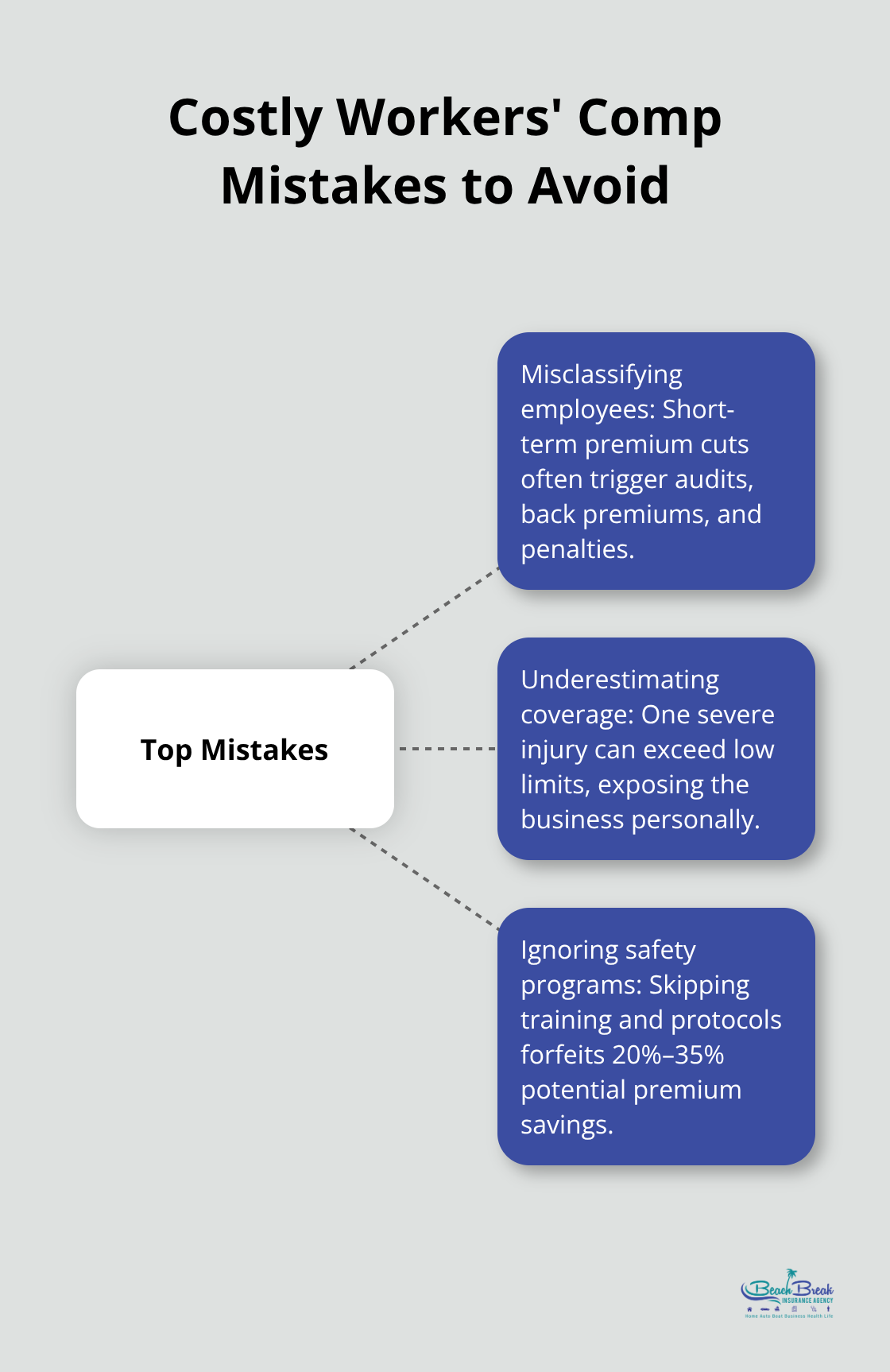
The three most expensive mistakes small business owners make with workers compensation stem not from ignorance but from pressure to cut costs immediately. The first mistake is misclassifying employees into lower-risk categories to reduce premiums, which sounds smart until the California Division of Workers Compensation audits your policy and discovers the truth. When misclassification happens, carriers don’t just correct the rate going forward-they calculate what you should have paid, charge you the difference plus penalties, and in some cases report the violation to state authorities. A construction company that classifies field supervisors as office administrators to save premium dollars might save $3,000 annually but face $15,000 to $25,000 in back premiums, audit costs, and penalties when discovered. The state takes this seriously because misclassification artificially shifts risk to other employers and destabilizes the entire system. Your industry classification code exists for a reason, and trying to game it creates far more expensive problems than the premium you’re trying to avoid.
Underestimating Your Actual Coverage Needs
The second critical mistake is underestimating your actual coverage needs based on what feels like it should be enough rather than what worst-case scenarios demand. Small business owners often think a $500,000 limit sounds substantial, then discover one serious injury with permanent disability, extended rehabilitation, and vocational retraining can easily exceed that figure. A 45-year-old construction worker with a permanent back injury might receive $800,000 to $1.2 million in lifetime benefits depending on wage history and injury severity, according to California workers compensation benefit schedules. Setting your limits based on average payroll rather than worst-case liability exposure leaves your business personally responsible for amounts beyond your policy limits.
Ignoring Safety Programs That Reduce Claims
The third mistake involves ignoring safety programs that directly reduce claims and premiums. Companies with documented safety protocols, regular training, and injury prevention measures qualify for experience modification rates that can lower premiums by 20 percent to 35 percent annually, according to the National Council on Compensation Insurance. A manufacturer investing $2,000 in quarterly safety training and equipment inspections might reduce their premium by $6,000 to $8,000 annually while simultaneously protecting employees and reducing actual injury frequency. These mistakes share a common thread: they prioritize short-term savings over long-term protection, and workers compensation is exactly the area where that trade-off costs exponentially more than it saves.
Final Thoughts
California workers compensation insurance protects your employees and your business, but only when you understand what you’re buying and avoid the shortcuts that create expensive problems later. The three core protections-unlimited medical coverage, wage replacement during recovery, and death benefits for families-form a safety net that prevents financial catastrophe for injured workers while shielding your company from lawsuits. Getting this right means classifying employees accurately, setting coverage limits based on realistic worst-case scenarios rather than wishful thinking, and investing in safety programs that actually reduce claims and premiums.
Your next step is straightforward: pull your current policy and compare it against what you’ve learned here. Check whether your coverage limits match your actual liability exposure, verify that your employee classifications reflect their actual job duties, and assess whether you’re missing safety programs that could lower your premiums by 20 to 35 percent annually. If you’re unsure about any of these elements, that uncertainty itself signals a need for professional guidance before your next renewal.
We at Beach Break Insurance Agency work with small business owners across San Diego to compare quotes from multiple top-rated carriers and find coverage that actually fits your operation (rather than accepting whatever your current carrier offers). Beach Break Insurance Agency helps you understand your options and align your policy with your real business needs, so you stop paying more than necessary while getting less protection than you deserve.
The information provided in this blog is for general informational purposes only and does not constitute legal, financial, or insurance advice. Coverage options, terms, and availability may vary. Please consult with a licensed professional for advice specific to your situation.
Artificial intelligence may have been used to generate text and images in some blog articles.


